Wayground logo

Free Printable Worksheets

Font size

S
M
L
XL
Worksheets

science

Total questions: 38

Worksheet time: 38mins

Name
Class
Date
1.
In an experiment, the one variable that is changed by the scientist is called the ______.
a)
independent variable
b)
dependent variable
c)
random variable
d)
controlled variable
2.
In an experiment, the factor that we observe and/or measure is called the ____.
a)
independent variable
b)
dependent variable
c)
random variable
d)
controlled variable
3.
What type of data is shown here?
a)
qualitative
b)
quantitative
4.
What type of data is shown here?
a)
qualitative
b)
quantitative
5.
A testable, possible explanation for a scientific question is called a(n) _____.
a)
theory
b)
random guess
c)
law
d)
hypothesis
6.
Observations that are made when you use your senses to gather information.
a)
manipulated
b)
quantitative
c)
qualitative
d)
operational
7.
Observations that are made with instruments such as rulers, balances, graduated cylinders, thermometers, timers, etc. and are measurable.
a)
manipulated
b)
quantitative
c)
qualitative
d)
operational
8.
An organized way to collect and record scientific observations is with a(n) _____.
a)
data table
b)
inference
c)
model
d)
definition
9.
Raccoons tend to have striped tails and black eye masks is an example of ____ data.
a)
qualitative
b)
quantitative
10.
There were seven boxes of cookies in the cupboard.
a)
qualitative
b)
quantitative
11.
A scientist studies how many days it takes people to get sick when eating different candies.  What is the independent variable?
a)
eating
b)
days until sick
c)
the scientist
d)
candies
12.
A scientist studies how many days it takes people to get sick when eating different candies.  What is the dependent variable?
a)
eating
b)
days until sick
c)
the scientist
d)
candies
13.
A scientist studies how many days it takes people to get sick when eating different candies.  What is not a controlled variable?
a)
age of people
b)
candy type
c)
amount of candy
d)
time of eating
14.

How do you make density?

a)

volume ✖ mass

b)

volume ÷ mass

c)

mass + volume

d)

mass ÷ volume

15.
True or False:  The density of a specific type of material never changes.  
a)
True
b)
False
16.
Frank has an eraser. It has a mass of 4g, and a volume of 2cm3. What is its density?
a)
8 g/cm3
b)
2 g/cm3
c)
1/2 g/cm3
d)
24 g/cm3
17.
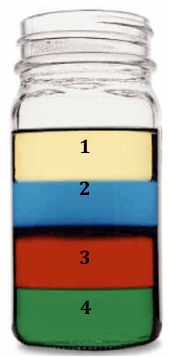
Put the liquids in order from most dense to least dense?
a)
4, 3, 2, 1
b)
1, 2, 3, 4
c)
3, 4, 2, 1, 
d)
4, 3, 1, 2
18.
Helium balloons rise on earth because
a)
helium is less dense than air
b)
helium is more dense than air
c)
helium is cooler than air
d)
helium is warmer than air
19.
An object that allows heat or electricity to pass through easily is a
a)
Insulator
b)
Conductor
20.
Which object would a magnet attract?
a)
a glass bottle
b)
a piece of paper
c)
a metal paper clip
compass
d)
a rubber eraser
magnetic field
21.
What object would best complete this circuit?
a)
A battery
b)
a peice of yarn
c)
an insulator
d)
a conductor
22.
How much matter there is in a certain space is...
a)
Volume
b)
Matter
c)
Density
d)
Mass
23.
Which is a physical change?
a)
Liquid water freezing into solid ice
b)
Burning wood
c)
Silver tarnishing
d)
Iron rusting
24.
Which is NOT a physical property:
a)
Density
b)
Flammability
c)
Boiling Point
d)
Color
25.
What is the density of water?
a)
1.0 g/mL
b)
2  g/mL
c)
5.0 g/mL
d)
10 g/mL
26.
what is the definition of physical change?
a)
any change that results in the formation of new chemical substances. 
b)
rusting
c)
changes affecting the form of a chemical substance, but not its chemical composition.
d)
any property that is measurable, whose value describes a state of a physical system
27.
Is burning wood a chemical or physical change?
a)
chemical
b)
physical
28.
Is hammering wood together to build a house a chemical or physical change?
a)
chemical
b)
physical
29.
Which of the following is a physical characteristic of a metal?
a)
texture
b)
malleable
c)
brittle
d)
semi-conductor
30.
Which of the following is a physical characteristic of a metalloid?
a)
texture
b)
malleable
c)
brittle
d)
semi-conductor
31.
What does luster mean?
a)
Breaks into pieces
b)
can be hammered into thin sheets
c)
No shine
d)
reflects light shiny 
32.
Look at the periodic table that is provided. Where would nonmetals be located? 
a)
to the left of the table 
b)
to the right of the table 
c)
in the zigzag line 
33.

Which is not one of the properties of semiconductor?

a)

4 electrons in outermost orbit, in covalent bonding.

b)

atoms vibrate causes electron to break free from the bonds.

c)

Electron free leaves hole.

d)

Semiconductor has 2 types of charge carriers.

e)

all of the above are the properties of it

34.

Materials which can conduct electricity better than insulator,but not as well as conductors. This is the definition of

a)

diode

b)

semiconductor

c)

conductor

d)

insulator

e)

superconductor

35.

Which of the following is NOT a property

of minerals?

a)

luster

b)

fracture

c)

color

d)

ore

36.

How are elements, rocks, and minerals

related?

a)

Minerals are made of elements and

elements are made of rocks.

b)

Elements are made of rocks and rocks

are made of minerals.

c)

Rocks are made of minerals, and

minerals are made of elements.

d)

Minerals are made of rocks, and rocks

are made of elements.

37.

Part of a gemstone's value is based on the way it shines in reflected light. The way a mineral reflects light is described as the mineral's

a)

streak

b)

color

c)

luster

d)

fracture

38.

Which of the following is NOT a property of a mineral?

a)

luster

b)

color

c)

hardness

d)

size