
 Worksheets
Eucharist Review
Total questions: 42
Worksheet time: 22mins
Which of the following sacraments is not a Sacrament of Initiation?
Eucharist
Baptism
Marriage
Confirmation
Which of the following best describes the Eucharist as a Sacrament of Initiation?
source and summit of Christian life
initiates one into relationship with God and Church
strengthens baptismal grace for Christ's mission
Which Jewish holiday is most associated with the Eucharist?
Rosh HaShana
Passover
Yom Kippur
Hanukkah
Which of the following is not a characteristic of covenants?
Creates a family
can't be broken
often is marked by a sacrifice
can be voided if conditions aren't met
Which scripture passage established the Eucharist as a Sacrament & provided the form?
Last Supper
Melchizedek's Thanksgiving Sacrifice
The Appearance on the Road to Emmaus
Paul's Instructions to the Corinthians
In transubstantiation, the bread/wine's ___ stay(s) the same while the ___ changes.
substance; accidents
Essence; physical features
accidents; substance
affect; emotions
Which terms refers to the bread and wine separately containing the entire substance of Jesus?
transubstantiation
anamnesis
concomitance
re-membering

What is this Eucharistic practice called?
Adoration
Laying on of Hands
Clothing with a White Garment
Tabernacle

What instrument is in the picture?
Monstrance
Tabernacle
Baptismal Font
Ark of the Covenant
Which of the following was not a lens through which we could view the Eucharist?
Communion with God and Church
Praise and Worship
Memorial
Thanksgiving
Which term refers to the "reminiscing" or "re-presenting" of the Last Supper and Jesus' death, resurrection, and ascension?
Economy of Salvation
Koinonia
Anamnesis
Excommunication
Which of the following is not a fruit of receiving the Eucharist?
Removal of venial sin
Bolsters sanctifying grace
Strengthens union with Christ/Church
Removes the guilt of Original Sin
In horizontal communion, we are being united with...
God
Jesus
Holy Spirit
Church
(Referencing the implications of the Eucharist) Because we receive the Eucharist, we should also...
Serve the poor
Pray for the healing of Christian division
Care for Creation
Offer sacrifice to seal covenants
Which of the following is not a norm for reception?
Doing a good deed
Free from mortal sin
Fast for 1 hr
Which of the following allows a priest to consecrate the Eucharist?
Character of Christ
Confirmation Character
Priestly Character of Christ
Because priests and bishops have received an indelible mark during their ordination, they are able to act -------- which means that Christ can be uniquely present in the minister when they are offering the Sacraments.
In persona Christi capitis
Agnus Dei
Ad Maiorem Dei Gloriam
Anathema
What is the difference between an "open communion" and a "closed communion"?
open = publicly visible, closed = private event
open = outdoors; closed = indoors
open = anyone watches; closed = no one watches
open = anyone receives; closed = those in communion with that denomination can receive
Excommunication is the _____ of warnings to an individual.
lightest
gravest
most moderate
most unhelpful
If a scientist observed a consecrated host under a microscope, they wouldn't observe any difference between this host and an unconsecrated host.
True
False
This is a non-biological way to create a family. It requires a sacrifice and cannot be broken; if it is violated, then it must be repaired.
Oath
Covenant
Deal
Contract
This philosophical term refers to the essence or nature of a thing; it cannot change.
Substantial
Substantiation
Subsistence
Substance
This philosophical term refers to the qualities of a thing that can change over time, either physically (hair, height) or non-physically (intelligence, maturity).
Accidents
Anecdotes
Antecedents
Accetuate
Citing the resources offered in our Real Presence of Christ worksheet, which of the following is not a source for the Catholic Church's belief in the Real Presence of Christ in the Eucharist?
Testimonies of major figures in the Early Church
Empirical Studies Post-Transubstantiation
Scriptural Evidence
Philosophy of Medieval Theologians
Which Scripture passage foreshadows the use of bread as a thanksgiving sacrifice after Abram saves Lot?
Melchizidek's Sacrifice
Passover
Last Supper
Bread of Life Discourse
What vocabulary term refers to God offering grace through the Sacraments for our salvation?
Sanctifying Grace
Exchange of Salvation
Economy of Salvation
Actual Grace
When we re-member something, we make the past… what?
Present
Future
Personal
All of the Above
2 of the Above
In this Scripture passage, the sacrifice of an unblemished lamb to save the Israelites foreshadows the death of Jesus for our salvation. This is memorialized in the Eucharist.
Bread of Life Discourse
The Last Supper
Passover
Pentecost
Which of the following is not a Jewish celebration or sacrifice of thanksgiving that is incorporated into the Eucharist?
Passover (saving from slavery)
Rash Hashanah (saving from indignation)
Yom Kippur (atoning for the sins of the people)
Todah Sacrifice (a regular thanksgiving sacrifice)
Which passage provides the form of the Sacrament, institutes the Sacrament, and makes a reference to the creation of a New Covenant?
Passover
Melchizidek's Sacrifice
Last Supper
Paul's Instructions to the Corinthians
Which Scripture passage - involving two disciples meeting Jesus as they leave Jerusalem - involves the explaining of Scripture and the breaking of bread (a proto-Mass)?
Paul's Instructions to the Corinthians
Bread of Life Discourse
Road to Emmaus
Last Supper
This is one of the foundation Scripture passages for the Catholic Church’s belief in the Real Presence of Christ in the Eucharist. After his disciples hear Jesus proclaim that they eat His flesh and drink His blood, some of them leave him. This passage also allows us to believe the Eucharist is spiritual nourishment
Bread of Life Discourse (John 6)
Last Supper
Passover
Paul's Instructions to the Corinthians
“The Eucharist is the ________ of the Christian life.”
Source & Summit
Width & Depth
Alpha & Omega
Beginning and End
In this Scripture passage, Paul communicates that participating in the Eucharist means participating in the Body of Christ (the Church). In this passage, he articulates that one ought not to receive the Eucharist if they are in a state of mortal sin.
Paul's Instructions to the Romans
Paul's Instructions to the Galatians
Paul's Instructions to the Corinthians
Paul's Instructions to the Samaritans
Which of the following ways is not a reason to claim the Eucharist as the source and summit of Christian life?
Jesus is the source of all grace
Communion with God in heaven is the focus of the Christian journey
Jesus is the source of all comfort and joy
the Eucharist is the high point of the Christian life here on Earth
Where in the Mass is the altar prepared for the Eucharistic sacrifice as we also prepare for the great prayer and meal that is to follow?
Communion
Presentation of the Gifts/Preparation of the Altar
Lord's Prayer
Prayer for Generosity
What is the principal prayer of the Church?
Lord's Prayer (Our Father)
Glory Be
Hail Mary
Prayer for Generosity
At this point, the priest asks God to send down the Holy Spirit in anticipation of the transformation of the bread and wine into the Body and Blood of Jesus.
Institutional Narrative
Doxology and Great Amen
Epiclesis
Communion
We are invited by the priest to "reminisce" or "re-present" the Last Supper & Jesus's death, resurrection, and ascension into heaven.
Epiclesis
Sign of Peace
Preface
Remembrance (Anamnesis)
During this part of the Mass, one is intimately united with Christ by receiving his Body and Blood.
Communion
Remembrance (Anamnesis)
Preface
Fraction Rite/Lamb of God
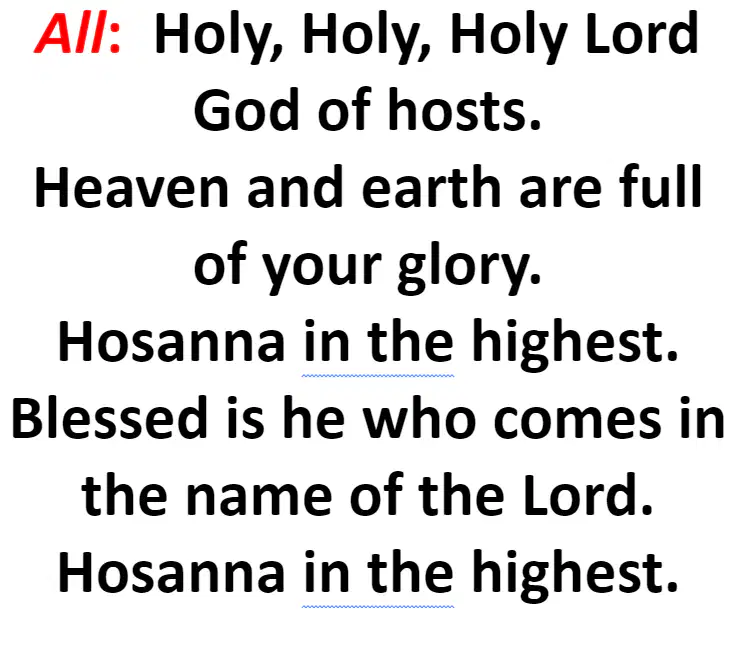
What part of the Mass is this?
Gloria
Gospel
Sanctus
Presentation of the Gifts/Preparation of the Altar
Through which of the following ways do we perceive Christ in the Mass? Select all that apply.
Eucharist
Priest
Body of Christ (congregation)
Scripture

