
 Worksheets
1st 9 Weeks Exam (2019)
Total questions: 30
Worksheet time: 1hrs 3mins
How many valence electrons do Halogens have?
-1
7
17
+1
Carbon atoms can link themselves together into long chains and rings to form a vast number of highly complicated molecules. Which of the following statements BEST explains why carbon atoms behave this way?
They easily form ionic bonds with each other.
They easily combine with atoms of oxygen
They easily form covalent bonds with each other.
They easily become highly charged ions.
Which of the following scenarios would lead to the creation of an anion.
adding a proton
removing an electron
changing the number of neutrons
adding an electron
The number of protons in a neutral atom of an element is equal to the number of
electrons
neutrons
ions
isotopes
In what way are fission and fusion reactions similar?
they both form light nuclei from heavy nuclei.
the both form heavy nuclei from light nuclei
absorb a large amount of energy
release a large amount of energy.
What is the correct formula for the compound formed when lithium and oxygen combine?
LiO
Li2O
LiO2
Li2O2
A scientist describes an element as shiny, dense, and ductile. What other physical characteristic would MOST LIKELY describe the element?
dull
brittle
having a high melting point
gas at room temperature
Use your periodic table to predict the ionic charges of the following elements: O, Al, and Ne
-2, +3, 0
0, -3, +2
+2, -3, +8
6, 3, 8
What is the chemical name for MgF2
Magnesium Flourine
Monomagnesium difluoride
Magnesium difluoride
Magnesium Fluoride
Which pair of elements is MOST similar?
Ca and F
Na and Cl
Ne and Ar
Li and H
Which chemical formula represents the compound Potassium Nitride
KN
K3N
KN3
PN
How many protons would a Carbon ion with a -2 charge have?
4
6
8
14
In the formation of the compound lithium bromide
a bromine ion donates one proton to a lithium atom.
a lithium atom donates one electron to a bromine ion
a lithium atom donates a neutron to a bromine atom
the lithium and bromine atoms share a pair of electrons equally.
Which group on the Periodic Table houses the alkaline metals?
14
18
1
2
What type of compound is formed when calcium and iodine react?
ionic
covalent
metallic
molecular
Ms. Sutton creates a table to compare and contrast metals and nonmetals. She writes, "metals are dense, malleable, ductile, and poor conductors. Do you agree with her table?
Yes, Ms. Sutton's table accurately describes metals.
No, because metals are not ductile.
No, because metals are not malleable.
No, because most metals are good conductors.

The model above represents a(n) _______ of Carbon
isotope
ion
neutral atom
equation

The model represents a neutral atom of which element?
Lithium
Magenese
Magnesium
Sodium

How would you calculate the atomic mass of this atom?
Count the total number of protons and electrons
Count the total number of protons, neutrons, and electrons
Subtract the atomic number from the atomic mass
Count the total number of protons and neutrons

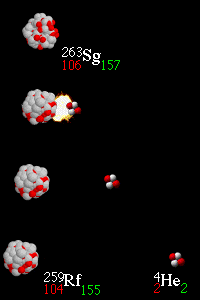
What type of reaction is shown in the model above?
Alpha decay
Fission
Fusion
Beta decay
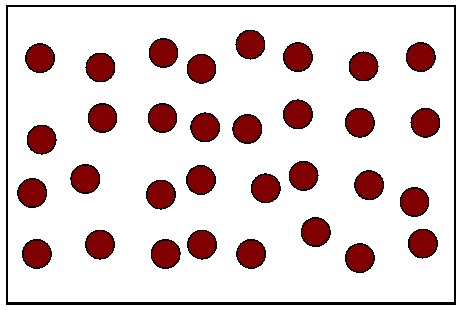
The diagram shows 32 atoms
32 of the Red are the parent isotope
0 of the atoms are daughter isotopes
How many half-lives have occurred?
0
1
2
3
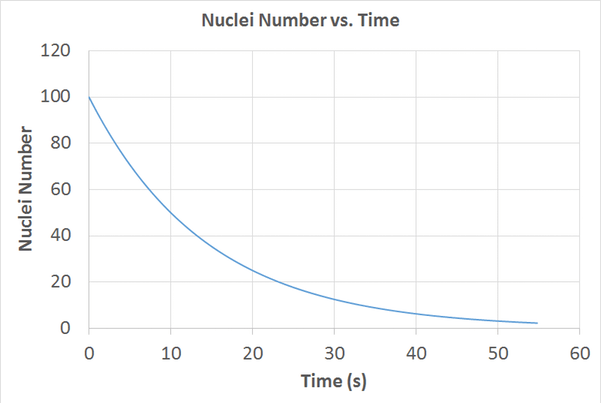
What is the Half life of this isotope?
5 seconds
10 seconds
15 seconds
20 seconds


A neutral atom of Magnesium (shown in image) will...
Lose 2 electrons when it becomes an ion
Gain 2 electrons when it becomes an ion
Gain 6 electrons when it becomes an ion
Lose 1 electron when it becomes an ion
Think fast! An element has 25 protons and 22 electrons. It has a charge of...
3+
3-
2+
1-


