
 Worksheets
Wave - Superposition
Total questions: 20
Worksheet time: 22mins
Name
Class
Date
1.

Two transverse waves overlap. Crests overlap with troughs. Troughs overlap with crests. The waves are
a)
In-phase
b)
Out-of-phase
c)
In-synchronicity
d)
Out-of-synchronicity
2.

If two overlapping waves are in-phase, the resultant wave will have ______ compared to the two waves.
a)
Greater amplitude
b)
Greater frequency
c)
Greater wavelength
d)
Greater wave speed
3.
What is the superposition of waves?
a)
when a single wave splits into two different waves at a point
b)
when two waves combine at the same place at the same time
4.
What are standing waves?
a)
waves that appear to remain in one place and do not seem to move
b)
waves that seem to move along a trajectory
5.
Standing waves are formed --
a)
by the superposition of two or more waves moving in opposite directions.
b)
by the superposition of two or more waves moving in the same direction.
c)
by the superposition of two or more waves moving in perpendicular directions.
d)
by the superposition of two or more waves moving in any arbitrary directions.
6.
A stretched string is observed to have four equal segments in a standing wave driven at a frequency of 480 Hz. What driving frequency will set up a standing wave with five equal segments?
a)
600 Hz
b)
360 Hz
c)
240 Hz
7.
The changing pitch of a police siren as the car moves past you
a)
sound interfernce
b)
doppler effect
c)
constructive interference
d)
destructive interference
8.
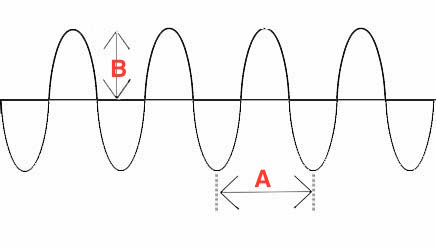
What property of this wave is represented by the letter "A"
a)
amplitude
b)
crest
c)
trough
d)
wavelength
9.
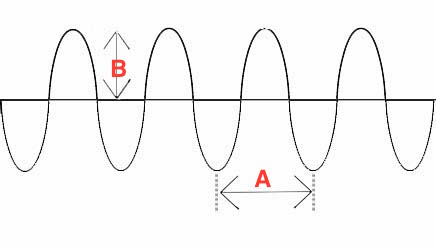
What property of the wave is represented by the letter "B"?
a)
amplitude
b)
crest
c)
trough
d)
wavelength
10.

What do the light waves of a galaxy that is moving TOWARD us look like?
a)
red shifted
b)
blue shifted
c)
green shifted
d)
yellow shifted
11.

How does the Big Bang Theory explain observations of the Doppler effect in the universe?
a)
Galaxies make lots of sound waves.
b)
Galaxies are blue shifted and moving toward us.
c)
Galaxies are redshifted and moving away from us.
d)
No connection. Light waves aren't visible in the universe.
12.
A 0.588-m string is tightly clamped at both ends. If the lowest standing wave frequency of the string is 326 Hz, how fast do waves travel on this string?
a)
383 m/s
b)
475 m/s
c)
582 m/s
d)
724 m/s
13.

A string that is 2.0 meters long is fixed at both ends and tightened until the wave speed is 18 m/s. What is the frequency of the standing wave shown in the figure?
a)
27 Hz
b)
54 Hz
c)
81 Hz
d)
110 Hz
14.

The moving black dot is called:
a)
a node
b)
an anti-node
c)
an anti-amplitude
d)
the wangy bit
15.

How many antinodes does this standing wave have?
a)
5
b)
6
c)
7
d)
8
16.

Which harmonic is shown?
a)
1st
b)
2nd
c)
3rd
d)
4th
17.

The figure represents a string of length L, fixed at both ends, vibrating in several harmonics. Which string shows the 4th harmonic?
a)
A
b)
B
c)
C
d)
D
e)
E
18.

What is the first harmonic also called?
a)
First harmonic
b)
First Overtone
c)
The fundamental
d)
The resonant frequency
19.
What number harmonic is shown in A
a)
1
b)
2
c)
3
d)
4
20.
Even numbered harmonics do not form in a closed pipe because
a)
the pipe “fits” only an odd number of quarter wavelengths
b)
the pipe “fits” only an even number of quarter wavelengths
c)
the pipe cannot put an anti-node at the open end
d)
the pipe cannot get enough air to vibrate in the pipe at these lengths
100 %

