
 Worksheets
Anatomy Chapter 07.1-07.5: Muscle Tissue
Total questions: 60
Worksheet time: 30mins
The entire muscle is encased by a connective tissue called what?
Sacromere
Sarcoplasm
Myosin
Epimysium
The _______________ covers bundles of cells (fascicles) within the muscle.
endomysium
perimysium
sarcoplasm
tendon
The cord-like connective tissue that attaches a muscle to a bone is called:
a tendon
a ligament
a sarcomere
a fascicle
The functional contractile unit within a muscle fiber is called what?
Sarcomere
Fascia
Sarcoplasm
Tendon
The cytoplasm of a muscle cell is called the:
Myosin
Actin
Fascia
Sarcoplasm

Structure B is known as the thin filaments of the sarcomere. What is another name for the thin filaments?
myosin
actin
fascia
myofibril

Structure C is known as the thick filament of the sarcomere, it is also known as:
myosin
actin
fascia
myofibrils

Structure A is located on either side of the sarcomere. What is it called?
A band
I band
Z disc
fascia

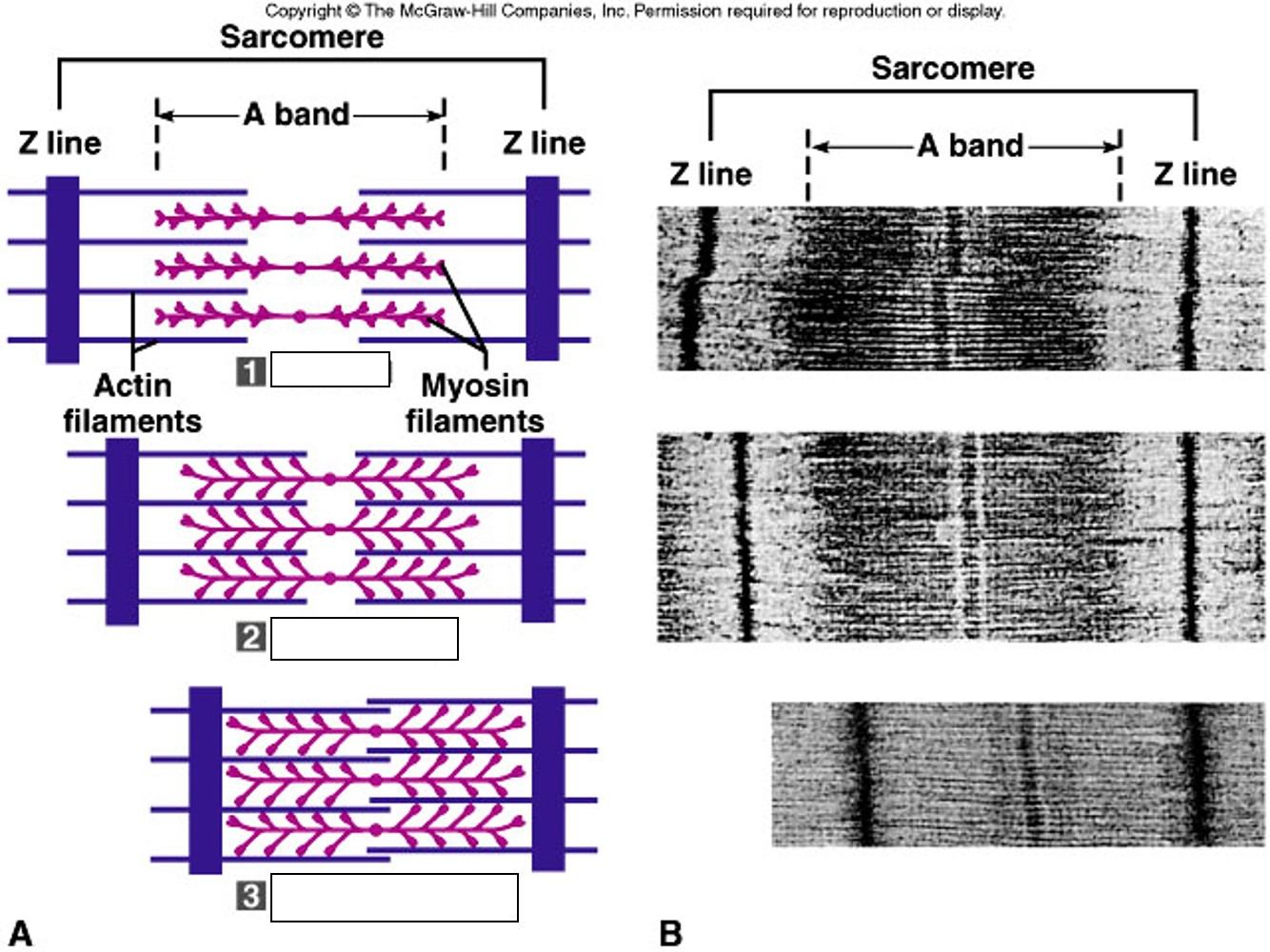
The unit between A and A is called?
a sarcomere
The I band
the Z disc
fascia
This type of muscle tissue is found only in the heart.
Skeletal
Cardiac
Smooth
This type of muscle tissue is found in the walls of hollow organs such as the stomach.
Skeletal
Cardiac
Smooth
This type of muscle tissue is attached to bones and helps control voluntary movement.
Skeletal
Cardiac
Smooth
Which of the following is a type of muscle tissue?
Skeletal
Cardiac
Smooth
All of the above
What is the function of muscle tissue?
It is a tissue that functions in lining, covering, and glandular tissue
It is a tissue involved in protecting, supporting, and binding together other body tissues
It is a tissue that contracts and shortens to produce movement
It is a tissue that receives and conducts electrochemical impulses from one part of the body to another
Which types of muscle tissue are voluntary?
Cardiac Muscle
Smooth Muscle
Skeletal Muscle
Skeletal Muscle and Smooth Muscle
Which type(s) of muscle tissue have visible striations?
Only Cardiac Muscle
Only Skeletal Muscle
Only Smooth Muscle
Skeletal and Cardiac Muscle

What is another name for #1?
Skeletal muscle
Cardiac muscle
Smooth muscle
Myofiber
What is another name for #2? (Hint: It is a muscle layer)
Skeletal muscle
Epimysium
Perimysium
Endomysium
What is another name for #5? (Hint: It is a muscle layer)
Skeletal muscle
Epimysium
Perimysium
Endomysium
What is another name for #6? (Hint: It is a muscle layer)
Skeletal muscle
Epimysium
Perimysium
Endomysium
What is the name of #3?
Skeletal muscle
Myofibril
Myofiber
Tendon
Which number represents a fascicle?
#6
#5l
#4
#10
What is another name for #9 (cell membrane)?
Sarcomere
Sarcolemma
Myofibril
Myofiber
What is another name for #10?
Sarcomere
Sarcolemma
Myofibril
Myofiber
What is another name for a muscle cell?
Sarcomere
Sarcolemma
Myofibril
Myofiber
The skeletal system does all of the following EXCEPT:
Produces red blood cells
Stores calcium and minerals
Protects organs
Excretes waste

Which thin filament protein binds to Ca+ during muscle contraction?
Actin
Myosin
Troponin
Tropomyosin
What is the name of the plasma membrane surrounding each muscle fiber?
T Tubule
Sarcolemma
Sarcoplasm
Nucleus
What protein makes up the thick filaments?
Troponin
Tropomyosin
Myosin
Actin

The enzyme that functions to degrade ACh during excitation-contraction coupling is...
Tropomyosin
Acetylcholinesterase
Troponin
Creatine Kinase

What is the initial process of the contraction cycle?
The head of myosin binds to actin
The head of myosin releases phosphate
A power stroke occurs
Splitting ATP into ADP and phosphate
The head of myosin binds to ATP
The period that occurs between the application of the stimulus (zero time on the graph) and the start of the contraction is called...
Latent period
Relaxation
Contraction
Action potential
Rest period
___ are thin filaments.
Troponin
Tropomyosin
Actin
Myosin
___ are thick filaments.
Actin
Myosin
Troponin
Tropomyosin
___ are regulatory proteins that cover the myosin binding site on the actin.
Troponin-tropomyosin
Sarcomere
Sarcolemma
Sarcoplasmic reticulum
Calcium binds to the ___ in the troponin-tropomyosin complex.
troponin
tropomyosin
actin
myosin
Calcium is stored in the ___.
sarcoplasm
sarcolemma
sarcoplasmic reticulum
transverse tubules
A ___ extends from one Z disc to another Z disc.
Sarcolemma
Neuromuscular junction
Sarcomere
Motor end plate
___ gets shorter during contraction.
Actin
Myosin
Troponin-Tropomyosin
None of these
___ forms a cross-bridge with actin.
Actin
Myosin
Calcium
ATP
___ provides energy for muscle contraction and relaxation.
cAMP
ADP
ATP
M line
Which ion below is NOT critical to muscle contraction?
Sodium Ion
Calcium Ion
Potassium Ion
Phosphorus Ion
The role of mitochondria in muscle contraction is the production of...
Synthesis of ATP
Metabolism of ATP
Synthesis of Proteins
Metabolism of Worn out Proteins
Which is more likely to cause muscle contraction?
Actin pulls on the myosin
Myosin pulls on the titin
Myosin pulls on actin
Actin pulls on titin
Which two ions are pumped in/out of the sarcolemma as part of muscle contraction?
Sodium / Calcium
Calcium / Potassium
Sodium / Potassium



What is the part of the muscle cell labeled C?
mitochondria
thin filament (actin)
thick filament (myosin)
myofibril
Sarcolemma

