
 Worksheets
DNA,Mitosis, RNA, Protein Synthesis
Total questions: 30
Worksheet time: 45mins
Which explains how the second strand of DNA compares with the first strand of DNA?
The second strand is a complement of the first strand.
There is no relationship between the two strands
The second strand is a single helix, and the first strand is a double helix.
Both strands are exactly the same
How is the shape of a DNA molecule described?
Ladder rings
Double helix
Globular
Linear
In which part of the cell does the initial process of transcription take place?
Protein
Lysosome
Mitochondria
Nucleus
DNA molecules contain the genetic information that determines the characteristics of a living organism. How do DNA molecules express the genetic information they contain?
By dividing uncontrollably causing cancer
By traveling to the mitochondria for DNA synthesis
By directing the process of protein synthesis
By causing cellular respiration
What are the components of each nucleotide?
a phosphate group, a sugar molecule, and a nitrogen base
glycerol and 3 fatty acids
amino acids and proteins
carbohydrates, fatty acids, and amino acids
Why are proteins among the most diverse molecules?
Amino acids create DNA and RNA
The building blocks of proteins are lipids
Proteins create carbohydrates
Amino acids can link up in different combinations.
What is the role of mRNA?
Transfers anticodons
Makes a copy of DNA in the nucleus then travels from nucleus into the cytoplasm to deliver messages to the ribosome
It has no role in protein synthesis
It creates carbohydrates and transforms them into proteins
What best describes DNA replication?
None of these are correct
A recycling of genetic material to send information across the cell
A semi-conservative process creating a new DNA strand using an old DNA template
A slow process in which RNA is split in half to form new DNA strands
When coding RNA, which nitrogen base pairs with adenine?
Thymine
Guanine
Uracil
Cytosine
Which best describes the relationship between nucleic acids and proteins?
There is no relationship between nucleic acids and proteins
Nucleic acids provide the instructions on how to build proteins.
Proteins provide the instructions to make nucleic acids
DNA is made up of proteins
What is the diploid number of chromosomes for human body cells?
46
24
12
96
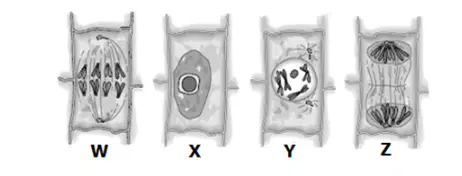
Look at the diagram. Which sequence lists the phases of mitosis in the correct order?
W, X, Y, Z
Z, Y, W, X
X, Y, W, Z
Y, W, X, Z
Why is DNA called the blueprint of the cell?
It helps create more species by dividing during cell division
It allows the passing of substances through the nuclear membrane
It creates glucose needed by all eukaryotic organisms
It contains all the necessary information for the synthesis of RNA and proteins
A scientist discovers a piece of DNA containing 23 % adenine. What is the expected percentage of the other 3 bases?
Thymine= 23%
Guanine= 27%
Cytosine= 27%
Thymine= 27%
Guanine= 23%
Cytosine= 23%
Thymine= 20%
Guanine= 30%
Cytosine= 30%
Thymine= 77%
Guanine= 77%
Cytosine= 77%
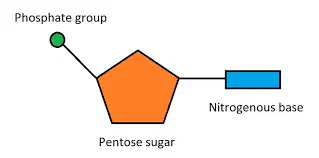
Click on the image. This is the monomer for which biomolecule?
Carbohydrates
Nucleic Acids
Proteins
Lipids
Where does translation occur?
Nucleus
Ribosome
Chloroplast
Mitochondria
What is the function of tRNA?
to supply the correct amino acids for translation
to provide all the proteins needed for cellular functions
to supply the correct amino acids for transcription
to provide a template for the sequence of proteins needed
A segment of DNA has the sequence ATG CCA TAG. What mRNA sequence will be produced during transcription?
TUC GGU ATC
TAC GGT ATC
UAC GGU AUC
UUC GGU UUC
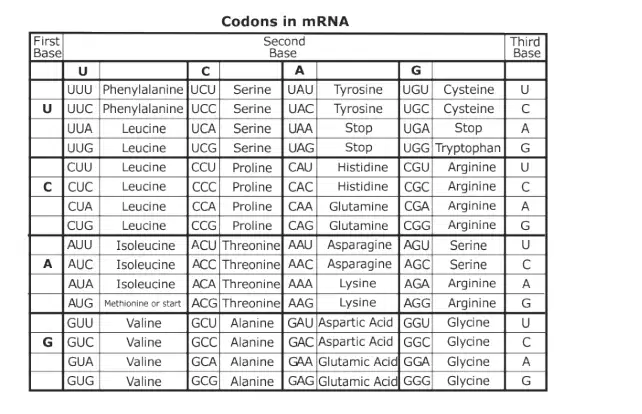
What amino acid sequence would be coded by the RNA sequence AUG-GGU-CCA
met- gly-pro
met- val- glu
met- pro- stop
pro- gly- val
What is the correct sequence of events by which an individual would ultimately end up with a particular trait?
1. DNA in the nucleus codes for tRNA production
2. The tRNA travels to the ribosome to attach to an amino acid
3. The sequence of amino acids will determine the trait
1. DNA in the nucleus codes for the production of mRNA
2. mRNA determines the amino acid sequence at the ribosome
3. Sequence of amino acids determine the protein for that trait
1. tRNA in the nucleus is converted to mRNA
2. The mRNA travels to the ribosome.
3. The mRNA will build a polypeptide chain that will result in that trait
1. mRNA determines the amino acid sequence at the ribosome
2. rRNA copies the DNA strand using special enzymes
3. tRNA transfers the nucleotide chain that will result in that trait
A group of 3 bases is known as
Anticodon
Codon
Organelle
A strand
Any change to the sequences of bases in a DNA molecule is a(n)
Mutation
Prophase
Chromatin
Ribosome
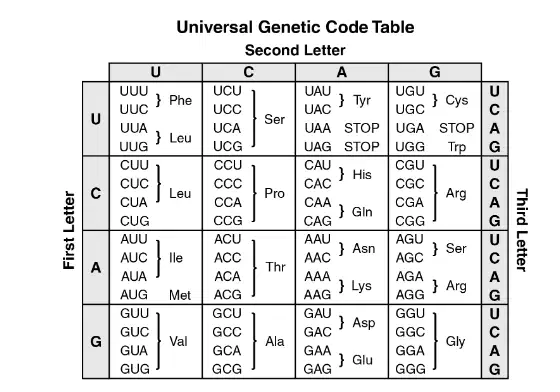
What is the correct amino acid sequence for the following DNA sequence?
TAC CCC GAA GGT
Met - Trp - Ser - Gly
Gly - Met - Pro - Leu
Val - Arg - Ser - Met
Met - Gly - Leu - Pro
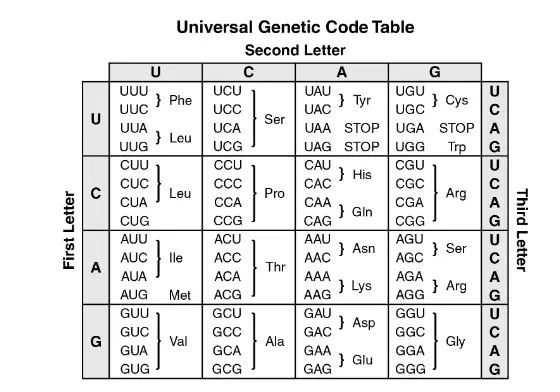
Which of the following are STOP codons?
AUG, UGG, UGC
GGG, UUU, AAA
UGA, UAA, UAG
UAU, UUC, UAC
The mutated DNA segment is TTCGCAAG. This is an example of ___ mutation.
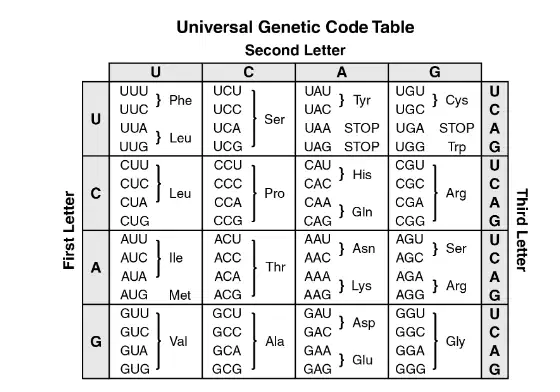
Use the codon chart to figure out what amino acids will be made from the following DNA sequence:
TGA -CCA -TTG
Met - Pro - Ser
Thr - Gly - Asn
Try - Glu - Arg
Thr - Glu - Leu
The --------------------- cells undergo Mitosis while the --------- undergo Meiosis
(A) Somatic or body ; Gametes
(B) Gametes; Somatic or body cells
(C) Gametes; Gametes
(D) Somatic or Body cells; Somatic or Body cells
Meiosis results in ------------ While Mitosis resuls in ---------
(A) 2 haploid daughter cells and 2 haploid daughter cells
(B) 4 haploid daughter cells and 2 diploid daughter cells
(C) 2 diploid daughter cells and 4 haploid daughter cells
(D) 4 diploid daugther cells and 2 haloid daughter cells
Which phase is known as a growing phase and where the cell spends 90% of its time?
metaphase
interphase
prophase
telophase

