wayground logo

Free Printable Worksheets

NEW

Font size

S
M
L
XL
Worksheets

BWS Kinetic particle theory

Total questions: 25

Worksheet time: 32mins

Name
Class
Date
1.

Which of the following is a correct description for solids?

a)

closely arranged and in fixed positions

b)

closely arranged and vibrate in fixed positions

c)

closely arranged and can move around

2.

Which statement about the molecules in the gas carbon dioxide is correct?

a)

The molecules are close together.

b)

The molecules are diatomic.

c)

The molecules move randomly.

d)

The molecules all move with the same speed.

3.

When something goes from gas to liquid, it is called...

a)

Evaporation

b)

Condensation

c)

Deposition

d)

Freezing

4.

Something that goes from liquid to gas is...

a)

Evaporation

b)

Melting

c)

Freezing

d)

Sublimation

5.

Which of the following sentences are true about solids?

a)

Solids are rigid, have a fixed shape but not a fixed volume

b)

Solids are not rigid, have a fixed shape and no fixed volume

c)

Solids are rigid, have a fixed shape and a fixed volume

6.
An inflated balloon is placed in a refrigerator. Which statement describes the movement of the gas particles in the balloon?
a)
The particles move more slowly and become closer together.
b)
The particles move more slowly and become further apart.
c)
The particles move faster and become closer together.
d)
The particles move faster and become further apart. 
7.
Which of the following statements about the kinetic particle theory is not true?
a)
The particles of a gas move faster than those of a liquid.
b)
The particles of a solid have more kinetic energy than those of a gas.
c)
The particles that make up matter are always moving.
d)
The forces of attraction between the particles of a solid are very strong.
8.
The graph below shows part of the cooling curve of a substance. Which row correctly identifies P, Q and R?
a)
P: Gas, Q: Gas and Liquid, R: Liquid
b)
P: Liquid, Q: Gas and Liquid, R: Gas
c)
P: Gas, Q: Liquid, R: Solid
d)
P: Solid, Q: Liquid, R: Gas
9.
A solid compound X was heated steadily for 20 minutes. The graph below shows the change in temperature of X with time. At what temperature did X melt?  
a)
20°C
b)
40°C
c)
90°C
d)
100°C
10.
A solid compound X was heated steadily for 20 minutes. The graph below shows the change in temperature of X with time. What is the boiling point of X?
a)
20°C
b)
40°C
c)
90°C
d)
100°C
11.
What is/are the physical state(s) of X at 100°C?
a)
Solid
b)
Solid and liquid
c)
Gas
d)
Liquid and gas
12.
Which of the following statements about the kinetic particle theory is not true?
a)
The particles of a gas move faster than those of a liquid.
b)
The particles of a solid have more kinetic energy than those of a gas.
c)
The particles that make up matter are always moving.
d)
The forces of attraction between the particles of a solid are very strong.
13.
A substance Y has a melting point of –7ºC and a boiling point of 63ºC. At which temperature is Y a liquid?
a)
A
b)
B
c)
C
d)
D
14.
Which of the following statements about the particle of a gas is true?
a)
The particles of a gas vibrate about fixed positions.
b)
The particles of a gas are packed close together in a disorderly arrangement.
c)
The particles of a gas are far apart and move in all directions.
d)
The particles of a gas are stationary in an orderly arrangement.
15.

The amount of energy needed to change 1 kg a material from a solid to a liquid state.

a)

Latent Heat of Solids

b)

Latent Heat of Liquids

c)

Latent Heat of Fusion

d)

Latent Heat of Vaporization

16.

A measure of the average kinetic energy of the particles in a sample of matter.

a)

temperature

b)

pressure

c)

internal energy

17.

The amount of energy needed to change 1 kg of a material from a liquid to a gas.

a)

Latent Heat of Liquids

b)

Latent Heat of Gas

c)

Latent Heat of Fusion

d)

Latent Heat of Vaporization

18.
Density is a measure of...
a)
mass in a given volume
b)
distance in a given volume
c)
distance in a given time
d)
speed in a given distance
19.
What is the volume of the rock? The water level is displaced from 20 mL to 23 mL with the rock.
a)
3 mL
b)
23 mL
c)
20 mL
d)
43 mL
20.
Which liquid has the greatest density?
a)
lamp oil
b)
karo syrup
c)
water
d)
honey
21.
Which of the following would increase the (gas) pressure of a system?
a)
Increase the Temperature
b)
Pump in more gas
c)
Decrease the volume
d)
All of these
22.

A gas at a volume of 4 litres is at a pressure of 2 atm. The volume is changed to 16 litres, what must the new pressure be? (Assume the temperature is constant.)

a)

2 atm

b)

12 atm

c)

10 atm

d)

0.5 atm

23.

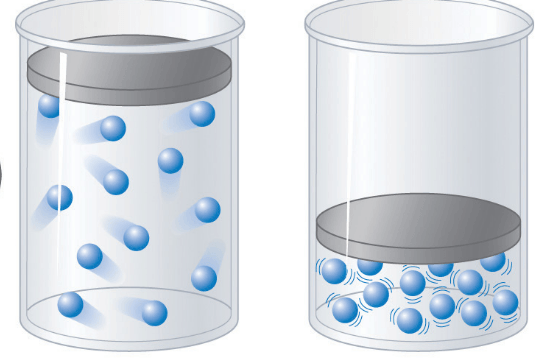
Which container will have a lower pressure?

a)

left

b)

right

c)

they both have the same pressure

24.
Which two variables must be held constant for Boyle’s Law to apply?
a)
pressure & volume
b)
volume & temperature
c)
temperature & moles (amount of gas)
d)
volume & moles (amount of gas)
25.

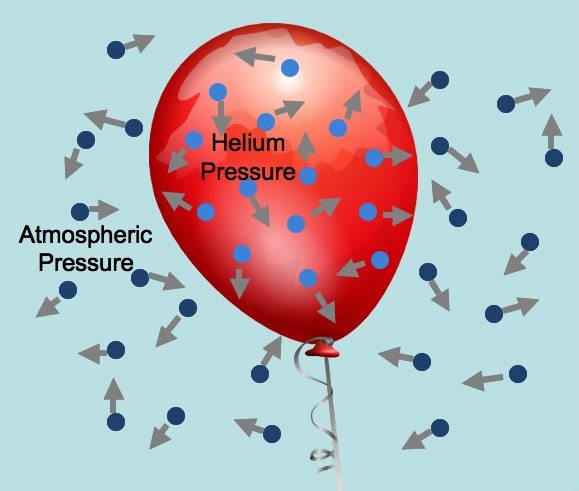
What causes pressure?

a)

The thickness of walls of the container

b)

The vacuum in the container

c)

The collisions of the particles with the walls of the container

d)

Atmospheric pressure acting on the outside walls