
 Worksheets
CPhys Optics Review
Total questions: 17
Worksheet time: 17mins

Which figure represents the path light takes through a converging lens?
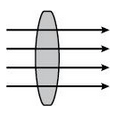
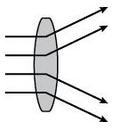
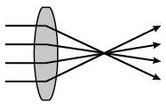
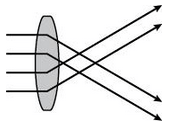
The angle of reflection is always equal to the angle of incidence.
True
False

What type of reflection is shown in the image?
Regular reflection
Diffuse reflection
Total internal reflection
Which of the following statements is true about refraction?
Light does not bend as it passes from one medium to another.
Refraction is due to changes in temperature.
Light travels faster in glass than air.
Refraction is due to changes in the speed of light.
Why can you see yourself in a mirror?
The smooth surface reflects the light in a perfect pattern.
The smooth surface scatters the light in a perfect pattern.
The smooth surface scatters the light in all directions.
The smooth surface absorbs all of the light.
Why can't you see yourself in a piece of wood?
The wood absorbs all of the light.
The wood scatters light.
The wood reflects light.
The wood transmits light.


When a ray of light enters a glass slab from air
its wavelength decreases
its wavelength increases
its frequency increases
neither its wavelength nor its frequency changes.
how does diffraction work
it goes through water and air
is a beam of light stopping at a wall
it bounces off of light
is the bending of light as it passes around the edge of an object
A wave of constant wavelength diffracts as it passes through an opening in a barrier. As the size of the opening is increased, the diffraction effects
decrease
increase
remain the same


How does the density of glass compare to the density of air?
Equal
Glass has a greater density.
Air has a greater density.
Impossible to say

