wayground logo

Free Printable Worksheets

NEW

Font size

S
M
L
XL
Worksheets

Phosphorus Cycle

Total questions: 15

Worksheet time: 19mins

Name
Class
Date
1.

This is NOT a part of the phosphorus cycle.

a)

Phosphate is incorporated into sedimentary rocks

b)

Phosphate bound to soil

c)

Atmospheric phosphate

d)

Phosphate is absorbed from the soil by plants

2.
Phosphorous is passed from plants to ____ who eat them
a)
plants
b)
animals
c)
scavengers
3.
_____ brings phosphorous into our waterways. .
a)
precipitation
b)
runoff
c)
transpiration
d)
condensation
4.
Which of the following statements is true of the phosphorus cycle?
a)
Phosphorus enters the atmosphere as phosphates.
b)
The phosphorus cycle utilizes the processes of erosion, and weathering.
c)
Phosphates are used in carbohydrate and glucose storage.
d)
The phosphorus cycle utilizes bacteria to breakdown phosphates and make them available for plants.
5.
What role do decomposers play in the phosphorous cycle?
a)
absorb phosphorous 
b)
release phosphorous into atmosphere
c)
return phosphorous into the soil
d)
combustion
6.
This is released by the weathering of rocks.
a)
Carbon
b)
Oxygen
c)
Phosphorus
d)
Nitrogen
7.
Which nutrient is not cycled through the atmosphere and stays only on ground level?
a)
carbon
b)
nitrogen
c)
phosphorus
d)
water
8.

Too much phosphorus in waterways (rivers, lakes) can lead to___________.

a)

eutrophication

b)

Nothing

c)

Death

d)

diseases

9.

An algal bloom is the rapid growth of a population of

a)

fungi

b)

protozoans

c)

algae

10.

In general, algal blooms occur when

a)

toxins accumulate in shellfish.

b)

nutrients decrease in the water.

c)

nutrients increase in the water.

11.

What is the carrying capacity of the graph?

a)

1000

b)

8000

c)

800

d)

600

12.

What happens if a population grows past its carrying capacity?

a)

The population keeps growing

b)

The population starts to die off

c)

The entire species will go extinct

d)

The carrying capacity just increases

13.

The largest number of individuals that an environment can support long term is...

a)

carrying capacity

b)

emigration

c)

immigration

d)

population density

14.

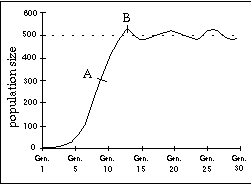
What is the carrying capacity of the graph?

a)

around 500

b)

more than 800

c)

less than 300

d)

around 700

15.

How does sedimentary rock form?

a)

Cooling of lava or magma.

b)

Compacting and cementing.

c)

Heat and pressure.

d)

Weathering of soils