
 Worksheets
Final Review
Total questions: 174
Worksheet time: 6hrs 34mins

The picture below shows the Apollo 11 spacecraft that took astronauts to the Moon in 1969. The spacecraft weighed 6.1 million pounds, and its motors produced 7.5 million pounds of thrust. Use the picture to answer any questions that follow.
The spacecraft produced an upward force of thrust that was equal to the downward force of gravity.
The spacecraft produced an upward force of thrust that was greater than the downward force of gravity.
The spacecraft produced a downward force of thrust that was equal to the downward force of gravity.
The spacecraft produced a downward force of thrust that was less than the downward force of gravity.

The following diagram shows a satellite in orbit around Earth. Which arrow shows the direction of the force that keeps the satellite in its circular path around Earth?
arrow A
arrow B
arrow C
arrow D
Changing which of the following factors would have the greatest effect on the weight of an object?
intensity of sunlight
altitude
gravitational pull
electromagnetic charge
Two new planets are discovered called planet X and planet Y. The planets have identical volumes, but the mass of planet X is two times greater than the mass of planet Y. If two identical space ships land on both planets, which of the following will be true?
The mass of the space ship on planet Y will be greater than the mass of the space ship on planet X.
The mass of the space ship on planet X will be greater than the mass of the space ship on planet Y.
The weight of the space ship on planet X will be greater than the weight of the space ship on planet Y.
The weight of the space ship on planet Y will be greater than the weight of the space ship on planet X.
Joel's mass on Earth is 50.0 kilograms. The gravity on the Moon is approximately one-sixth the gravity on Earth. How would Joel's mass and weight be affected if they were measured on the Moon?
His mass would increase, and his weight would remain the same.
His mass and his weight would remain the same.
His mass and his weight would decrease.
His mass would remain the same, and his weight would decrease.
A boy holds a box steadily in the air. Which picture correctly shows the forces applied the box?


A ball rolls down from the top of a grassy hill, reaches the bottom of the hill, continues to roll, and then starts to slow down and comes to a stop. What forces caused this ball's motion?
Frictional force caused the ball to roll down the hill, but air resistance caused the ball to slow down and stop.
Magnetic force caused the ball to roll down the hill, but gravity caused the ball to slow down and stop.
The force of the hill caused the ball to roll down it, but gravity caused the ball to slow down and stop.
Gravity caused the ball to roll down the hill, but frictional force caused the ball to slow down and stop.
Which of the following is NOT a non-contact force?
applied force
gravitational force
electrical force
magnetic force
What kind of force changes an object’s motion?
pull
push
balanced
unbalanced

The picture below shows a compass. The needle in the middle of a compass is a magnet. If the needle on a compass turns when a person changes position on Earth, then what force is acting on the needle in the compass?
the frictional force found on the surface of Earth
the gravitational force found at the center of Earth
the magnetic force found at Earth's poles
the gravitational force found at Earth's poles

Looking at the figure above, which of the blocks above will have the greatest acceleration to the right?
Block 1
Block 2
Block 3
Block 5
Roger and William are performing an experiment testing which type of surface allows a toy car to travel down a ramp the fastest. They tested four different materials and gathered results. Which of the following forces applied to the toy cars is a CONTACT force?
Gravity
Magnetism
Friction
Electricity

The picture below shows a nail made of magnetic metal that is placed near a magnet. What will happen to the nail if the magnet is moved closer to the nail?
The nail will rise upward due to the force of air resistance.
The nail will stay in its same position because gravity is pushing up on it.
The nail will move toward the magnet due to a pulling force by the magnet.
The nail will move away from the magnet due to the electrical force of the magnet.

Currently, an airplane has a weight of 8,000 N and a lift of 9,500 N. In which direction is the plane moving?
Up with a force of 17,500 N
Up with a force of 1,500 N
Up with a force of 9,500 N

The picture below shows a race car. If this race car was in motion and the force of friction became greater than the force of the motor, then what would happen to the race car's motion?
It would speed up.
It would slow down.
It speed up, then slow down.
It would slow down, then speed up.
Which pair below are contact forces?
friction and magnetic force
magnetic force and applied force
applied force and friction
gravitational force and electrical force
Ships encounter surface currents and waves as they travel across the ocean. Surface currents and waves form when energy from the sun causes two of Earth’s spheres to interact. Which two spheres interact to produce these waves and currents?
the geosphere and biosphere
the biosphere and hydrosphere
the cryosphere and atmosphere
the atmosphere and hydrosphere
When plants and animals decompose, nutrients return to the soil and help future plants grow. This interaction between the decomposing plants/animals and the soil is between which Earth Spheres?
The atmosphere and geosphere
The hydrosphere and biosphere
The atmosphere and biosphere
The biosphere and the geosphere
Living things in the biosphere interact with other parts of the Earth system to exchange energy. Which picture represents the basic source of energy for the biosphere?


The picture below shows the Glen Canyon Dam, which was built to hold back the waters of the Colorado River and produce electricity with turbines. Use the picture to answer any questions that follow.
During the dam's construction, what two spheres were interacting at X?
the biosphere and geosphere, as humans placed beams onto the canyon's wall to secure the dam
geosphere and cryosphere, as the canyon's walls cracked due to the pressure applied by the dam
hydrosphere and atmosphere, as the dam's construction made water leak and evaporate from the canyon's walls
atmosphere and cryosphere, as humans opened up the ice barrier stored underground in the canyon's clay
Which two spheres are interacting when a squirrel buries an acorn that will grow into a tree?
geosphere and atmosphere
cryosphere and hydrosphere
biosphere and atmosphere
biosphere and geosphere
Which of the following tables has the correct definitions for Earth's spheres?


The Florida panther is one of the most endangered mammals on Earth. Where is the air that Florida panthers breathe?
in the biosphere
in the geosphere
in the atmosphere
in the hydrosphere
Which of the following is correct about Earth's atmosphere?
It has holes that allow sunlight to reach Earth's surface to maintain Earth's comfortable temperature.
It has water vapor that forms ice and cools Earth's atmosphere, like ice in a cup of water.
It holds gases that insulate against extremely hot and cold temperatures.
It has layers that chemically react to control Earth's temperatures.
Air is in constant motion. As air rises higher into the atmosphere, what happen to the air pressure as the elevation increases?
It increases.
It decreases.
It stays the same.
It increases at first, then it decreases.
Which of the following is NOT a protection provided by the layers of Earth's atmosphere?
the reduction of the Sun's harmful rays reaching living organisms on Earth
the burning of objects from space before they reach the surface of Earth
the maintenance of a stable temperature suitable for life on Earth
the creation of seasons that allow temperature changes on Earth
How will an increase in wind speed affect soil erosion?
Soil erosion will increase.
Soil erosion will decrease.
Soil erosion will completely stop.
Soil erosion will remain the same.
Which of these explain how a natural phenomenon works or happens?
theory
law
Which of these describes a natural phenomenon or relationship that always occurs under specific conditions
theory
law
Which of these can be represented mathematically and provide no explanation why a phenomenon occurs?
theory
law

Based on the picture, if the roller coaster car nearly stops as it crosses hill X, what changes in energy occur as it moves between hill X and hill Y?
Kinetic changes to potential, then some potential changes to kinetic.
Potential changes to kinetic, then some kinetic changes to potential
Kinetic changes to potential, then some potential changes to thermal
Thermal changes to potential, then some potential changes to thermal.

When does the ball have maximum potential energy and minimum kinetic energy?
R and T
R
S
T

When is the rocket's potential energy increasing and its kinetic energy decreasing?
when the rocket is at the peak of flight, only
when the rocket's motor is burning and when the rocket is free falling
when the rocket's motor is burning and when the rocket is ascending
when the rocket is free falling, only

Where is the ball's potential energy at its maximum and its kinetic energy at its minimum?
R
T
V
Z

Where does the ball have decreasing kinetic energy and increasing potential energy?
R and T
R
S
T

Energy based on the position of the item is called?
Potential energy
Kinetic energy
kinesis Energy
Position energy

Where is the ball's kinetic energy at its maximum and potential energy at its minimum?
R
X
V
Z

Which describes best the energy conversion of the roller coaster?
At position A the roller coaster has all potential energy, then at B the energy converts to half potential and half kinetic, and at C the roller coaster has all kinetic energy
At position A the roller coaster has all kinetic energy, then at B the energy converts to all potential energy and at C the energy has half potential and half kinetic energy
At position A the roller coaster has half potential and half kinetic energy, at B the roller coaster has all kinetic energy, and at C the roller coaster has all potential energy
Which of these is Kinetic energy
wind blowing
water in a glass
a can of vegitables
the school walls

What do you know about the kinetic energy of the vehicles?
The motorcycle has the most kinetic energy because it is the vehicle with the least mass.
All of the vehicles have the same kinetic energy because they are moving at the same speed
The delivery van has the greatest kinetic energy because its mass is greater than that of the other vehicles.
The delivery van has the greatest kinetic energy because it has the most tires in contact with the pavement.

At which time is the ball's kinetic energy at its maximum?
0.0 s
0.5 s
2.0 s
2.5 s

The diagram below shows an example of the water cycle. At which point the energy from the sun is required to change the state of water from liquid to gas?
2
3
4
5
Liquid water can change into gas through which process?
condensation
sublimation
transpiration
precipitation

Which part of the water cycle represents precipitation?
A
B
C
D

Which elements seen would be adding water vapor to the atmosphere?
palm trees only
ocean water only
ocean water and palm trees
palm trees, ocean water, and sand

The diagram below shows an example of the water cycle. At which point does water turn from a gas to a liquid?
2
3
4
5

How can the cycling of water at Point Y affect the weather?
The reflection of the Sun's rays from the lake into the atmosphere can cause more clouds to form.
The heat of the land can reflect into the atmosphere, warming the liquid water to form clouds.
Water vapor in the atmosphere can condense and then fall as precipitation due to gravity.
Water vapor in the atmosphere can evaporate and then fall as precipitation due to gravity.

What makes these areas most likely to have this type of tropical climate?
They are along Earth's equator, which exposes them to more sunlight, causing the warm water to evaporate and precipitate frequently.
They are along the Earth's equator, which exposes them to less sunlight, causing warm moisture to stay condensed in the air.
They are along Earth's equator, which exposes them to more sunlight, preventing water from precipitating since it is constantly evaporating.
They are along Earth's equator, which exposes them to less sunlight, causing warm water to condense and precipitate frequently.
Which statement is true regarding the water cycle and the effect it has on weather patterns and climates?
Evaporation and precipitation are unbalanced in the atmosphere; if evaporation increases, precipitation decreases.
Earth's internal convection controls the water cycle; the more internal convection that occurs, the more it rains.
Evaporation and precipitation are balanced in the atmosphere; if evaporation increases, precipitation increases.
The Sun's energy controls the water cycle; the more solar energy that is present, the less it rains.
Gabriel wants to explain evaporation and condensation to a friend. Which of the following would be the BEST explanation of evaporation and condensation?
Evaporation occurs when a liquid absorbs enough heat to become a gas. Condensation occurs when a gas is cooled enough to become a liquid.
Evaporation occurs when a gas is cooled enough to become a liquid. Condensation occurs when a liquid absorbs enough heat to become a gas.
Evaporation occurs when a liquid is cooled enough to become a solid. Condensation occurs when a solid absorbs enough heat to become a liquid.
Condensation and evaporation are different names for the exact same process.
The area in which you live has a particular climate. It also has weather. What is the difference between climate and weather?
Weather is determined by temperature and precipitation, whereas climate is determined only by humidity, air pressure, and wind conditions.
Climate is the condition of Earth’s atmosphere at a particular time and place, whereas weather is the characteristic climate in an area over a long period of time.
Climate is determined by temperature and precipitation, whereas weather is determined only by humidity, air pressure, and wind conditions.
Weather is the condition of Earth’s atmosphere at a particular time and place, whereas climate is the characteristic weather in an area over a long period of time
The area in which you live has a particular climate. It also has weather. What is the difference between climate and weather?
Weather is determined by temperature and precipitation, whereas climate is determined only by humidity, air pressure, and wind conditions.
Climate is the condition of Earth’s atmosphere at a particular time and place, whereas weather is the characteristic climate in an area over a long period of time.
Climate is determined by temperature and precipitation, whereas weather is determined only by humidity, air pressure, and wind conditions.
Weather is the condition of Earth’s atmosphere at a particular time and place, whereas climate is the characteristic weather in an area over a long period of time

Which statement best explains why the rock is steep and jagged?
Over time, wind blowing against the rock heated it until it changed shape.
Over time, waves crashed onto the rock and carried away any broken pieces.
Wind dropped sand onto the side of the rock, and as it built up, it became steep.
Waves dropped sand onto the side of the rock, and as it built up, it became steep.

Which statement best explains how this canyon formed over millions of years?
Rain fell for years in this area and caused the sides of the hills to fall down.
Rivers carried sand along their banks and formed steep plateaus.
Water and flowing rivers wore away the sides of raised landforms.
Wind carried sand that formed steep hills and mountains.
Which statement best explains why the rock is steep and jagged?
Over time, wind blowing against the rock heated it until it changed shape.
Over time, waves crashed onto the rock and carried away any broken pieces.
Wind dropped sand onto the side of the rock, and as it built up, it became steep.
Waves dropped sand onto the side of the rock, and as it built up, it became steep.
Which statement best explains how this canyon formed over millions of years?
Rain fell for years in this area and caused the sides of the hills to fall down.
Rivers carried sand along their banks and formed steep plateaus.
Water and flowing rivers wore away the sides of raised landforms.
Wind carried sand that formed steep hills and mountains.
Marley has a vegetable garden in her yard. During a storm, heavy rain falls. The rain runs over the garden, and some of the soil is washed away. Which term best describes this movement of soil from one place to another?
deposition
discharge
erosion
weathering

Which of the following best explains what caused the rocks and dirt to gather along the banks of the river?
condensation
deposition
sedimentation
weathering
Which of the following best explains what caused the rocks and dirt to gather along the banks of the river?
condensation
deposition
sedimentation
weathering

What is X, and how did it form?
It is a delta that formed when a river slowed down as it flowed into the ocean, causing rocks and sand that it was carrying to settle and build up over time.
It is an island that formed when wind picked up and carried rocks and sand from the banks of a river's edge and dropped them into the ocean.
It is a peninsula that formed as ocean waves carved away land and pulled pieces of the shore out to sea.
It is a sand dune that formed by coastal winds blowing beach sand into the mouth of a river over time.

What type of landform would most likely be found at point X?
a cliff
a hill
a plateau
a delta

What is the physical weathering factor?
wind
air
ice
rock
Acid rain dissolves underground limestone to form caves. The process that best describes this situation is:
Chemical weathering
Physical weathering
Erosion
Deposition
A fast-moving river carries away large amounts of muddy water. The process that best describes this situation is:
Chemical weathering
Physical weathering
Erosion
Deposition
What is an enormous mass of ice moving over land?
dune
ice wedging
iceberg
glacier
The dropping off of sediments in a new place is called
departing
deposition
weathering
erosion
the transfer of heat in a fluid (gas or liquid) by means of up & down movements called convection currents
conduction
convection
radiation
the transfer of heat through a vacuum (empty space)
conduction
convection
radiation
the transfer of heat through a medium (material) by direct contact of molecules
conduction
convection
radiation
How does heat move?
from cold to hot
from hot to cold
Burning your feet on the hot sand is an example of...
conduction
convection
radiation
Feeling the warm breeze from the ocean is an example of...
conduction
convection
radiation

Which answer correctly labels each box?
1. Conduction
2. Convection
3. Radiation
1. Convection
2. Radiation
3. Conduction
1. Convection
2. Conduction
3. Radiation
1. Radiation
2. Convection
3. Conduction
Nucleus
organs, organ systems, organisms, cells, tissues
Animal Cell
Plant Cell


animal cells?


There are three tenets of the Cell Theory. Which of the following is NOT a tenet?
Cells are the basic structure and function of life.
All living things are made of one or more cells.
The cell is the basic unit of matter.
All cells come from preexisting cells.
Which choice is NOT part of the cell theory.
All organisms are composed of cells.
Cells are the basic unit of life.
All cells come from previous cells.
Cells are always the same size and shape.


Biologist group living things based on ____.
Habitat
Size
Colors
Shared Characteristics

The Eukarya Domain has which organisms?
Bacteria that causes diseases
Bacteria found in volcanoes
plants, animals., fungi and protists
none of the above
Carries oxygen and nutrients to all parts of the body.
Integumentary
Nervous
Circulatory
Respiratory
Receives stimuli and transports impulses, coordinates actions and reactions in the body
Integumentary
Nervous
Circulatory
Respiratory
Supports and provides structure for the body
Skeletal
Muscular
Circulatory
Respiratory
Supports and provides structure for the body
Skeletal
Muscular
Circulatory
Respiratory
Supplies blood with oxygen and rids the body of carbon dioxide
Integumentary
Nervous
Circulatory
Respiratory
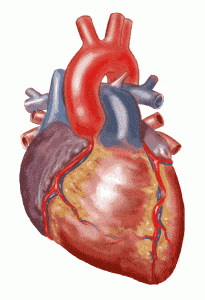
Main Organs: Heart and blood vessels
Integumentary
Nervous
Circulatory
Respiratory
Main Organs: Bones and joints
Skeletal
Muscular
Circulatory
Respiratory

Which body system controls the body to maintain homeostasis?
excretory
nervous
circulatory
skeletal
What is the key function of the respiratory system?
digestion of food
allows movement
exchanges gases
processes energy
Which two systems work together to maintain homeostasis while transporting oxygen throughout the body and removing carbon dioxide?
circulatory and respiratory
respiratory and excretory
circulatory and digestive
respiratory and digestive
Which organ is part of the immune system?
the eyes
skin
the stomach
the intestines
Which of the following describes homeostasis?
keeps variables exactly at the set point
organism's ability to maintain steady(stable) internal conditions
acts to keep values outside of a desired range
operates through positive feedback
The one factor that a scientist changes during an experiment. (It affects the results of the experiment).
Controlled Variable
Dependent Variable
Independent Variable
The variable that is measured. It is the result of the experiment.
Controlled Variable
Dependent Variable
Independent Variable
The factors that stay the same throughout the experiment.
Constant
Dependent Variable
Independent Variable
The factors that stay the same throughout the experiment.
Constant
Dependent Variable
Independent Variable
Why is it important to have only one independent variable and to control the other variables when performing science experiments?
So you can tell which factor is causing the change in the experiment and get more accurate results
It does not matter, you can have as many independent variables as you want.
None of these answers are correct
Ben makes five paper helicopters with different wing lengths. He drops them the same way from a height of two meters for five trials each. He records the amount of time it takes for each helicopter to fall to the ground.
What is the independent variable?
Dropping the same way
Wing Length
Amount of time it takes the helicopter to hit the floor
Dropping from the same height
Ben makes five paper helicopters with different wing lengths. He drops them the same way from a height of two meters for five trials each. He records the amount of time it takes for each helicopter to fall to the ground.
What is the dependent variable?
Dropping the same way
Wing Length
Amount of time it takes the helicopter to hit the floor
Dropping from the same height
Ben makes five paper helicopters with different wing lengths. He drops them the same way from a height of two meters for five trials each. He records the amount of time it takes for each helicopter to fall to the ground.
What are two CONSTANTS? (Select 2 answers)
Dropping the same way
Wing Length
Amount of time it takes the helicopter to hit the floor
Dropping from the same height
What two words should be in your hypothesis?
I think
My guess
If... then
No idea
What a hypothesis?
an explanation about what you observed
using your 5 senses to gather data
the thing changed on purpose in the experiment
an educated guess about what will happen in the experiment.
When is a hypothesis written?
before you decide on a question
after the experiment
after the conclusion
before the experiment
When is a hypothesis written?
before you decide on a question
after the experiment
after the conclusion
before the experiment
A hypothesis is never wrong.
True
False

