wayground logo

Free Printable Worksheets

NEW

Font size

S
M
L
XL
Worksheets

ELSS

Total questions: 22

Worksheet time: 18mins

Name
Class
Date
1.
What is the water cycle?
a)
the 3 forms of water
b)
the movement of water on, above, or below the surface of the Earth
c)
when water melts
d)
when clouds form
2.
What part of the water cycle does this picture show?
a)
condensation
b)
precipitation
c)
evaporation
3.
Which is the opposite of condensation?
a)
runoff
b)
evaporation
c)
precipitation
d)
transpiration
4.
Which best explains why runoff is important?
a)
It returns water to other locations on Earth
b)
It increases the chance of flooding
c)
It makes evaporation occur faster
d)
It increases condensation
5.
Snow, sleet, hail, and rain are all examples of  ________________. 
a)
evaporation
b)
condensation
c)
accumulation
d)
precipitation
6.
What is it called when plants give off water vapor as a waste product?
a)
condensation
b)
evaporation
c)
sublimation
d)
transpiration
7.
The water cycle has no start or end
a)
true
b)
false
8.
What is a layer of rock or sediment that holds water?
a)
glacier
b)
well
c)
aquifer
d)
natural spring
9.
When water pools in large areas, it is know as 
a)
Infiltration
b)
Accumulation
c)
Both of these
10.

Which compound does NOT contain carbon atoms?

a)

carbon dioxide

b)

ammonium

c)

calcium carbonate

d)

methane

11.
When humans burn fossil fuels, most of the carbon quickly enters the                       as carbon dioxide.
a)
Water
b)
Atmosphere
c)
Sun
d)
Air
12.
Which one of these does not add CO2 to the atmosphere?
a)
cooking with gas
b)
planting trees
c)
burning wood
d)
riding in a bus
13.
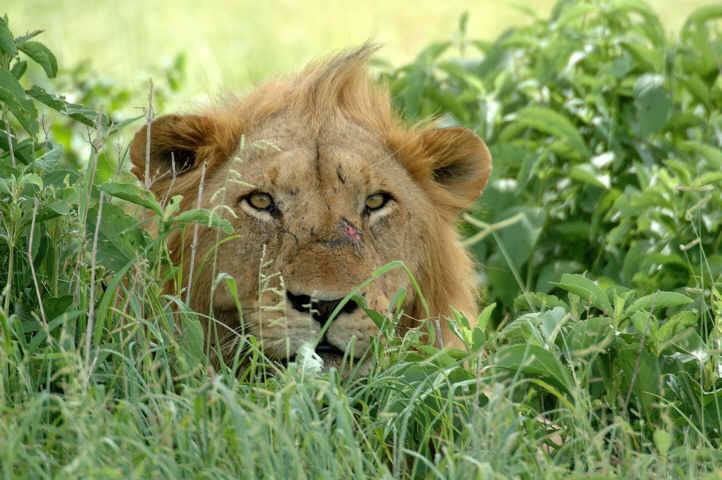
How does the carbon in grass become part of a lion?
a)
The lion eats the grass
b)
Carbon from grass doesn't end up in a lion. 
c)
The carbon ends up in the lion's food chain. 
d)
The lion breathes in carbon given out by the plant
14.
Organisms that do not decompose can be buried and become what?
a)
water
b)
nutrients
c)
air
d)
fossil fuels
15.

Which of the following creates a calcium carbonate structure?

a)

plants

b)

cows

c)

corals

d)

decomposers

16.
Which countries have regions in the Arctic Circle?
a)
Russia, the USA, Canada, Greenland, Norway, Sweden, Finland, Denmark.
b)
Russia, the USA, Canada, England, Norway, Sweden, Finland, Iceland.
c)
Russia, the USA, Canada, Greenland, Norway, Sweden, Finland, Germany.
d)
Russia, the USA, Canada, Greenland, Norway, Sweden, Finland, Iceland.
17.
How cold does it get in the Arctic Circle?
a)
-15° Celsius
b)
-25° Celsius
c)
-35° Celsius
d)
-45° Celsius
18.
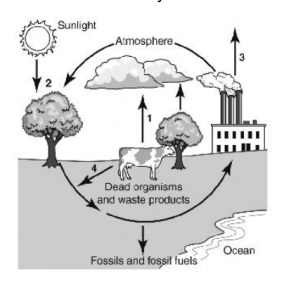
What is happening at 1?
a)
respiration: releasing CO2
b)
decomposing COin the soil
c)
photosynthesis: absorbing CO2
d)
turning CO2 from the atmosphere into organic molecules
19.

What is the tree line?

a)

Where trees grow

b)

The limit to where trees will grow

c)

the point of no return for trees

d)

Negative heat balance within trees

20.

The active layer is:

a)

has tall trees in it

b)

contained within the soils

c)

lower most layer of permafrost

d)

uppermost layer of permafrost

21.

What is flux?

a)

the amount of carbon exchanged between Earth's carbon pools

b)

the amount of water exchanged between Earth's carbon pools

c)

the amount of carbon exchanged between Earths water storages

22.

•Thermokarst is what?

a)

rock with small selective gaps

b)

hollows produced by the selective melting of permafrost.

c)

pools of water randomly located on the landscape

d)

human induced pools of water placed on the landscape