Wayground logo

Free Printable Worksheets

Font size

S
M
L
XL
Worksheets

Protein Chemistry

Total questions: 25

Worksheet time: 14mins

Name
Class
Date
1.
What is the monomer of proteins?
a)
amino acids
b)
polypeptides
c)
nucleotides
d)
monosaccharides
2.
Which macromolecule is this?
a)
carbohydrate
b)
lipid
c)
protein
d)
nucleic acid
3.
Enzymes are capable of increasing the rate of a chemical reaction within a living cell.  Enzymes accomplish this through which of the following means?
a)
reducing the number of products   
b)
reducing the activation energy
c)
increasing the temperature of the cell
d)
increasing the concentration of reactants 
4.
Given the graph below, which statement best describes the role of enzymes?
a)
More energy is released without the presence of enzymes
b)
Less energy is needed to start a reaction when enzymes are present.
c)
A reaction is catalyzed by the lack of enzymes
d)
The presence of enzymes causes reactions to occur at a slower rate.
5.

Which colored box highlights the amino group?

a)

Blue (left)

b)

Turquoise (top)

c)

Orange

d)

Red

e)

Purple

6.

Which colored box is the reason this is an organic molecule?

a)

Blue (left)

b)

Turquoise (top)

c)

Orange

d)

Red

e)

Violet

7.

Which colored box is different for every amino acid?

a)

Blue (left)

b)

Turquoise (top)

c)

Orange

d)

Red

e)

Purple

8.

Which colored box highlights the carboxyl?

a)

Blue (left)

b)

Turquoise (top)

c)

Orange

d)

Red

e)

Purple

9.

What is a long chain of amino acids called?

a)

Polysaccharide

b)

Lipid

c)

Carbohydrate

d)

Polypeptide

e)

Nucleic acid

10.

Enzymes belong to which category of organic molecule?

a)

Proteins

b)

Lipids

c)

Carbohydrates

d)

Nucleic acids

11.

Which statement about enzymes is FALSE?

a)

They are made from amino acids

b)

They can be used multiple times

c)

They lower the energy needed for reactions

d)

A single enzyme has many different functions

12.

What happens when an enzyme is placed outside it's normal environment?

a)

It functions normally

b)

It functions better

c)

It's function ceases

13.
The bond that joins amino acids are called:
a)
Peptide Bonds
b)
Ester Bonds
c)
Glycosidic Linkages
d)
Phosphodiester Bonds
14.

If a methyl group (-CH3), which does not like water, were at the 'R', the amino acid would likely be:

a)

Hydrophobic

b)

Hydrophilic

c)

Ionic

d)

Acidic

15.
The reaction used to digest and break the bond in red is:
a)
Hydrolysis
b)
Dehydration Synthesis
c)
Oxidation
d)
Single Displacement
16.
The primary sequence of a protein refers to the:
a)
Order of amino acids
b)
α-Helix or β-Pleated Sheet
c)
Interaction of subunits
d)
Hydrogen Bonding
17.
Structures like an α-Helix are formed because of:
a)
Hydrophobic Interactions
b)
DiSulphide Bridges
c)
Salt Bridges
d)
Hydrogen Bonding
18.
The amino acid that results in disulphide bridges is:
a)
Cysteine
b)
Alanine
c)
Glutamic Acid
d)
Valine
19.
The structure of proteins can be changed by environmental factors such as temperature or pH.
a)
True
b)
False
20.
Refers to the three-dimensional structure of an entire amino acid chain in a protein molecule
a)
tertiary structure
b)
primary structure
c)
secondary structure
d)
fibrous proteins
21.
Which of the following conclusions can be drawn from this graph?
a)
The optimum pH of the enzyme is 6.6.
b)
The optimum pH of the enzyme is 5.8
c)
The enzyme’s activity increases as pH increases 5.0 to 9.0
d)
The enzyme’s activity is greater around pH of 8.0 .
22.
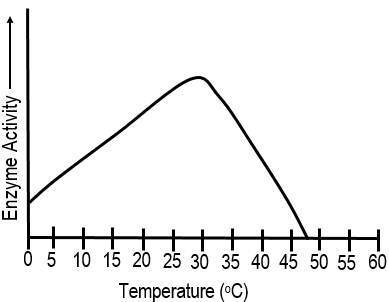
Based on the graph, what temperature does this enzyme work best? 
a)
15 C
b)
40 C
c)
30 C
23.
What happens when enzymes are heated to a high temperature?
a)
The enzymes die.
b)
The shapes of the enzyme are altered or denatured
c)
The enzymes' amino acid sequence changes.
d)
The enzymes remain the same
24.
Letter D...
a)
active site
b)
enzyme
c)
substrate
d)
products
25.
Letter C...
a)
active site
b)
enzymes
c)
substrate
d)
products