
NEW
Font size
 Worksheets
BL_Nervous System
Total questions: 25
Worksheet time: 15mins

Identify components that made up the nervous system.
heart, brain, kidneys
lungs, liver, stomach
brain, spinal cord, nerves
eyes, pancreas, veins

Identify the correct statement that best describes the relationship between sensory neurons and motor neurons.
Motor neurons bring a stimulus input to the brain and sensory neurons carry a movement output.
Sensory neurons tell motor neurons what to do.
Sensory neurons bring a stimulius input to the spinal cord or brain and the brain or spinal cord sends a motor neuron response.
Sensory neurons do more than motor neurons

Select the part of the neuron that conducts action potentials.
Axon
Dendrite
Axon Terminal
Cell Body

Identify the reason that triggers the movement of vesicles towards the post-synaptic membrane.
Influx of Ca++
Influx of Na++
Movement of K+ out of the cell
Movement of Ca++ out of the cell

Select the cause of depolarization phase of an action potential.
Na+ rushing into the axon
K+ rushing out of the axon
Ca++ rushing into the axon
Activation of Na/K pumps

Choose the phase of generation of action potential where Na/K Pumps are the most active.
Hyperpolarization
Depolarization
Repolarization
Resting Membrane Potential
Select the part of the neuron that insulates the axon and increases the speed of the neural message within the neuron.
Synapse
Dendrite
Myelin Sheath
Axon Terminal Button
Identify the part of neuron that stores and releases neurotransmitters into the synapse.
Axon
Dendrite
Myelin Sheath
Axon Terminal
Name the gap between two neurons.
Impulse
Synapse
CNS
Inter neuron
Name the chemicals produced by neurons that function to carry messages to other neurons
myelin sheath
neurotransmitter
axon
axon terminal
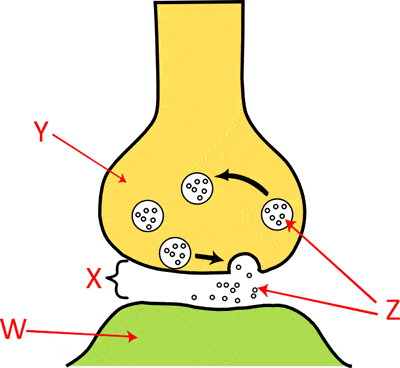
Identify W.
Axon Terminal Button
Neurotransmitters
Dendrite
Synapse

The value -70 mV is the measure of?
Threshold Potential
Action Potential
Resting Potential
End Point Potential
After depolarization, predict the step involved to restore resting potential.
Sodium channels open & sodium ions diffuse out of the neuron.
Potassium channels open & potassium ions diffuse into the neuron.
Potassium channels open and potassium ions diffuse into the neuron.
Sodium channels open and sodium ions diffuse into the neuron.
What generates a nerve impulse on the post-synaptic membrane?
Calcium binding with a receptor site
Potassium leaking into the post-synaptic membrane
Neurotransmitter binding with receptor sites
Neurotransmitter being removed from the synapse
Select the statement that best describes a neuron.
Specialized cells that protects the body from any foreign particles
Specialized cell that transports oxygen throughout the cardiovascular system
Specialized cell that functions to transmit electrical impulses within the nervous system
Specialized cells that receive and read signals sent from the body
In order for a neuron to have an action potential, the neuron must receive more
excitatory neurotransmitters
inhibitory neurotransmitters
agnostic neurotransmitters
antagonistic neurotransmitters
Locate the nucleus and organelles in a neuron.
dendrites
axon
cell body
Schwann cells
For a neuron with a resting membrane potential at -70mv, an increase in the movement of sodium ions into the neuron's cytoplasm would result in:
the depolarization of the neuron.
the repolarization of the neuron
the replacement of potassium ions with sodium ions.
the replacement of potassium ions with calcium ions.

Identify A.
Axon
Dendrite
Axon Terminal
Cell Body
Identify parts of the body that are included in the central nervous system.
brain and spinal cord
brain and backbone
spinal cord and eyes
brain and eyes
Identify the correct statement about neuron at rest.
The inside of the neuron is more negatively charged than the outside
Outside of the neuron is more negatively charged than the inside
Either of the above can be true
The inside and the outside of the neuron have the same electrical charge
Identify the role of the Na+/K+ pump in the nervous system.
Maintain proper ionic concentration gradients across the neuron membrane
Generate the nerve impulse when the neuron is stimulated
Transmit the nerve impulse across the synaptic cleft between neurons
None of the above - it plays no role
What happens to excess neurotransmitter produced by presynaptic neurons?
It is eliminated by substances contained within the cell body
It is removed and taken around the rest of the body
It is taken back into the presynaptic neuron
All of it is taken up by postsynaptic neurons
Electrical impulses gather and accumulate in which part of a neuron, in order to initiate an action potential?
Dendrites
Axon hillock
Axon terminal branches
Node of Ranvier
Calcium ions are crucial to synaptic transmission
They are required for manufacture of neurotransmitter in the Golgi complex
because they bind to the postsynaptic receptor inducing a permeability change in the membrane
Since decreases in the intracellular calcium level induce neurotransmitter release
since Localised increases in the intracellular calcium level induce neurotransmitter release from the presynaptic element

