
 Worksheets
Atomic Theory and Structure
Total questions: 25
Worksheet time: 27mins
Name
Class
Date
1.
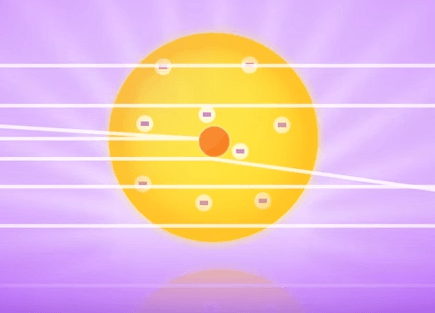
Rutherford discovered the...
a)
electron
b)
proton
c)
neutron
d)
nucleus
2.
an element will always have the same number of
a)
neutrons
b)
protons
c)
isotopes
d)
atoms
3.
Which particle does not contribute mass to the atom?
a)
Proton
b)
Neutron
c)
Electron
d)
Nucleus
4.
What scientist is best known for his gold foil experiment?
a)
J.J. Tomson
b)
Ernest Rutherford
c)
John Dalton
d)
Democritus
5.
An atom has 10 protons and a mass of 18. It has __ neutrons
a)
10
b)
18
c)
28
d)
8
6.
The smallest particle into which an element can be divided and still be the same substance
a)
neutron
b)
atom
c)
electron
7.
The mass number of an element that has18 protons, 18 electrons, and 19 neutrons is _____.
a)
12.5
b)
13
c)
25
d)
37
8.
In an atom, electrons move in definite orbits around the nucleus.
a)
Thomson
b)
Rutherford
c)
Bohr
d)
Democritus
9.

What scientist is best known for his "Plum Pudding" model of the atom?
a)
J.J. Thomson
b)
Ernest Rutherford
c)
John Dalton
d)
Democritus
10.

Who came up with the model of an atom pictured?
a)
J.J. Thompson
b)
Ernest Rutherford
c)
Neils Bohr
d)
James Chadwick
11.
Which particle contributes the negative charge to the atom?
a)
proton
b)
electron
c)
neutron
d)
nucleus
12.
The three main subatomic particles are electrons, protons and ____________.
a)
photons
b)
neurons
c)
neutrons
d)
quarks
13.
What are the two main parts of the atom?
a)
nucleus and cytoplasm
b)
nucleus and electron cloud
c)
core and electron cloud
d)
protons and neutrons
14.
What is the standard unit of mass at the atomic level?
a)
centimeters
b)
millimeters
c)
amu
d)
milligrams
15.
What is the electrical charge of a proton?
a)
1+
b)
1-
c)
neutral
d)
2-
16.
DIFFERENT kinds of atoms chemically combined to form a substance are
a)
Mixture
b)
Element
c)
Compound
d)
Substance
17.
A homogeneous mixture has the same composition of particles throughout.
a)
True
b)
False
18.
A heterogeneous mixture would be:
a)
gold
b)
chex mix
c)
chocolate milk
d)
water
19.
Flammability is an example of what property?
a)
Chemical property
b)
Physical property
20.
Subatomic particles with a negative charge
a)
Electrons
b)
Neutrons
c)
Protons
d)
Quarks
21.
subatomic particles found on the outermost shell & responsible for the atom's reactivity
a)
neutrons
b)
valence electrons
c)
isotopes
d)
ions
22.
Measure mainly of the nuclear particles: protons + neutrons
a)
Subatomic Particles
b)
Atomic Number
c)
Atomic Mass
d)
Gluons
23.
Subatomic particles that are neutral in charge
a)
Neutrons
b)
Protons
c)
Nucleus
d)
Electrons
24.
Where electrons are likely to be found as they travel around the nucleus
a)
Nucleus
b)
Electron Cloud
c)
Within a Proton
d)
Within a Neutron
25.
Discovered the electron within the atom
a)
Thomson
b)
Chadwick
c)
Schrodinger & Heisenberg
d)
Dalton
100 %

