
 Worksheets
Junior Cycle Rates of reactions
Total questions: 16
Worksheet time: 15mins
Which factors increase the rate of a reaction?
increasing temperature
increasing concentration
increasing surface area
all of these
Which of the following increase the reaction rate?
less surface area
lower temperature
increased concentration
How can you increase the rate of a reaction?
Decrease the pressure
Decrease the concentration
Increase the concentration

Which piece of equipment is not shown in this diagram?
Beehive shelf
Graduated cylinder
Conical flask
Beaker
A chemical that changes the rate of a reaction but is not used up in the reaction is called a ...
Catalyst
Product
Reactant
Indicator
Concentration of a chemical is ...
a measure of how much of a chemical you have.
a measure of how strong the chemical is.
a measure of how dangerous a chemical is.
a measure of how quickly a chemical will react.

If you have 15 grams of Baking Soda and 20 grams of Vinegar as products, what would you expect the mass of your reactants to be?
15 grams
20 grams
5 grams
35 grams
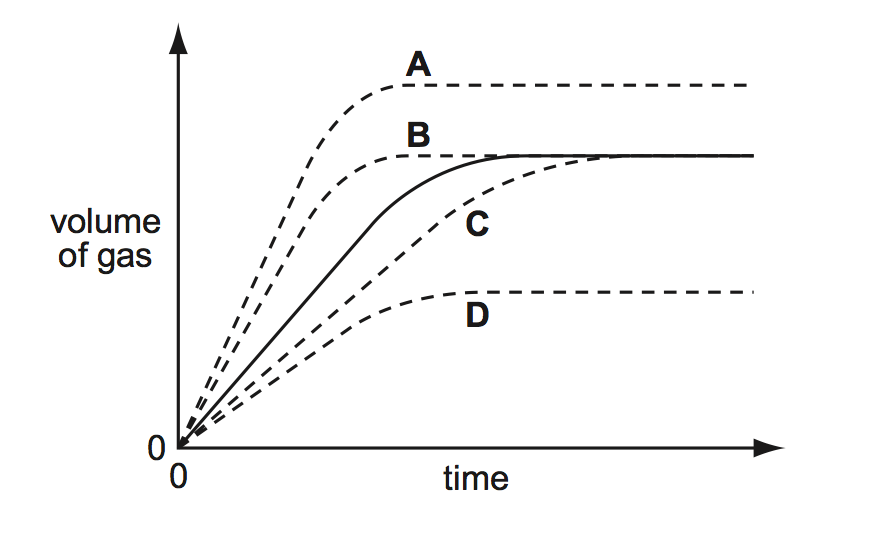
Identify where the rate of reaction is fastest.
A
B
C
D

In an experiment to measure the effect of temperature on the rate of reaction, what should be changed?
The amount of magnesium
The temperature of the magnesium
The temperature of the hydrochloric acid
The temperature of the water
In an experiment to measure the effect of concentration on the rate of reaction, what should be changed?
The amount of magnesium
The amount of the hydrochloric acid
The concentration of the hydrochloric acid
The temperature of the water
In an experiment to measure the effect of the type of reactant on the rate of reaction, what should be changed?
The amount of magnesium
The amount of the hydrochloric acid
The magnesium
The amount of hydrogen gas produced
What can be measured in this experiment to show the rate of the reation?
The amount of magnesium
The amount of the hydrochloric acid
The amount of water in the trough
The amount of hydrogen gas produced

In an experiment to test the effect of particle size on rate of reaction, what should be changed?
The size of the marble chips
The amount of hydrochloric acid
The amount of marble chips
The size of the cotton wool

