
 Worksheets
IGCSE 0610 16.4 Sexual reproduction in humans
Total questions: 50
Worksheet time: 2hrs 43mins

What is the question mark pointing to?
Bladder
Urethra
Penis
Testicles

Sexual reproduction is vital to the propagation of the Human race. Which of the following sequences represents the correct order of events in the formation of a human fetus?
Zygote → Blastocyst → Embryo → Fertilization
Fertilization → Zygote → Blastocyst → Embryo
Blastocyst → Embryo → Differentiation → Zygote
Fertilization → Growth → Differentiation → Zygote
Spermatogenesis (meiosis) is the process by which sperm develop and mature. Which of the following sequences correctly describes the anatomical path of spermatozoa from formation to ejaculation?
testes, vas deferens, prostate, urethra
testes, urethra, prostate, vas deferens
prostate, vas deferens, testes, urethra
prostate, urethra, testes, vas deferens
The main function of the placenta is to :
allow direct exchange of blood between the mother and fetus for nutrition.
facilitate gas and nutrient exchange between the fetus and mother.
support the weight of the developing fetus in the uterus.
store gases and nutrients for later delivery to the fetus.
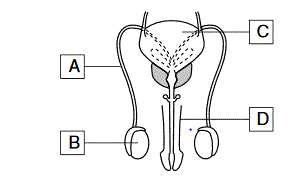
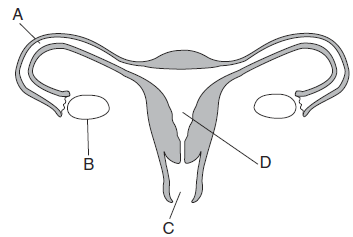
A reproductive system is represented in the diagram below. Which structure is correctly paired with its reproductive function?
A – pathway of gametes
C– production of sperm
D– regulation of homeostasis
B– synthesis of progesterone
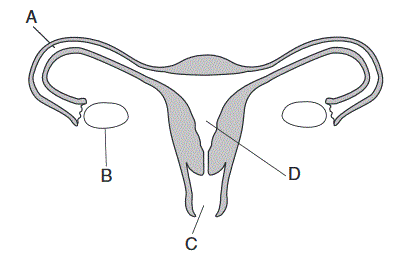
The diagram below represents structures found in the female reproductive system. If the areas labeled A were completely blocked on both sides, the most likely result would be that
egg production would stop
sperm production would stop
fertilization would not occur
an embryo would develop
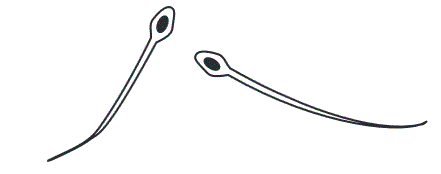
Which statement about the gametes represented
in the diagram below is correct?
They are produced by females
They are fertilized in an ovary.
They transport genetic material
They are produced by mitosis
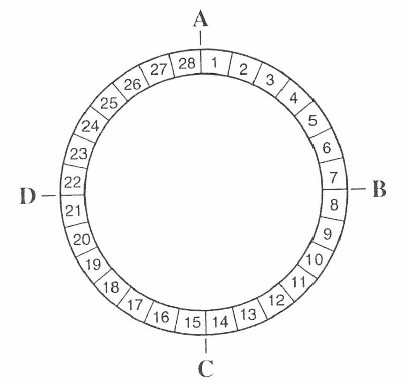
What does IVF stand for?
In vitro fertilisation
Insert viable foetus
Internal variable fertilisation
Internal vitro fertilisation
The pituitary gland produces
FSH
LH
GnRH
Oestradiol




State the name of the organ which produces sperm
(a)
State why women are often advised to avoid alcohol during pregnancy
(a)
The testes are part f the endocrine system because they release hormones.
State the name of the hormone released from the testes
(a)
Oestrogen is a hormone responsible for the development of secondary sexual characteristics during puberty.
State the name of the part of the female reproductive system that secretes oestrogen.
(a)

(a)

(a)

ovary --> oviduct --> uterus --> cervix
ovary --> uterus --> cervix --> vagina
vagina --> cervix --> uterus --> oviduct
vagina --> uterus --> cervix --> oviduct
The ovary secretes hormones that control the growth and maintenance of the lining of the uterus.
Name the hormone that stimulates the growth of the lining of the uterus during the first half of the menstrual cycle.
(a)
The ovary secretes hormones that control the growth and maintenance of the lining of the uterus.
Name the hormone that stimulates the maintenance of the lining of the uterus during the second half of the menstrual cycle.
(a)
Identical twins are formed when one sperm fertilises one egg, which then splits in two. Each of these then develops into an embryo.
Compare the alleles present in a pair of identical twins.
(a)

Name the process R
(a)
Name the cell S
(a)
Check all of the adaptive features of an egg cell
Has stores of energy
Is motile, can swim
Has enzymes to allow fertilisation to occur
Has a jelly coat which changes after fertilisation
Check all of the adaptive features of a human male gamete
Has stores of energy
Is motile, can swim
Has enzymes to allow fertilisation to occur
Has a jelly coat which changes after fertilisation

Check all of the functions of the placenta
To protect the baby from injury by absorbing shocks
To transfer nutrients
To kill pathogens
To transfer waste products
To transfer carbon dioxide

Put the events in the correct sequence.
Write your answer in capital letters without spaces.
The sequence begins with Y and ends XU do not include these in your answer.
(a)

Where are eggs made?
A
B
C
D
E
Where does fertilisation occur?
A
B
D
E
F
Where does implantation of the zygote occur?
A
B
D
E
F
Which of these are disadvantages of breast feeding?
Not all mothers can produce enough milk
It is free
Some pathogens can be passed through milk mother to baby
Fathers can feed the baby too
It is time consuming

Were are sperm made?
A
B
C
D
E
Were are sperm and urine carried out of the body?
A
B
C
D
E
Were is fluid that is added to the sperm made?
A
B
C
D
E

Name X
(a)
Name Y
(a)
Name Z
(a)
Which of these processes occur during labour and birth?
Fertilisation of the zygote
Contractions of the muscles in the uterus wall
Differentiation of the oviduct
Dilation of the cervix
Delivery of the afterbirth

