wayground logo

Free Printable Worksheets

NEW

Font size

S
M
L
XL
Worksheets

Homeo Eu and Pro Organelles

Total questions: 32

Worksheet time: 1hrs 5mins

Name
Class
Date
1.

The function of the cell wall is to provide structure and rigidity. Which system is most like cell wall?

a)

skeletal system

b)

integumentary system

c)

circulatory system

d)

nervous system

2.

A barrier between the external environment and internal environment is provided by the skin of our integumentary system. Which organelle is most like this system?

a)

nucleus

b)

mitochondria

c)

cell membrane

d)

endoplasmic reticulum

3.

Which system transports materials throughout the body like the endoplasmic reticulum transports materials throughout the cell?

a)

skeletal system

b)

integumentary system

c)

digestive system

d)

circulatory system

4.

The nucleus in the cell contains genetic information and controls cellular activities, which system is most like the nucleus?

a)

integumentary system

b)

respiratory system

c)

nervous system

d)

circulatory system

5.

The lysosomes consume and rid the cell of excess waste products; which two systems do that in the human body?

a)

digestive and excretory

b)

excretory and circulatory

c)

respiratory and circulatory

d)

digestive and respiratory

6.
What is another word that can be used to describe "homeostasis"?
a)
STABLE
b)
EQUAL
c)
COMPLETE
d)
CORRECT
7.
Is light an internal or external stimulus?
a)
Internal
b)
External
8.
The "effect" of a given stimulus is the...
a)
response
b)
stimulus
c)
cause
d)
result
9.
Which of the following is an example of positive feedback to indirectly maintain homeostasis?
a)
the chemical reactions involved in blood clotting
b)
your blood vessels dilate and you begin to sweat in response to elevated body temperature
c)
your blood vessels constrict and you begin to shiver in response to low body temperature
d)
your coach compliments you on your performance in practice
10.
Homeostasis in the human body is often maintained by a: 
a)
neutral feedback loop 
b)
solar feedback loop
c)
positive feedback loop
d)
negative feedback loop
11.
Which is true of prokaryotic and eukaryotic cells?
a)
Prokaryotic cells are larger than eukaryotic cells.
b)
Eukaryotic cells do not have nuclei, and prokaryotic cells do have nuclei.
c)
Prokaryotic cells lack membrane-bound organelles, and eukaryotic cells contain membrane-bound organelles.
d)
Eukaryotic cells are simpler than prokaryotic cells.
12.

Which do BOTH prokaryotes and eukaryotes contain?

a)

nucleus

b)

mitochondria

c)

ribosomes

d)

cell wall

13.

Which does only eukaryotic cells contain?

a)

nucleus

b)

DNA

c)

cell membrane

d)

ribosomes

14.
Which of the following is not a characteristic of a Prokaryotic cell?
a)
unicellular
b)
floating DNA
c)
very small
d)
complex
15.

CHALLENGE QUESTION: Which of the following provides evidence for the hypothesis that prokaryotes evolved before eukaryotes.

a)

prokaryotes are more complex

b)

prokaryotes have no nucleus and fewer genes

c)

eukaryotes are multicellular which makes them simpler

d)

prokaryotes grow into eukaryotes

16.
multicellular
a)
Prokaryote
b)
Eukaryote
c)
both
17.
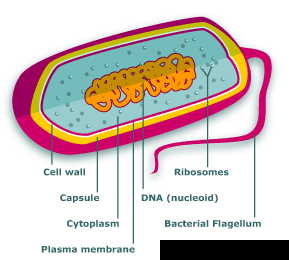
Which type of cell?
a)
Prokaryote
b)
Eukaryote
18.
Which type of cell?
a)
Prokaryote
b)
Eukaryote
19.
Where is the DNA found in a eukaryotic cell? 
a)
floating around in the cytoplasm 
b)
in the nucleus 
20.
What type of cell does not have a nucleus?
a)
eukaryotic 
b)
prokaryotic 
21.

What is the function of the cell membrane?

a)

To control what comes in and out of the cell

b)

To break down food inside the cell

c)

to serve as a barrier

d)

to eat the cells food

22.

Which organelle produces the energy a cell needs to carry out its function

a)

Mitochondria

b)

Golgi Bodies

c)

Cytoplasm

d)

Nucleus

23.

What is the function of the Vacuoles

a)

Store food, water and waste

b)

Receive proteins

c)

Assembles amino acids

d)

Found inside the nucleus

24.

Which cell contains Chloroplasts?

a)

Animal

b)

Plant

25.
An organelle that captures energy from the sunlight in order to use it to produce food in plant cells is ______________.
a)
Chromatin
b)
Chloroplast
c)
Cytoplasm
d)
Cell Membrane
26.

The _____________ holds the DNA, and controls the functions of eukaryotic cells.

a)

Nucleus

b)

Nuclear Membrane

c)

Mitochondria

d)

Chloroplast

27.

Cell organelles work together to maintain

a)

homeostasis

b)

eukarya

c)

prokarya

d)

organisms

28.
What organelle is called the "powerhouse" of a cell?

a)
Endoplasmic Reticulum
b)
Nucleus
c)
Mitochondria
d)
Nucleolus
29.
Using this image, what organelle is A?
a)
Cell Wall
b)
Large Central Vacuole
c)
Mitochondria
d)
Chloroplast
30.
Using this image, what organelle is C?
a)
Cell Wall
b)
Mitochondria
c)
Large Cell Vacuole
d)
Chloroplast
31.
Using this image, what organelle is N?
a)
Centrioles
b)
Cell Membrane
c)
Golgi Apparatus
d)
Ribosome
32.
What is the difference between rough and smooth ER?
a)
There is no difference.
b)
Plants have rough ER, animals have smooth ER.
c)
What type of injuries the Doctors treat.
d)
Rough has ribosomes, smooth does not.