
NEW
Font size
 Worksheets
Constant Acceleration - Honors PHysics
Total questions: 44
Worksheet time: 2hrs 57mins



Using the velocity vs time graph - what is the displacement of the car during the trip?
800 m
1400 m
900 m
1000 m


What does the area underneath this graph represent?
displacement
velocity
position
acceleration

The graph at right describes the motion of a ball. At what point does the ball have an instantaneous velocity of zero?
A
B
C
D
E
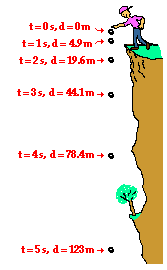
When there is no air resistance, objects of different masses dropped from rest
fall with equal accelerations and with equal displacements.
fall with different accelerations and with different displacements.
fall with equal accelerations and with different displacements.
fall with different accelerations and with equal displacements.
How long will it take a running horse to travel 260 m and attain a speed of 12 m/s from rest?
12 seconds
52 seconds
22 seconds
43 seconds
A train travels 6 meters in the first second of travel, 6 meters again during the second second of travel, 6 meters again during the third second. What's the train's acceleration ?
0 m/s2
6 m/s2
12 m/s2
18 m/s2
A ball is thrown downward from the top of a roof with a speed of 25 m/s. After 2 s, its velocity will be:
19.6 m/s
-5.4 m/s
-44.6 m/s
44.6 m/s

A golf ball accelerates off a tee at 8800 m/s2, changing its velocity from 0m/s to 44 m/s down the fairway. How long did it take the golf ball to accelerate?
0.22 seconds
200 seconds
14 seconds
0.0050 seconds
. A rock is thrown straight up from the edge of a cliff. The rock reaches the maximum height of 15 m above the edge and then falls down to the bottom of the cliff 35 m below the cliff. What is the displacement of the rock?
A. 15 m
B. 35 m
C. 50 m
D. 65 m
A car accelerates from rest at a constant rate 5 m/s2 . Which of the following statements is true?
A. The car travels 5 m in every second
B. The car decreases its velocity 5 m/s in every second
C. The car increases its velocity 5 m/s in every second
D. The car’s velocity doesn’t change
A student drops a pebble from the edge of a vertical cliff. The pebble hits the ground 4 s after it was dropped. What is the speed of the pebble just before it hits the ground?
A. 20 m/s
B. 40 m/s
C. 60 m/s
D. 80 m/s
When a ball is thrown straight up with no air resistance, the acceleration at its highest point
A) is upward
B) is downward
C) is zero
D) reverses from upward to downward
If the acceleration of an object is zero, then that object cannot be moving.
True
False
A cargo plane flies horizontally at a speed of 140 m/s at a height of 50 m above the ground. A supply package is dropped out of the bottom of the plane at time t=0. Two seconds later, a second package is dropped out of the bottom of the plane. Air resistance is negligible. How far apart will the packages land on the ground?
70m
140m
280m
420m
How do you calculate average speed?
divide total time by total distance
multiply total time by total distance
divide total distance by total time
subtract total time from total distance

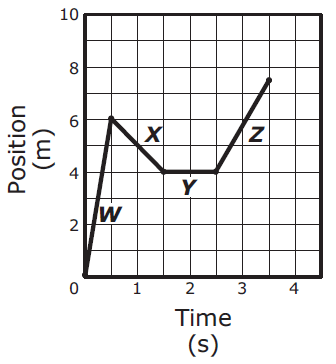
Find the displacement in the first 5 seconds.
8 meters
4 meters
2 meters
5 meters
The standard acceleration due to gravity (or standard acceleration of free fall),is the gravitational acceleration of an object in a vacuum near the surface of the Earth. It is defined by standard as:
9.81 m/s.
9.8 m.
9.81 m/s2.
9.8 s.
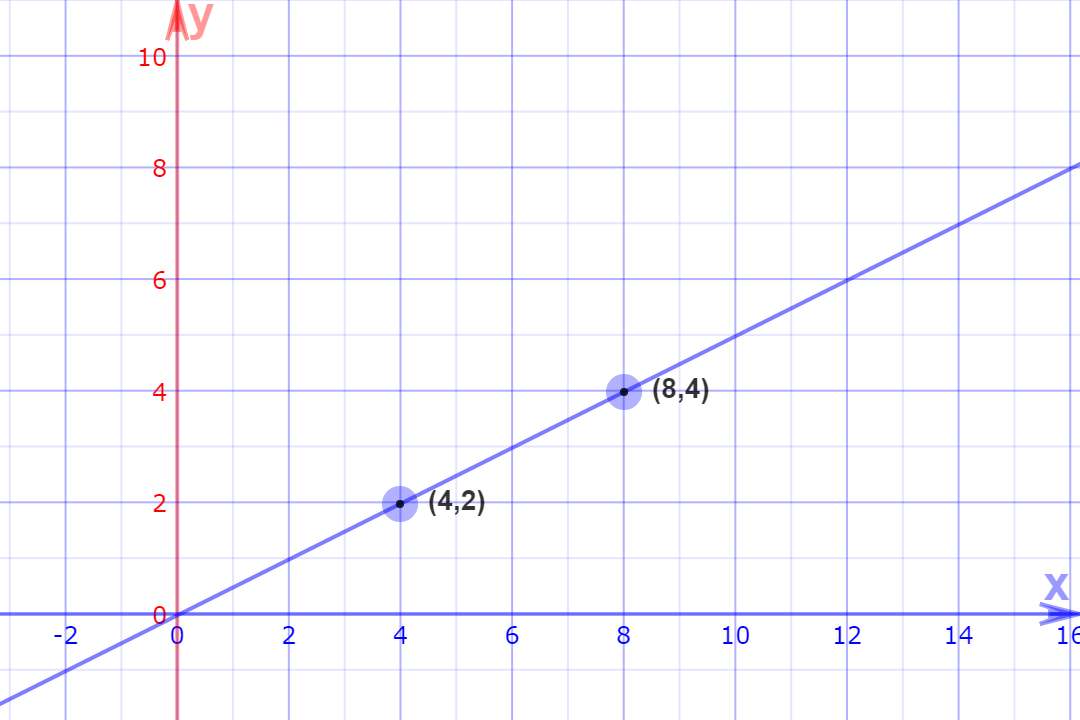
Which of the following graphs best represents free fall motion?
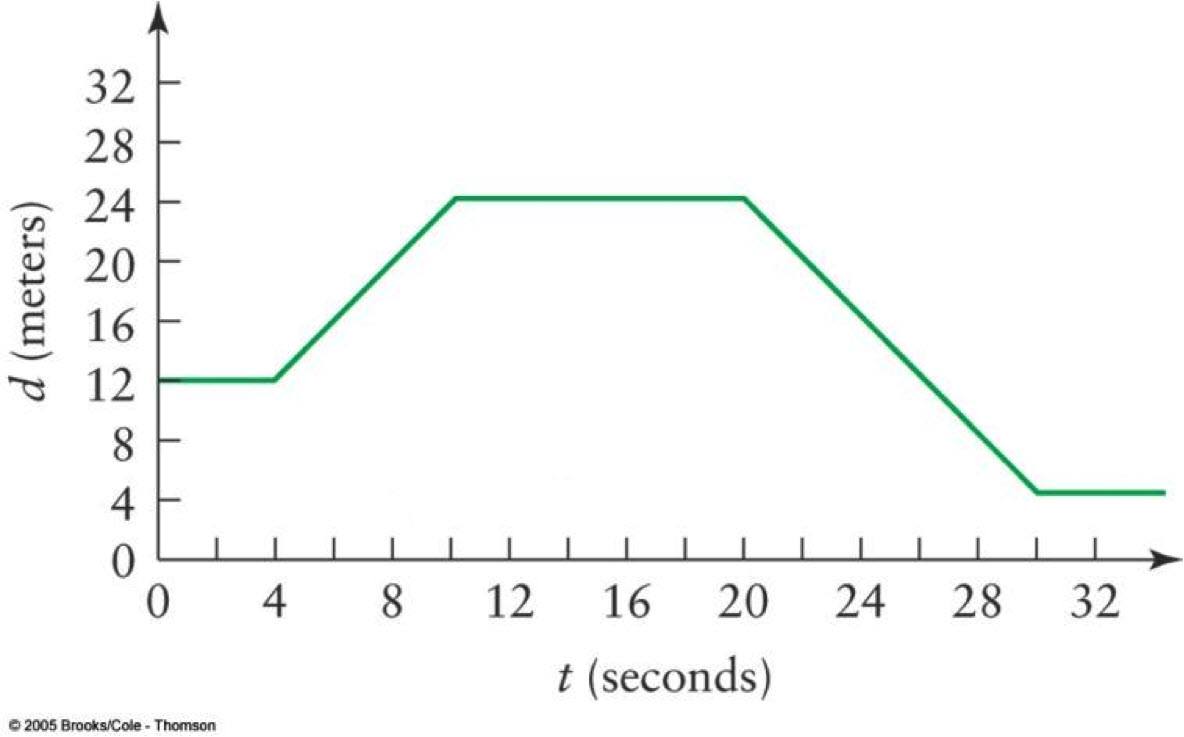
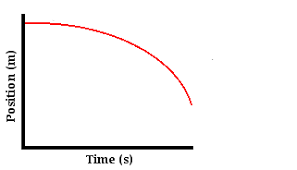
Juan is standing on the top observation deck of the Eiffel Tower in Paris at a height of 300 meters. He drops his cell phone. How fast will the phone be traveling when it hits the ground? Ignore the effect of air resistance.
9.8 m/s
76.68 m/s
149.76 m/s
46.99 m/s
If an object is free falling onto the Moon, which of the following would be correct?
It would accelerate at 9.8 m/s2
It would not encounter any air resistance.
It would not fall because the Moon has no gravity.
It would impact the surface and bounce back into space.
A Cessna aircraft has a lift-off speed of 120 km/hr. What minimum constant acceleration does this require if the aircraft is to be airborne after a take-off run of 240 m?
2.31 m/s2
3.63 m/s2
4.63 m/s2
5.55 m/s2
6.12 m/s2
Mt. Everest is more than 8 000 m high. How fast would an object be moving if it could free fall to sea level after being released from an 8000-m elevation? (Ignore air resistance.)
396 m/s
120 m/s
1200 m/s
12000 m/s
521 m/s
When velocity is negative and acceleration is negative, what happens to the object’s motion?
The object slows down
The object speeds up
Nothing happens to the objects motion
The object remains at rest
What is the difference between a vector quantity and a scalar quantity?
A scalar has a magnitude and direction and a vector has only a magnitude
A vector has a magnitude and direction and a scalar has only a magnitude
A scalar has a direction and a vector has a magnitude
None of the above
When the velocity is positive and the acceleration is negative, what happens to the objects motion?
The object slows down
The object speeds up
Nothing happens to the object
The object remains at rest
A toy car is given an initial velocity of 5m/s and experiences a constant acceleration of 2 m/s2 for 6 seconds. What is the final velocity of the car?
10 m/s
12 m/s
16 m/s
17 m/s

Which position-time graph matches the velocity-time graph?


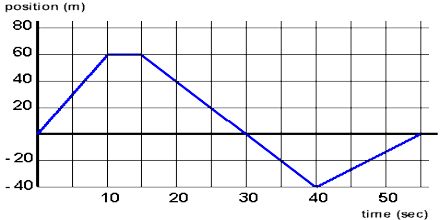
Which velocity-time graph matches the position-time graph below?



