wayground logo

Free Printable Worksheets

NEW

Font size

S
M
L
XL
Worksheets

TOPIC: ELECTRICITY

Total questions: 45

Worksheet time: 45mins

Name
Class
Date
1.
What is a closed path for electrons to flow through?
a)
static electricity
b)
circuit
c)
amperes
2.
Identify the insulator below.
a)
aluminum foil
b)
paperclip
c)
rubber eraser
3.
Thicker wires have _______ resistance than thinner wires.
a)
more
b)
less
c)
the same
4.
Electric current is measured in ______.
a)
Watts
b)
Volts
c)
Amperes
5.
As the resistance in a circuit increases, the electric current __________.
a)
increases
b)
decreases
c)
stays the same
6.
Which subatomic particles have a positive charge?
a)
neutrons
b)
electrons
c)
protons
7.
Which formulas represents Ohm's law?
a)
V=IR
b)
R=IV
c)
I=RV
8.
What is the unit for resistance?
a)
Volts
b)
Amperes
c)
Ohms
9.
How many volts are in a circuit with a battery that has a resistance of 10 Ohms and a current of 2 Amps? 
a)
.5 Volts
b)
5 Volts
c)
20 Volts
10.
Electricity is the flow of _________.
a)
protons
b)
neutrons
c)
electrons
11.
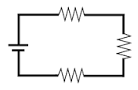
What type of circuit is pictured?
a)
series
b)
Parallel
12.
What type of circuit is pictured?
a)
series
b)
parallel
13.
Which type of current comes from a battery?
a)
alternating current (AC)
b)
direct current (DC)
14.
A battery or other device which provides energy for a circuit
a)
Conductor
b)
Power source
c)
Parallel circuit
d)
Complete circuit
15.
What is an insulator?
a)
The area of a conductor through which a current is able to move
b)
A material which does not allow electricity to go through it
c)
The amount of devices which are in a circuit
d)
A battery or other device which provides energy for a circuit
16.
The flow of electricity through a conductor
a)
Battery
b)
Current
c)
Static electricity
d)
Switch
17.
A small device that stores energy in a chemical form
a)
Complete circuit
b)
Switch
c)
Power source
d)
Battery
18.
a)
Power source
b)
Closed circuit
c)
Insulator
d)
Open circuit
19.
What is a conductor?
a)
A material that allows electricity to go through it
b)
The area of a conductor through which a current is able to move
c)
A battery or other device which provides energy for a curcuit
d)
When there is only one path for the electricity to flow
20.
A particle that carries a negative electric charge is called a(n) ______.
a)
neutron
b)
atom
c)
proton
d)
electron
21.
The potential difference that causes charges to move in a circuit is ___.
a)
voltage
b)
resistance
c)
current
d)
electric discharge
22.
An example of a voltage source is a _____.
a)
voltmeter
b)
battery
c)
resistance
d)
switch
23.

Why do electricians always wrap wires in plastic?

a)

Plastic comes in many different colors

b)

Plastic is a good electrical conductor

c)

Plastic makes the wires easy to bend

d)

Plastic is a good electrical insulator

24.

Which of these materials is a good conductor of electricity?

a)

Rubber

b)

Metal

c)

Newspaper

d)

Glass

25.
A student wants to use the diagram below to explain what happens when the light bulb turns on. How could she best explain what is happening?
a)
Light energy is transformed to electric energy.
b)
Electric energy is transformed to light energy.
c)
Electric energy is transformed to motion energy.
d)
Motion energy is transformed to electric energy.
26.
Will this circuit light the bulb? 
a)
Yes
b)
No
27.
Electric current that flows in only one direction. 
a)
Voltage 
b)
Direct Current 
c)
Alternating Current
d)
Series Circuit 
28.
When a balloon is rubbed on the hair ...
a)
negative charges are transferred from the hair to the balloon.
b)
positive charges are transferred from the hair to the balloon.
c)
negative charges are transferred from the balloon to the hair.
d)
positive charges are transferred from the balloon to the hair.
29.
Ms. Jo Jo rubbed two balloons with a piece of wool. What will happen when the balloons are brought near each other?
a)
The balloons will repel each other.
b)
The balloons will attract each other.
c)
The balloons will become positively (+) charged.
d)
The balloons will pop.
30.
Like charges ...
a)
attract each other
b)
repel each other
c)
stabilize each other
d)
are not attracted or repelled
31.
Which of the two circuits would have the brightest bulbs assuming all switches are closed? 
a)
A
b)
B
32.

What is the name of this electrical component called?

a)

Ammeter

b)

Voltmeter

c)

Bulb

d)

Resistor

33.

What is the name of this electrical component called?

a)

Bulb

b)

Resistor

c)

Voltmeter

d)

Ammeter

34.

What is the name of this electrical component called?

a)

Resistor

b)

Battery

c)

Switch

d)

Resistor

35.

What is the name of this electrical component called?

a)

Bulb

b)

Resistor

c)

Switch

d)

Battery

36.

What is the name of this electrical component called?

a)

Ammeter

b)

Voltmeter

c)

Resistor

d)

Bulb

37.

The circuit diagram shows 3 light bulb in series. What happens when one of the light bulb blows.

a)

The remaining bulbs remain on.

b)

The remaining bulbs are off.

c)

The remaining bulbs becomes brighter.

d)

The remaining bulbs becomes dimmer.

38.

The circuit shows three bulb in parallel. What happens when one of the light bulb is spoilt.

a)

The remaining bulbs remain on.

b)

The remaining bulbs are off.

c)

The bulbs become brighter.

d)

The bulbs become dimmer.

39.

Why is overloading a socket dangerous?

a)

It consumes too much electricity.

b)

A lot of energy is wasted.

c)

Over heating and fire may occur.

d)

The wires can become entangled.

40.

What is the danger of broken insulation?

a)

People can get electric shock.

b)

Appliances will be damage.

c)

A lot of energy is wasted.

d)

Heat is generated.

41.

What is the name of this electrical symbol?

a)

Variable voltmeter

b)

Variable resistor.

c)

Variable ammeter.

d)

Variable switch.

42.

How are ammeter and voltmeter connected in a circuit?

a)

Ammeter : Series

Voltmeter: Parallel

b)

Ammeter : Parallel

Voltmeter: Parallel

c)

Ammeter : Series

Voltmeter: Series

d)

Ammeter : Parallel

Voltmeter: Series

43.

What physical quantity does voltmeter measures?

a)

Power

b)

Voltage

c)

Current

d)

Resistance

44.

What physical quantity does ammeter measures?

a)

Voltage

b)

Current

c)

Resistance

d)

Power

45.

In a power station, what causes the turbine to turn?

a)

Heat

b)

Water

c)

Air

d)

Steam