wayground logo

Free Printable Worksheets

NEW

Font size

S
M
L
XL
Worksheets

Congruence and Proofs

Total questions: 53

Worksheet time: 53mins

Name
Class
Date
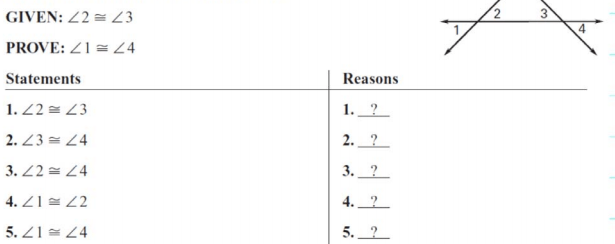
1.
What is the justification (reason)?
a)
Reflexive Property
b)
Symmetric Property
c)
Transitive Property
d)
Substitution
2.
What is the justification (reason)?
a)
reflexive property
b)
definition of segment bisect
c)
definition of a midpoint
d)
substitution property
3.
Which of the following is NOT a triangle congruence criteria?
a)
SAS
b)
AAS
c)
SSA
d)
ASA
4.
What does CPCTC stand for?
a)
Corresponding Parts of Congruent Triangles are Congruent
b)
Congruent Parts of Congruent Triangles are Corresponding
c)
Colorful Pieces of Corresponding Triangles are Congruent
d)
Congruent Pieces of Congruent Triangles are Congruent
5.
When using hypotenuse leg (HL) in a proof, you must first state ...
a)
CPCTC.
b)
there are right triangles.
c)
that vertical angles are congruent.
d)
the reflexive property.
6.
What triangle congruence criteria is shown in the given diagram?
a)
AAS
b)
ASA
c)
SSA
d)
SAS
7.
What triangle congruence criteria is shown in the given diagram?
a)
SSS
b)
SAS
c)
ASA
d)
AAS
8.
A triangle with two congruent sides and two congruent angles (base angles) is called ...
a)
scalene
b)
equilateral
c)
isosceles
d)
obtuse
9.
What is the missing piece of information required to prove these triangles congruent?
a)
QY ≅ QY
b)
NY ≅ PY
c)
∠N ≅ ∠P
d)
QY is the perpendicular bisector
10.
Which is the correct reason for statement 1 in the proof?
a)
Definition of Congruent Angles
b)
Substitution
c)
Transitive Property
d)
Given
11.
What reason do we have to use to put the statement that AB = AB in our proof?
a)
Reflexive Property of Equality
b)
Transitive Property of Equality
c)
Symmetric Property of Equality
d)
Distributive Property of Equality
12.
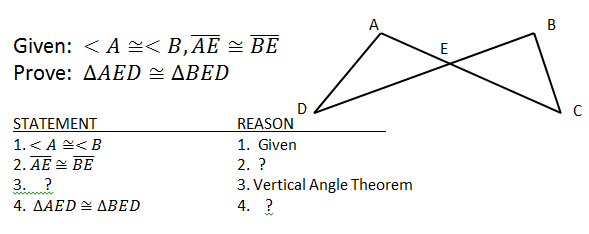
Identify the  missing statement or reason
a)
Reflexive Property
b)
Definition of Midpoint
c)
Given
d)
Vertical Angles Theorem
13.
What is the "reason" for step 5 of the proof?
a)
Angle Bisector Theorem
b)
Reflexive property
c)
CPCTC Theorem
d)
Proof
14.
What are the 2 missing pieces of information?
a)
Transitive Property, SAS(Side-Angle-Side)
b)
Reflexive Property, SAS(Side-Angle-Side)
c)
Transitive Property, SSS(Side-Side-Side)
d)
Reflexive Property, SSS(Side-Side-Side)
15.
What is the "statement" for step 2 of the proof?
a)
AD=AD
b)
AD=DA
c)
HD=DN
d)
HA = AN
16.
What is the "statement" for step 3 of the proof?
a)
HT=TA
b)
HA=AH
c)
MA=AM
d)
MA=MH
17.
What is always the 1st statement in reason column of a proof?
a)
Prove
b)
Given
c)
Reason
d)
Statement
18.
What is the "statement" for step 3 of the proof? 
a)
∡EDA≅∡DCB
b)
∡AED≅∡BEC
c)
DE=CE
d)
∡AED≅∡CED
19.
Determine if the triangles are congruent, if "yes" state the theorem.
a)
yes, SAS
b)
not congruent
c)
yes, ASA
d)
yes, AAS
20.

Given: B is the midpoint of AC. What should you conclude?

a)

AB + BC = AC

b)

AB = BC

c)

A is the segment bisector of BC

d)

ABC is a straight angle

21.

Given: OR \perp QP.  What should you conclude by definition of perpendicular?

a)

<ORP is a right angle

b)

QR + RP = QP

c)

<ORQ and <ORP are complementary

d)

<QRP = 180 °\degree  

22.

Given: <1 and <3 are vertical angles. What should you conclude by the vertical angles theorem?

a)

<1 and <2 are a linear pair

b)

<1 and <3 are right angles

c)

<2 and <4 are vertical angles

d)

 <1<3<1\cong<3  

23.

Given: <1 and <2 are supplementary. What can you conclude?

a)

m<1 + m<2 = 180

b)

m<1 + m<2 = 90

c)

m<1 = m<2

d)

nothing

24.

Given: PL is the angle bisector of <RPQ


What can you conclude by definition of angle bisector?

a)

m<RPL = m<LPQ

b)

<RPL + m<LPQ = m<RPQ

c)

<RPQ is acute

d)

m<RPQ = 90

25.
Name the angle relationship.
a)
Alternate Interior
b)
Alternate Exterior
c)
Corresponding
d)
Vertical Angles
26.
Name the angle relationship.
a)
Alternate Interior
b)
Alternate Exterior
c)
Corresponding
d)
Vertical Angles
27.
If DA bisects IE, then
a)
ID=ED
b)
IA=EA
c)
<IDA=<EDA
d)
<IAD and <EAD are right angles
28.
If AD bisects <EDI, then
a)
<ADE=<IDA
b)
IA=AE
c)
ID=ED
d)
All of the above
29.
If DA is perpendicular to IE, then we can immediately conclude that
a)
IA=AE
b)
<IAD = <DAE
c)
<IDA=<EDA
d)
<IAD and <DAE are right angles
30.
An angle bisector cuts an angle into two congruent _________
a)
Angles!
b)
Segments
c)
Mysteries
31.
A segment bisector cuts a segment into two congruent
a)
Segments!
b)
Angles
c)
Mysteries
32.
In this picture,
a)
<BCA=<DCE because they are vertical angles and vertical angles are always congruent to each other
b)
<C=<C because they are vertical angles and vertical angles are always congruent to each other
c)
<EDC=<ACB because they are vertical angles and vertical angles are always congruent to each other
d)
None of the above; we don't actually have vertical angles
33.
State if the two triangles are congruent.  If they are, state how you know.
a)
A
b)
B
c)
C
d)
D
34.
State if the two triangles are congruent.  If they are, state how you know.
a)
A
b)
B
c)
C
d)
D
35.
PICK THE CORRECT CONGRUENCE STATEMENT
a)
∆TUV ≅ ∆EUV
b)
∆VUT ≅ ∆UVE
c)
∆TUV ≅ ∆UEV
d)
∆UTV ≅ ∆EUV
36.
Use the congruence statement to find the missing part of the statement
a)
WV
b)
WU
c)
VU
d)
WB
37.
What is the "statement" for step 3 of the proof? 
a)
∡EDA≅∡DCB
b)
∡AED≅∡BEC
c)
DE=CE
d)
∡AED≅∡CED
38.
What is the "statement" for step 2 of the proof?
a)
∆BAC≅∆DAC
b)
BC=DC
c)
∡B≅∡D
d)
∡BAC≅∡DAC
39.
What is the "reason" for step 3 of the proof?
a)
Proof
b)
Def. of Midpoint
c)
Reflexive Property
d)
Vertical angle Theorem
40.
What would be the correct "given" statements for this diagram?
a)
T is the midpoint of segment BG and
∡B≅∡G
b)
∡B≅∡G and ∡A≅∡W
c)
T is the midpoint of segment BG and ∡A≅∡W
d)
T is the midpoint of segment AW and ∡A≅∡W
41.
Which symbol means "perpendicular"?
a)
b)
c)
d)
42.
What is statement #1?
a)
BC≅DC
b)
AC≅EC
c)
BC≅DC, AC≅EC
d)
∆BCA≅∆DCE
43.
What is reason #2?
a)
Definition of Midpoint
b)
Definition of Perpendicular
c)
Definition of Bisect
d)
Definition of Right Triangle
44.
What is statement #3?
a)
FH≅FH
b)
GF≅GF
c)
IH≅IH
d)
GF≅FI
45.
What is statement #4?
a)
∆HFG≅∆IHF
b)
∆FHG≅∆IHF
c)
∆GFH≅∆IFH
d)
∆HFG≅∆IFH
46.
What is reason #4?
a)
ASA
b)
SAS
c)
HL
d)
AAS
47.
What is statement #1?
a)
AB≅DC
b)
AC≅AC
c)
AB∥DC
d)
∠A≅∠C
48.
What is reason #2?
a)
Vertical angles are congruent.
b)
Consecutive angles are congruent.
c)
Alternate interior angles are congruent.
d)
Definition of Bisect
49.

What is Reason C?

a)

SSS Congruence

b)

SAS Congruence

c)

ASA Congruence

d)

AAS Congruence

e)

HL Congruence

50.

What is Reason F?

a)

Given

b)

Definition of Congruence

c)

Triangle Congruence

d)

CPCTC

51.

What is Reason B?

a)

Definition of Right Angles

b)

Definition of Perpendicular

c)

Definition of Given

d)

Definition of Right Triangles

52.

What is Reason C?

a)

Definition of Right Angles

b)

Definition of Perpendicular

c)

Definition of Given

d)

Definition of Right Triangles

53.

What is Reason E?

a)

SSS Congruence

b)

SAS Congruence

c)

ASA Congruence

d)

AAS Congruence

e)

HL Congruence