
 Worksheets
Sponges and Cnidarians
Total questions: 38
Worksheet time: 25mins
Name
Class
Date
1.
What is an invertebrate?
a)
An animal with a backbone
b)
a mammal
c)
An animal without a backbone
d)
birds
2.
Between 90-95% of all animals on earth can be classified as _____.
a)
invertebrates
b)
vertebrates
c)
reptiles
d)
mammals
3.
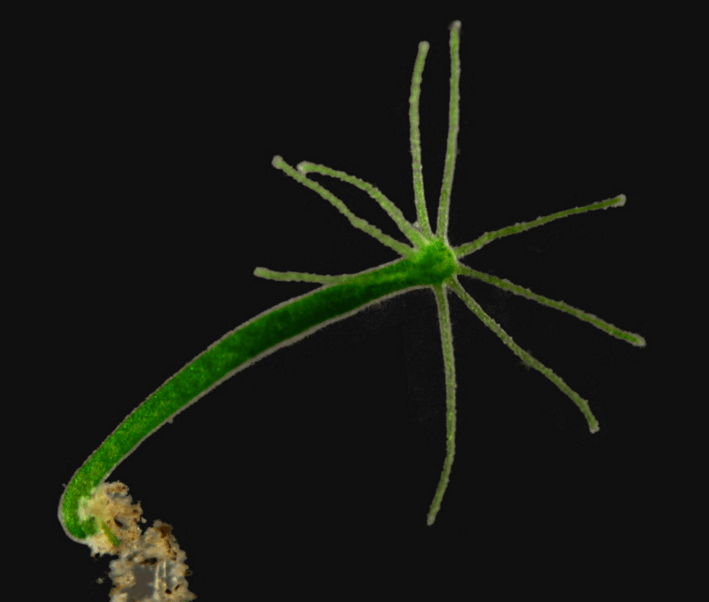
I have a digestive cavity with one opening, and have tentacles. I am a hydra.
a)
Echinoderm
b)
Cnidarian
c)
Arthropod
d)
Mollusk
4.
Which phylum is mainly asymmetrical?
a)
cnidaria
b)
porifera (sponges)
c)
echinodermata
d)
arthropoda
5.
Most animals have this type of symmetry?
a)
radial
b)
asymmetrical
c)
bilateral
d)
trilateral
6.
These organisms all have nematocysts.
a)
cnidaria
b)
mollusca
c)
arthropoda
d)
porifera
7.
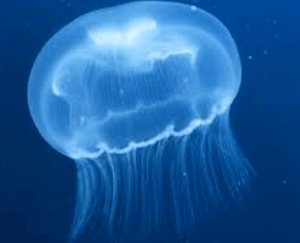
This form of cnidaria is known as a _______.
a)
polyp
b)
medusa
8.
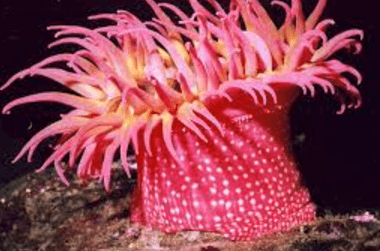
This form of cnidaria is known as a __________.
a)
medusa
b)
polyp
9.
What filters food and eliminates waste from the water it lives in?
a)
sponge
b)
segmented worm
c)
arthropod
d)
mollusk
10.
Sponges use pores to
a)
move from place to place.
b)
filter food from the water.
c)
defend themselves.
11.
Cnidarians have what kind of symmetry?
a)
Radial
b)
Bilateral
c)
Asymmetrical
12.

Which type of symmetry is shown
a)
Bilateral
b)
Radial
c)
Asymmetrical
d)
No symmetry
13.

What type of symmetry is shown
a)
Bilateral
b)
Radial
c)
Asymmetry
d)
No symmetry
14.
Animals are
a)all unicellular
b)all multicellular
c)
mostly unicellular
d)mostly multicellular
15.
Animals whose body parts are arranged in a circle around a center point have
a)radial symmetry
b)spherical symmetry
c)asymmetry
d)bilateral symmetry
16.
Cnidarians use _______ to sting their prey.
a)
red blood cells
b)
cysts
c)
nematocysts
d)
setae
17.
Which part of the sponge body is a large opening at the top of the central cavity through which water leaves the sponge?
a)
Ostia
b)
Meenchyme
c)
Spongecoel
d)
Osculum
18.
humans have
a)
radial symmetry
b)
bilateral symmetry
c)
no symmetry
19.
sponges have
a)
radial symmetry
b)
bilateral symmetry
c)
no symmetry
20.
sea anemones have
a)
radial symmetry
b)
bilateral symmetry
c)
no symmetry
21.
Polyps and Medusa are
a)
cnidarians
b)
sponges
c)
platyhelminthes
d)
roundworms
22.
Budding is a form of _________.
a)
sexual reproduction.
b)
asexual reproduction.
23.

What is the translation of the Phylum Porifera?
a)
Stinging cells
b)
Filter feeders
c)
Soft bodied
d)
Pore bearing
24.

Specialized feeding cells of a sponge
a)
Gonads
b)
Nematocysts
c)
Spongin
d)
Choanocytes
25.

Hard fibers that provide a sponge structural support
a)
Spicules
b)
Bones
c)
Cartilage
d)
Ossicles
26.

Attached to one spot their entire adult life is referred to as
a)
Stuck
b)
Medusa
c)
Bipinnaria
d)
Sessile
27.

Sponges are:
a)
Unicellular & prokaryotic
b)
Multicellular & eukaryotic
c)
Unicellular & eukaryotic
d)
Multicellular & prokaryotic
28.

Sponges have this type of symmetry
a)
Unilateral
b)
Bilateral
c)
Radial
d)
Asymmetric
29.

The immature stage of an organism
a)
Larva
b)
Nekton
c)
Benthic
d)
Sessile
30.

Stinging cells of a Cnidarian are called:
a)
Collar cells
b)
Choanocytes
c)
Cnidocytes
d)
Gonads
31.

Anemones and Corals are in which kingdom?
a)
Protista
b)
Cubozoa
c)
Animalia
d)
Cnidaria
32.

When damage occurs to the reef, coral polyps die or expel their algal cells, causing the colony to take on a stark white appearance
a)
Pollution
b)
Acidification
c)
Bleaching
d)
Drying
33.
What is the outer most layer of Porifera?
a)
epidermis
b)
gastrodermis
c)
endodermis
d)
mesoglea
34.
The elastic fibrous protein found in sponges is called .....
a)
mesohyl
b)
spicules
c)
spongin
d)
tissue
35.
What are the organelles inside the stinging cells that inject paralyzing toxins into their prey?
a)
pinacocytes
b)
lysomatocyts
c)
choanocytes
d)
nematocysts
36.
Many cnidarians feature 2 body forms, the asexual ____________, and the sexual _____________.
a)
blastula, planula
b)
medusa, polyp
c)
planula, blastula
d)
polyp, medusa
37.
Sponges belong in which phylum?
a)
Cnidaria
b)
Porifera
c)
Chordata
d)
Arthropoda
38.
Anemones belong to which phylum?
a)
Cnidaria
b)
Porifera
c)
Echinodermata
d)
Platyhelminthes
100 %

