wayground logo

Free Printable Worksheets

NEW

Font size

S
M
L
XL
Worksheets

Unit 3: Ecology Benchmark Review

Total questions: 40

Worksheet time: 18mins

Name
Class
Date
1.
This biome has the most diverse species of plants and animals.
a)
desert
b)
tropical rainforest
c)
savanna
d)
tundra
2.
Which two biomes have the least precipitation?
a)
tropical rain forest and temperate grasslan
b)
savanna and tropical dry forest
c)
tundra and desert
d)
boreal forest and temperate woodland
3.
Which biome has dense evergreen (pine) forests?
a)
taiga (boreal forest)
b)
tundra
c)
desert
d)
savanna
4.

Which would have barnacles, seaweed, and starfish in tide pools?

a)

nertic zone

b)

intertidal ocean

c)

oceanic zone

d)

benthic zone

5.
Estuary water should have 
a)
less salt than the ocean
b)
more salt than the ocean
c)
no salt
6.
Estuaries form where 
a)
a lake evaporates
b)
a river meets the sea
c)
a river becomes dammed
d)
a wetland becomes filled in
7.
Which is NOT a freshwater wetland?
a)
estuary
b)
marsh
c)
bog
d)
swamp
8.
An ecosystem where water covers the soil or water is near the surface of the soil is called
a)
a desert
b)
an ocean
c)
an estuary
d)
a wetland
9.
Which factor(s) affect aquatic ecosystems?
a)
depth
b)
flow
c)
nutrients
d)
all affect aquatic ecosystems
10.

The benthic zone is

a)

the ocean's dark sea floor where photosynthesis cannot occur

b)

the sunlit upper layer of the ocean where photosynthesis occurs

c)

on the bottom of lakes, streams, and oceans.

d)

where benthos are found

11.
A wetland that contains a mixture of fresh water and salt water is called
a)
an estuary
b)
a stream
c)
a river
d)
a pond
12.
The sum of all the Earth's ecosystems is called
a)
Community
b)
Ecosystem
c)
Biosphere
d)
Biome
13.
What is the name for a community or species and its non-living environment
a)
Community
b)
Ecosystem
c)
Biosphere
d)
Biome
14.

What is the name for an area with a particular climate and unique types of plants?

a)

Community

b)

Ecosystem

c)

Biosphere

d)

Biome

15.
Terrestrial means
a)
Can fly
b)
Relating to water
c)
Relating to space
d)
relating to land
16.
Aquatic means
a)
Relating to water
b)
Relating to oceans
c)
Relating to fresh water
d)
Does not include rivers
17.
The term abiotic means;-
a)
Not a robot or robotic
b)
Living Things
c)
Water based environments
d)
Non-living things
18.
The term biotic means;-
a)
Not a robot or robotic
b)
Living Things
c)
Water based environments
d)
Non-living things
19.

Producers are ...

a)

plants

b)

able to do photosynthesis

c)

also called autotrophs

d)

all of these are true

20.

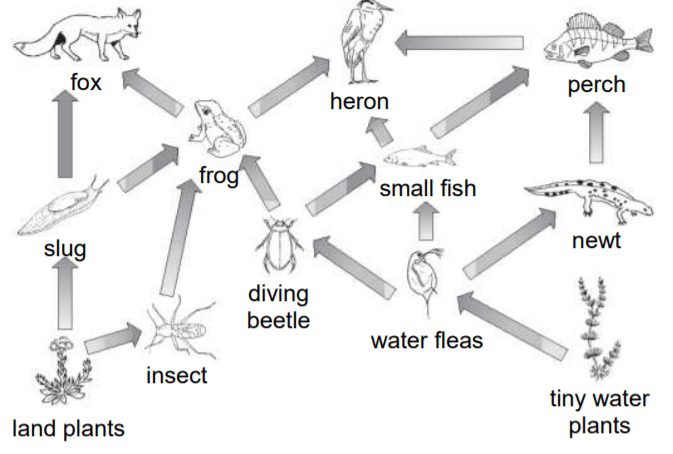
Arrows in a food web represent...

a)

eating

b)

sunlight

c)

flow of energy

d)

matter

21.

All of these are types of consumers except...

a)

omnivores

b)

carnivores

c)

producers

d)

herbivores

22.
a)

This is a food chain

b)

This is a food web

c)

This is an energy pyramid

23.

The original source of energy for a food web is...

a)

plants

b)

sun

c)

producers

d)

decomposers

24.

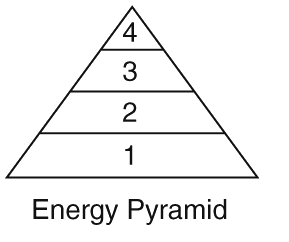
Level 1 on the pyramid

a)

Producers

b)

Primary Consumer

c)

Secondary Consumer

d)

Tertiary Consumer

25.

Level 3 on the pyramid

a)

Producers

b)

Primary Consumer

c)

Secondary Consumer

d)

Tertiary Consumer

26.

Which section of the pyramid has the most energy?

a)

1

b)

2

c)

3

d)

4

27.

Which section of the pyramid has the least energy?

a)

1

b)

2

c)

3

d)

4

28.

How much energy moves up each level of the energy pyramid?

a)

5%

b)

10%

c)

50%

d)

90%

29.
A feeding relationship where one organism hunts and one is hunted.
a)
Commensalism
b)
Decomposistion
c)
Mutualism
d)
Predator-Prey
30.
An organism that helps to recycle nutrients within an ecosystem by eating dead or decaying organisms is a:
a)
Predator
b)
Autotroph
c)
Producer
d)
Decomposer
31.
A relationship that describe a close interaction between two different species is known as what?
a)
Biodiversity
b)
Symbiosis
c)
Predation
d)
Emigration
32.
This is known as a relationship in which one organism benefits, while the other is unaffected.
a)
Parasitism
b)
Mutualism
c)
Immigration
d)
Commensalism
33.
A clownfish uses a sea anenome as a safe place to live. While living there, the clownfish lures in food for the anenome. This is an example of what type of relationship?
a)
Predator-Prey
b)
Commensalism
c)
Mutualism
d)
Parasitism
34.
This is known as a relationship in which both organisms involved benefit. 
a)
Predator-Prey
b)
Commensalism
c)
Mutualism
d)
Decomposition
35.
A feeder fish usually follows behind sharks to pick up food scraps that they leave behind. The fish gets food and the shark is unaffected. This is an example of:
a)
Mutualism
b)
Commensalism
c)
Parasitism
d)
Decomposition
36.
A relationship between two organisms where one benefits while the other is harmed is known as what?
a)
Decomposition
b)
Consummerism
c)
Mutualism
d)
Parasitism
37.
This term describes a living part of an environment.
a)
Biotic factor
b)
Sunlight
c)
Abiotic Factor
d)
Niche
38.
An organism that eats other organisms to obtain energy is known as a:
a)
Mutualist
b)
Autotroph
c)
Producer
d)
Heterotroph
39.
This term refers to the total number of organisms that a particular habitat can support.
a)
Population
b)
Carrying capacity
c)
Ecosystem
d)
Niche
40.
This is the study of interactions between organisms and the interactions that organisms have with their environment. 
a)
Evolution
b)
Biology
c)
Ecology
d)
Commensalism