wayground logo

Free Printable Worksheets

NEW

Font size

S
M
L
XL
Worksheets

Atomic Structure: Atoms, Isotopes & Ions

Total questions: 50

Worksheet time: 40mins

Name
Class
Date
1.

The negatively charged subatomic particles that are located in energy levels around the nucleus

a)

Protons

b)

Neutrons

c)

Electrons

d)

Ions

2.

The negatively charged subatomic particles that are located in energy levels around the nucleus

a)

Protons

b)

Neutrons

c)

Electrons

d)

Ions

3.

Positively charged subatomic particles located in the nucleus of an atom

a)

protons

b)

neutrons

c)

electrons

d)

ions

4.
all matter is made of what 
a)
energy 
b)
atoms 
c)
electrons 
d)
compounds 
5.
The positive particles of an atom are 
a)
electrons 
b)
positrons 
c)
neutrons 
d)
protons 
6.
the central region of an atom where its neutrons and protons are is its 
a)
nucleus 
b)
electron cloud
c)
core 
d)
center 
7.
an atom with atomic number 6 would have how many protons 
a)
6
b)
12
c)
3
d)
cannot be determined 
8.
Particles in an atom that are neutral and have no charge are 
a)
negatrons 
b)
electrons 
c)
neutrons 
d)
protons 
9.
A particle that moves around the nucleus is a(n)...
a)
Proton
b)
Neutron
c)
Electron
d)
Quark
10.

What does the 1.00794 stand for?

a)

mass number

b)

atomic number

c)

average atomic mass

d)

number of protons

11.
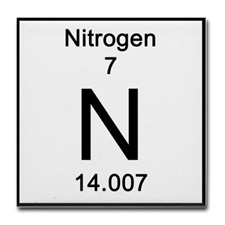
What is the number of protons that the element in this image contain?
a)
14
b)
7
c)
15
d)
18
12.
What is the number of protons that the element in this image contain?
a)
14
b)
7
c)
15
d)
18
13.

If an atom has 12 protons, which of the following must it also have to be considered a neutral atom?

a)

12 neutrons

b)

12 electrons

c)

12 protons

d)

24 protons and neutrons

14.
If an atom has 10 protons, 10 neutrons, and 10 electrons, what is the mass of the atom?
a)
10
b)
20
c)
30
15.

What charge does an atom have when it GAINS electrons?

a)

Positive

b)

Negative

c)

Neutral

16.

What two particles determine the mass number?

a)

Protons and electrons

b)

Electrons and neutrons

c)

Protons and neutrons

17.

What two particles determine the mass number?

a)

Protons and electrons

b)

Electrons and neutrons

c)

Protons and neutrons

18.

What two particles determine the mass number?

a)

Protons and electrons

b)

Electrons and neutrons

c)

Protons and neutrons

19.

When an atom loses an electron, it becomes a(n) _____________ ion.

a)

positive

b)

negative

c)

neutral

d)

polyatomic

20.

If the mass number of this chlorine atom is 36, how many neutrons does it have?

a)

17

b)

18

c)

19

d)

can't be determined

21.

What is the atomic number of this atom shown in the Bohr model?

a)

11

b)

12

c)

13

d)

can't be determined

22.

What is the mass number of the atom shown in the Bohr model?

a)

11

b)

12

c)

23

d)

Can't be determined

23.

Is this atom an ion? If so what would it's charge be?

a)

Yes, 1-

b)

No it is neutral

c)

Yes, 1+

d)

Can't be determined

24.

Most of the mass of an atom is found in the ______.

a)

nucleus

b)

proton

c)

electron cloud

d)

isotope

25.
An atom with an unequal number of protons and electrons is said to have (a) ___.
a)
no charge
b)
balance
c)
charge
d)
unbalance
26.
Two atoms of the same element but with different mass numbers are called________
a)
electrons
b)
isotopes
c)
variables
d)
electron cloud
27.
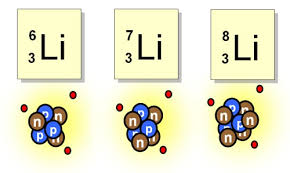
How many neutrons does the isotope of lithium have?
a)
8
b)
3
c)
4
d)
5
28.
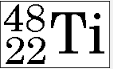
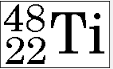
How many protons does this isotope of titanium have?
a)
48
b)
22
c)
26
d)
70
29.
How many protons does this isotope of titanium have?
a)
48
b)
22
c)
26
d)
70
30.
How many neutrons in C-14?
a)
6
b)
7
c)
14
d)
8
31.
How many neutrons does the isotope below have?     89 36Kr
a)
53
b)
36
c)
89
d)
125
32.
How many neutrons does an atom of the isotope Neon-22 have?
a)
12
b)
10
c)
22
d)
20
33.

Isotopes of an element have a different number of...

a)

Protons

b)

Neutrons

c)

Electrons

d)

Mass

34.

Potassium-39 has how many neutrons?

a)

19

b)

18

c)

20

d)

21

35.

Nickel-59 has how many neutrons?

a)

30

b)

31

c)

32

d)

33

36.

Bromine-80 has how many neutrons?

a)

41

b)

42

c)

44

d)

45

37.

12 protons and 13 neutrons

a)

Mg-12

b)

Mg-13

c)

Mg-25

d)

Mg-24.305

38.
What is the charge on a lithium atom that looses 1 electron?
a)
+1
b)
0
c)
-1
d)
-2
39.
Is the element shown in this image an ion, isotope or normal atom?
a)
atom
b)
isotope
c)
cation (+ ion)
d)
anion (- ion)
40.
Helium (He atomic number 2) has 2 protons, 2 neutrons, and 2 electrons) is the He element shown above an atom, an element, or an isotope?
a)
atom
b)
cation  (+ ion)
c)
isotope
d)
anion (-)
41.
The atomic mass is equal to _.
a)
the number of protons only
b)
the number of neutrons only
c)
the total number of protons and neutrons
d)
the number of protons, neutrons, and electrons.
42.
What is the net charge on the element shown above? 
(Calcium - atomic number 20)
a)
cation +1 charge
b)
cation +2 charge
c)
anion -1 charge
d)
anion -2 charge
43.
How many protons does this isotope of titanium have? Hint titanium has an atomic number of 22.
a)
48
b)
22
c)
26
d)
70
44.
What element is this?  What is the mass number of this atom?
a)
sodium, 23
b)
magnesium, 23
c)
magnesium, 12
d)
sodium, 11
45.
Which atom has  4 neutrons?
a)
Li-6
b)
Li-7
c)
Li-8
d)
they have the same # of neutrons
46.
What is the atomic number of Fe? (click to see image)
a)
26
b)
55.845
c)
56
d)
None of these
47.
How many neutrons does B (Boron) contain?
a)
5
b)
11
c)
6
d)
10.811
48.
Carbon has an atomic number of 6 and an atomic mass of 12. Which elements are considered isotopes of carbon?
a)
Carbon-12
b)
Carbon-13
c)
Carbon-14
d)
Both Carbon-13 and Carbon-14
49.
The image shows that Hydrogen can become an isotope by adding a(n)..
a)
electron
b)
proton
c)
nuetron
d)
any of the above answers
50.
How many neutrons does Lithium have (atomic mass = 6.94)
a)
3
b)
4
c)
6.94
d)
24.94