
 Worksheets
US Constitution
Total questions: 25
Worksheet time: 2hrs 38mins
Weaknesses in the Articles of Confederation:
No power to enforce laws
No executive branch
No judicial branch
How did these weaknesses impact the writing of the Constitution?
The Founding Fathers gave Congress the power to legislate.
The Founding Fathers created a government with three branches.
The Founding Fathers gave the states the power to interpret national laws?
The Founding Fathers created the office of president to settle disputes.

Congress can raise an army.
Congress has the power to tax.
The President has the power to tax.
The Supreme Court has the power of judicial review.

Weakness of the Articles of Confederation
Problems of the U.S. Constitution
Federalist argument for a weak central government
A colonial legislature

What was the main weakness of the Articles of Confederation?
the federal government was too weak
It had no legislative branch
The judicial was too powerful
The executive was too powerful
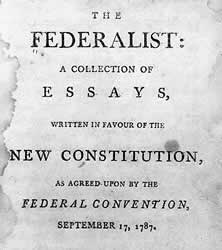
The "Federalist Papers" were written to:
Explain and convince the people into supporting the new U.S Constitution.
spark a new revolution among the American people against their government.
oppose a strong centralized government.
create a new monarchy.
Anti-Federalists were in favor of:
States Rights and the protection of individual rights.
A strong Central Government.
A Monarchy (King & Queen) to rule over the country.
a powerful National Government

Wanted to strengthen the authority of the Federal government.
Federalist
Ant-Federalist
Which of the provisions below allows the US Constitution to change over time?
Amendment Process
Federal Systeming
Electoral College
Separation of Powers
Based on the US Constitution, the government is run by _________.
The President
Congress
The Supreme Court
"The People"
The promise from the Preamble that mentions the idea of fairness is ___.
promote the general welfare
insure domestic tranquility
establish justice
provide for the common defense
The promise from the Preamble that describes peace in our country is ___.
establish justice
provide for the common defense
promote the general welfare
insure domestic tranquility
Which of these excerpts from the United States Constitution best reflects the principle of checks and balances?
“This Constitution, and the Laws of the United States . . . shall be the supreme Law of the Land. . . .”
“The [listing] in the Constitution, of certain rights, shall not be [interpreted] to deny . . . others retained by the people.”
“All persons born or naturalized in the United States . . . are citizens of the United States and of the State wherein they reside.”
“Every Bill which shall have passed [Congress] shall, before it becomes a Law, be presented to the President of the United States.”
Read the following excerpt and answer the question below.
"We the People of the United States, in Order to form a more perfect Union, establish Justice, insure . . . peace, provide for the common defense, promote the general Welfare, and secure the Blessings of Liberty to ourselves and [future generations], do [call for] and establish this Constitution for the United States of America."
Based on the excerpt, what was the main reason that the Founding Fathers wrote the Constitution?
They wanted to reduce the power of the states.
They wanted to improve the alliance of the states.
They wanted to establish new courts for the states
They wanted to resolve important differences among the states
The most difficult question facing the delegates at the Constitutional Convention was.....
how strong the national government should be
how to count the population of the United States
how to divide the newly acquired western lands
how to pay off the revolutionary war debt

An agreement that Congress should be composed of a Senate, with States represented equally, and a House, with representation based on a State’s population...
Commerce and Slave Trade Compromise
Great Compromise
New Jersey Plan
Virginia Plan
Why is Popular Sovereignty important?
The rights and liberties of the citizens are not fully protected by national standards in the social contract
It gives woman the right to vote
It shows people how they vote and why they vote for congress
Our rights have the right to vote and choose the person we want running our country

