Wayground logo

Free Printable Worksheets

Font size

S
M
L
XL
Worksheets

Sun-Earth-Moon

Total questions: 40

Worksheet time: 20mins

Name
Class
Date
1.
Among the Earth, Sun, and Moon, what makes the Earth unique? Only the Earth –
a)
can generate energy
b)
lacks an atmosphere
c)
is made mostly of rock
d)
contains water in liquid form
2.
What characteristic do the Earth and Moon share that makes them different from the Sun?
a)
Spherical shape
b)
Rotate on an axis
c)
Rocky crust and surface
d)
Found in our Solar System
3.
Of the Earth, Sun, and Moon, which ones orbit another object?
a)
the Sun and the Earth
b)
the Sun and the Moon
c)
the Moon and the Sun
d)
the Moon and the Earth
4.
The moon’s surface has many more craters than the Earth’s. What best explains the difference in the number of craters on the surface of the Moon and the Earth?
a)
The Moon rarely gets impacted by meteorites.
b)
The Earth’s atmosphere protects it from impacts.
c)
The Moon’s gravity attracts more meteorites than Earth's.
d)
The Earth rotates on its axis more quickly than the Moon.
5.

The earth's rotation lasts for _______.

a)

24 hours

b)

24 days

c)

365 days

d)

365 hours

6.
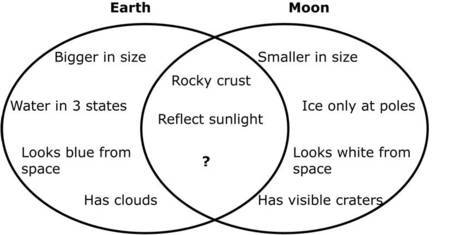
A student created a diagram to compare the characteristics of the Earth and the Moon.
Which of the following characteristics could be placed in the center part of the diagram?
a)
orbits another object
b)
strong gravitational pull
c)
rotates every 24 hours
d)
has an atmosphere
7.
Which of the following is a characteristic of both the Earth and the Moon?
a)
Atmosphere containing oxygen
b)
Rocky surface covered with landforms
c)
Flowing water in oceans and rivers
d)
Fossils and fossil fuels under the surface
8.
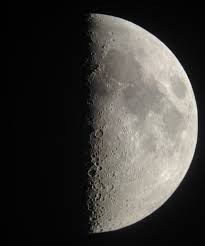
What moon phase came right BEFORE this one?
a)
First Quarter
b)
Last Quarter
c)
New Moon
d)
Full Moon
9.
Name the moon phase
a)
First Quarter
b)
Last Quarter
c)
New Moon
d)
Full Moon
10.

The Earth's ________ is an imaginary line that goes from the North Pole to the South Pole.

a)

equator

b)

axis

c)

prime meridian

d)

equinox

11.

The Earth's tilt is _______ degrees.

a)

0

b)

90

c)

23.5

d)

41

12.

The spinning of an object on its axis is called ________.

a)

orbit

b)

rotation

c)

revolution

d)

tide

13.

If the Earth rotated slower, how would that affect the length of the day?

a)

There would be a longer day.

b)

There would be a shorter day.

c)

It would be the same time, 24 hours.

d)

All of these could be the answer.

14.
What are the reasons for the seasons?
a)
Earth's tilt and rotation.
b)
Earth's rotation and revolution.
c)
Earth's tilt and revolution.
d)
Earth's tilt and resolution
15.
What would happen if the Earth's axis was tilted at a greater angle than it is now? 
a)
Days would be more than 24 hours.
b)
Days would be less than 24 hours.
c)
Hotter summers, colder winters
d)
More tilt would not make a difference.
16.
When the Northern Hemisphere of Earth is leaning away from the Sun, What season is the Southern Hemisphere experiencing?
a)
Summer
b)
Winter
c)
Spring
d)
Fall
17.
When the Northern Hemisphere is pointing towards the sun, what season is the Southern Hemisphere?
a)
Winter
b)
Spring
c)
Fall
d)
Summer
18.
Name this phase of the moon.
a)
waning crescent
b)
waxing crescent
c)
waning gibbous
d)
waxing gibbous
19.
If Earth revolved more slowly, what would happen?
a)
Years would be longer.
b)
Years would be shorter.
c)
Summer would be longer.
d)
Winter would be shorter.
20.
Which of the following causes the ocean’s tides?
a)
The Earth's spinning makes the oceans slosh like a bathtub.
b)
The Earth's gravity pulling on the moon.
c)
The Sun and Moons gravity pulling on the Earth.
d)
The Sun's gravity pulling on the moon.
21.

The star at the center of the Solar System that supplies heat and light to earth; its enormous gravity keeps the Solar System in orbit.

a)

satellite

b)

sun

c)

craters

d)

moon

22.

A natural force that causes two objects to pull toward each other because of their mass and the distance between them.

a)

gravity

b)

orbit

c)

atmosphere

d)

axis

23.

Bowl-shaped indents or cavities on the surface of a planet, moon, or asteroid that are caused by a collision with another object, such as a meteorite.

a)

gravity

b)

orbit

c)

craters

d)

axis

24.

The path one object takes as it revolves (moves) around another object.

a)

gravity

b)

orbit

c)

rotate

d)

axis

25.

A natural satellite that orbits a planet.

a)

sun

b)

atmosphere

c)

moon

d)

craters

26.

All of the air surrounding the Earth, protecting it from space objects and the sun's harmful rays.

a)

gravity

b)

atmosphere

c)

axis

d)

physical features

27.

To spin on an axis

a)

orbit

b)

rotate

c)

axis

d)

atmosphere

28.

A line, real or imaginary, around which something spins.

a)

orbit

b)

rotate

c)

gravity

d)

axis

29.

A specific region on Earth's surface always has its highest temperatures in June and its lowest temperatures in December. Which of these statements explains why the temperatures are lowest in December?

a)

The region is tilted the most toward the sun in December.

b)

The region in tilted the most away from the sun in December.

c)

The region is farthest from the sun in December.

d)

The region is closest to the sun in December.

30.
Suppose that a camera on Earth takes a picture of an astronomical event.  The picture shows an object that is large, dark, and has a bright area immediately around it.  Which event does this picture most likely show?
a)
Total lunar eclipse
b)
Waning gibbous moon
c)
Waxing crescent moon
d)
Total solar eclipse
31.
What moon phase is this?
a)
full moon
b)
new moon
c)
1st quarter 
d)
3rd quarter
32.
Which moon phases is this?
a)
waning crescent
b)
waning gibbous
c)
3rd quarter
d)
full moon
33.

Sunlight shines equally on the northern and southern hemisphere during _______ and _________.

a)

spring equinox, fall equinox

b)

spring equinox, summer solstice

c)

fall equinox, winter solstice

d)

summer solstice, winter solstice

34.
Earth is 3.5 million miles closer to the sun in December than in July.  What effect does this have on the Earth's temperature?
a)
This causes our summer
b)
This causes our winter
c)
It has no effect; Earth's tilted axis effects temperature.
d)
It causes Christmas :-)
35.
The moon travels around Earth at a speed of about 1 km/s.  Which of the following keeps the moon in orbit around Earth?
a)
gravity
b)
magnetism
c)
ocean tides
d)
the suns heat and light
36.

What does the rotation of Earth cause?

a)

temperature

b)

The seasons

c)

A year

d)

Day and Night

37.

When the Northern hemisphere is experiencing summer, the Southern hemisphere is experiencing

a)

winter

b)

spring

c)

summer

d)

fall

38.

Seasons are caused by

a)

Earth's tilted axis (23.5 degrees)

b)

Earth's distance from the sun

c)

Rotation on Earth's axis

d)

The months of the year

39.

Place the planets in the correct order.

a)

Mars, Venus, Earth,, Jupiter, Saturn,Mercury, Uranus, Neptune

b)

Venus,Mercury, Earth, Mars, Jupiter, Saturn, Uranus, Neptune

c)

Mercury, Venus, Earth, Mars, Jupiter, Saturn, Uranus, Neptune

d)

Mercury, Venus, Earth, Mars, Neptune, Saturn, Uranus, Jupiter

40.
Which of the following lists the Earth, Sun, and Moon in order of size, from largest to smallest?
a)
Earth, Sun, and Moon
b)
Earth, Moon, and Sun
c)
Sun, Earth, and Moon
d)
Sun, Moon, and Earth