wayground logo

Free Printable Worksheets

Font size

S
M
L
XL
Worksheets

Earth's Interior- Waves and Layers

Total questions: 72

Worksheet time: 46mins

Name
Class
Date
1.

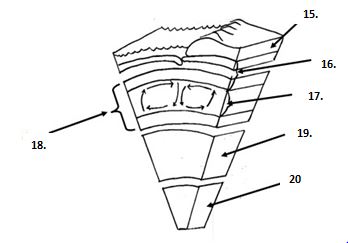
What is the name of layer R?

a)

lithosphere

b)

inner core

c)

outer core

d)

asthenosphere

e)

mesosphere

2.

Which of the following apply to p-waves? (choose ALL that apply)

a)

compressional waves

b)

travel through solids, liquids, and gases

c)

only travel through solids

d)

fastest moving seismic waves

e)

shear waves

3.

What is the name of layer S?

a)

lithosphere

b)

inner core

c)

outer core

d)

asthenosphere

e)

mesosphere

4.

Where is heat and pressure the greatest in the Earth?

a)

crust

b)

mantle

c)

outer core

d)

inner core

5.

How have scientists been able to infer the internal structure of Earth without being able to directly observe inside the Earth?

a)

Scientists analyze how earthquake waves move throught Earth's interior.

b)

Scientists use satellite radar and sonar technologies to map Earth's internal layers.

c)

Scientists make educated guesses about Earth's internal structure based on previous hypothesis.

d)

Scientists study different types of rocks from many different locations on Earth's surface.

6.

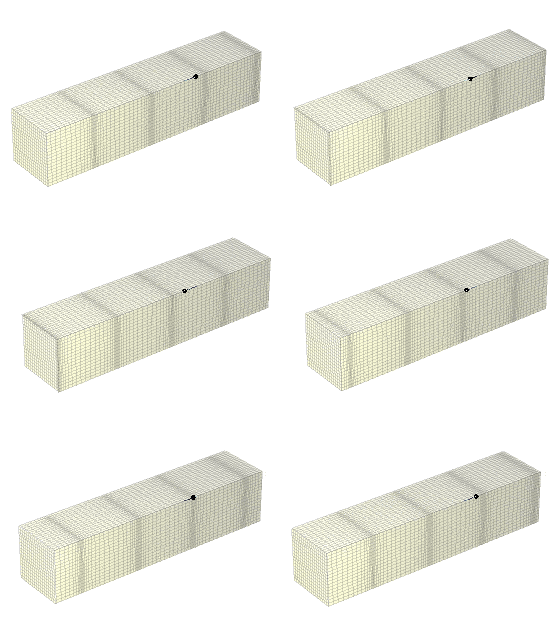
What kind of seismic wave is being modeled by the slinky?

a)

p-waves

b)

s-waves

7.

What kind of seismic wave is being modeled by the rope?

a)

p-waves

b)

s-waves

8.

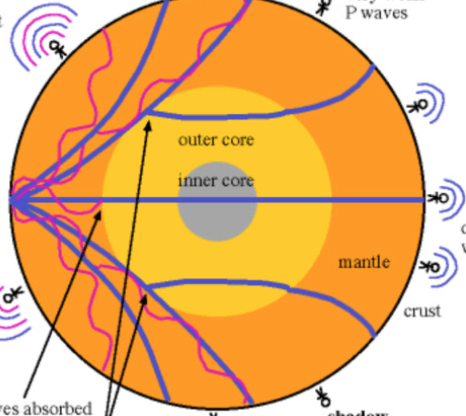
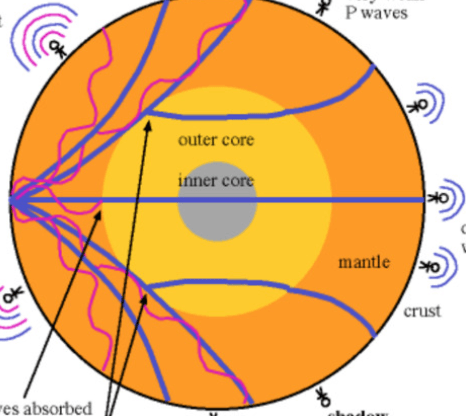
Which pathways given in the diagram would s-waves NOT be able to travel? (choose ALL that apply)

a)

pathway 1

b)

pathway 2

c)

pathway 3

d)

pathway 4

9.

Why don't any s-waves travel through Earth's core?

a)

the outer core is liquid and s-waves can't travel through liquids

b)

the outer core is solid, and s-waves can't travel through solids

c)

the outer core is metallic and s-waves can't travel through metals

d)

the outer core is very hot, and s-waves can't travel through hot materials

10.
Which layer is made up of iron and nickel?
a)
Crust
b)
Mantle
c)
Inner Core
d)
Lithosphere
11.
Which is the source extremely high temperatures in the Earth?
a)
Volcanoes
b)
Solar Radiation
c)
Earthquakes
d)
Heat created by the formation of the earth
12.
What is radioactive decay?
a)
Damaging rays from the sun
b)

A source of heat inside the Earth from Uranium breaking down

c)
Waves emitted from a radio
d)
The glue that holds the layers of the Earth together
13.

Seismic p-waves _____ when they go from a solid to a liquid.

a)
Slow down
b)
Speed up
c)
Remain the same
d)
Slow down and then speed up
14.
The speed of seismic waves _____ through materials that are MORE dense. 
a)
increase
b)
decrease
15.
How was the formation of the Earth similar to the formation of our solar system?
a)
The densest materials moved to the center.
b)
The densest materials moved to the outside.
c)
The densest materials moved to the middle layer.
d)
The densest materials were evenly distributed.
16.
S waves move through
a)
Solids only
b)
Liquids only
c)
Solids and liquids
d)
None of these
17.
What creates the magnetic field around the Earth?
a)
The Earth spinning on its axis
b)
The liquid outer core spinning around the solid inner core
c)
The solid outer core spinning around the liquid inner core
d)
Seismic waves
18.

Which layer of earth is molten (liquid metal)?

a)

inner core

b)

outer core

c)

crust

d)

lithosphere

19.
Which layer is plastic and has the consistency of silly putty allowing movement?
a)
asthenosphere
b)
lithosphere
c)
mesosphere
d)
crust
20.

Identify A

a)

Crust

b)

Mantle

c)

Outer Core

d)

Inner Core

21.

Identify B

a)

Crust

b)

Mantle

c)

Outer Core

d)

Inner Core

22.

What are TWO sources of heat in Earth’s core?

a)

The sun

b)

High Pressure

c)

Radioactive Decay

d)

Convection in the mantle

e)

Leftover heat from the Earth’s formation

23.
Which layer of the Earth is the thickest at about 1802 miles (2900 km) and makes up about 84% of Earth's total volume?
a)
crust
b)
mantle
c)
outer core
d)
inner core
24.
What is radioactive decay?
a)
Damaging rays from the sun
b)
A source of heat inside the Earth
c)
Waves emitted from a radio
d)
The glue that holds the layers of the Earth together
25.
The speed of seismic waves _____ through materials that are MORE dense. 
a)
increase
b)
decrease
26.
P waves move through____
a)
Solids only
b)
Liquids only
c)
Solids and Liquids
d)
None of these
27.
S waves move through
a)
Solids only
b)
Liquids only
c)
Solids and liquids
d)
None of these
28.
What creates the magnetic field around the Earth?
a)
The Earth spinning on its axis
b)
The liquid outer core spinning around the solid inner core
c)
The solid outer core spinning around the liquid inner core
d)
Seismic waves
29.

Which of the following increases as depth increases into the Earth? (choose all that apply)

a)

time

b)

Pressure

c)

temperature

d)

density

30.

Which materials density would match up with the Earths core

a)

Clay 1.8 g/ml

b)

aluminum 2.4 g/ml

c)

nickle 4.6 g/ml

d)

cotton 0.2 g/ml

31.

How do scientists know the Earth has layers?

a)

Drilling into the mantle

b)

Volcanoes

c)

Seismic waves data

d)

ocean waves

32.
These are the first waves released during an earthquake
a)
S waves
b)
Surface Waves
c)
P waves
33.
Which body wave is pictured?
a)
P-Wave
b)
S-Wave
c)
Rayleigh Wave
d)
Love Wave
34.
In the diagram of Planet A, what do we know about the layers by looking at the S waves?
a)
1 and 2 are both solids
b)
1 and 2 are both liquids
c)
1 is a solid and 2 is a liquid
d)
1 is a liquid and 2 is a solid
35.
What do we know about the material in each layer by looking at the S waves?
a)
Both layers are made of the same material
b)
Each layer is made of a different kind of material
36.
Temperature ____ as waves travel deeper into the earth.
a)
Increases
b)
Decreases
37.
Density ____ as waves travel deeper into the earth.
a)
Increases
b)
Decreases
38.
An instrument that detects and measures earthquakes is a 
a)
seismogram
b)
focus seismic map
c)
focus
d)
seismograph 
39.

Rank the seismic waves in order of appearance when an earthquake first occurs as measured by a seismograph.

a)

S waves, P waves, then surface waves

b)

P waves, S waves, then surface waves

c)

S and P waves at the same time, then surface waves

d)

Surface waves, then S and P waves at the same time

40.

What are the areas called that don't receive seismic data (p-waves, s-waves, or both) at the seismograph during an earthquake called?

a)

No Mans Land

b)

Dead Zone

c)

Epicenter

d)

Shadow Zone

41.

Identify Item #4

a)

P-wave (Primary wave)

b)

S-wave (Secondary wave)

c)

Body waves

d)

Surface waves

42.

Identify Item #3

a)

P-wave (Primary wave)

b)

S-wave (Secondary wave)

c)

Body waves

d)

Surface waves

43.
Which layer of Earth is characterized by rock that is plastic, or soft enough to flow?
a)
asthenosphere
b)
crust
c)
lithosphere
d)
inner core
44.
The solid, outer layer of the Earth that consists of the crust and the rigid upper part of the mantle
a)
Lithosphere
b)
Mesosphere
c)
Mantle
d)
Crust
45.
Temperature _____________________ as you go deeper into the earth.
a)
increases
b)
decreases
c)
goes up and down depending on the layer
d)
stays the same
46.
Pressure ______________________ as you go deeper into the Earth
a)
increases
b)
decreases 
c)
goes up or down depending on the layer
d)
stays the same
47.

The lithosphere combines what two layers?

a)

Athenosphere & Crust

b)

Crust & Upper Mantle

c)

Mantel & Asthenosphere

48.
Identify layer  #20.
a)
mantle
b)
asthenosphere
c)
inner core
d)
outer core
49.
The order of the earth’s compositional layers from most dense to least dense are
a)
Inner Core, Crust, Mantle and Outer Core
b)
Crust, Mantle, Outer Core and Inner Core
c)
Inner Core, Outer Core, Mantle and Crust
d)
Crust, Outer Core, Inner Core and Mantle.
50.
What observation can we make about Earth’s lithosphere AND asthenosphere?
a)
The asthenosphere floats on top of the lithosphere.
b)
The crust and the core make up the lithosphere.
c)
The crust and mantle make up the asthenosphere. 
d)
The lithosphere floats on top of the asthenosphere
51.
Scientists determine what Earth’s interior looks like by using:
a)
Volcanoes
b)
Seismic Waves
c)
Continental Drift
d)
Convection Currents
52.
Which earth layer is #2?
a)
Crust
b)
Mantle
c)
Outer core
d)
Inner core
53.
Which earth layer is #3?
a)
Crust
b)
Mantle
c)
Outer core
d)
Inner core
54.
Identify each layer - #17.
a)
Crust
b)
Mantle
c)
Lithosphere
d)
Asthenosphere
55.
S Waves can move through which of the following?
a)

Liquid

b)

Solid

c)

Both of these

56.
The green seismic body waves are...
a)
S Waves because they don't travel through the outer core
b)
P Waves because they don't travel through the outer core
c)
S Waves because they refract as they hit the outer core
d)
P Waves because they refract as they hit the outer core
57.

If an earthquake happened at F/E, which points would receive S-waves?

a)

G & U

b)

Y

c)

W

d)

U & Y

58.

If an earthquake happened at F/E, which point(s) would NOT receive P-waves?

a)

G

b)

Y

c)

W

d)

U

59.

If an earthquake happened at F/E, which point would not receive P-waves?

a)

G

b)

Y

c)

W

d)

U

60.

The green/blue region highlight in this model represents a

a)

P wave shadow zone

b)

S wave shadow zone

c)

Surface wave shadow zone

d)

Convection currents

61.

The pink lines are

a)

p waves

b)

s waves

c)

rayleigh waves

d)

love waves

62.

The blue lines are _______

a)

p waves

b)

s waves

c)

rayleigh waves

d)

love waves

63.

S waves do not travel through the liquid outer core and reach the side opposite the epicenter of an earthquake due to the fact that they are:

a)

absorbed

b)

refracted

c)

diffracted

64.
Which waves travel the deepest into the center of the Earth?
a)
p waves
b)
s waves
c)
surface waves
d)
p, s, and surface waves all travel to the center
65.
Scientists discovered changes in Earth's interior by studying _________________.
a)
tsunamis
b)
tides
c)
changes in seismic waves
d)
all of these
66.

USe the picture to answer your question. How long did it take for the p-wave to arrive to the city?

a)

0 minutes

b)

4 minutes

c)

8 minutes

d)

8:50 minutes

67.

Which shadow zone is larger?

a)

S wave shadow

b)

P waves shadow

c)

P and S shadow zones are equal in size

68.

Which waves will reach a seismic station first?

a)

P waves

b)

S waves

c)

Both reach at the same time

69.

What causes convection current in the Earth?

a)

The uneven heating on each layer inside the Earth.

b)

The crusts outer layer.

c)

The temperatures we feel outside.

70.
In convection, WARM air
a)
Rises
b)
Sinks
71.

What happens when particles are under cold water compared to hot?

a)

The particles move towards the hot and begin to rise

b)

The particles stay in place and do not move

c)

The particles begin to rise under the cold

72.

The plates of the crust move because...

a)

volcanoes erupt violently.

b)

of the weight of the oceans.

c)

of convection currents in the mantle.

d)

of the moon's gravity.