Wayground logo

Free Printable Worksheets

Font size

S
M
L
XL
Worksheets

Lesson 4.1-4.2 Review

Total questions: 40

Worksheet time: 2hrs 36mins

Name
Class
Date
1.

What is the driving energy source for the water cycle?

a)

the sun

b)

the earth

c)

wind

d)

the moon

2.
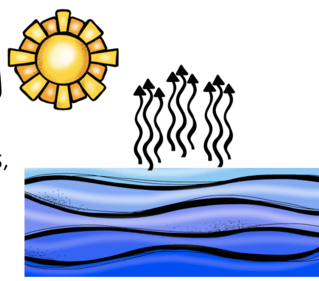
What is evaporation?
a)
The part of the water cycle when the sun heats up water, turning it from a liquid into water vapor or steam. It rises from the ground into the air.
b)
The part of the water cycle when the water vapor in the air gets cold. The water turns back into a liquid and forms clouds.
c)
The part of the water cycle when clouds get heavy and can no longer hold the liquid water. This causes the water to fall from the sky to the earth as rain, snow, sleet, or hail.
3.
What is condensation?
a)
The part of the water cycle when the sun heats up water, turning it from a liquid into water vapor or steam. It rises from the ground into the air.
b)
The part of the water cycle when the water vapor in the air gets cold. The water turns back into a liquid and forms clouds.
c)
The part of the water cycle when clouds get heavy and can no longer hold the liquid water. This causes the water to fall from the sky to the earth as rain, snow, sleet, or hail.
4.
What is precipitation?
a)
The part of the water cycle when the sun heats up water, turning it from a liquid into water vapor or steam. It rises from the ground into the air.
b)
The part of the water cycle when the water vapor in the air gets cold. The water turns back into a liquid and forms clouds.
c)
The part of the water cycle when clouds get heavy and can no longer hold the liquid water. This causes the water to fall from the sky to the earth as rain, snow, sleet, or hail.
5.
What is it called when plants give off water vapor as a waste product?
a)
condensation
b)
evaporation
c)
sublimation
d)
transpiration
6.
Which is the opposite of condensation?
a)
runoff
b)
evaporation
c)
precipitation
d)
transpiration
7.
Which best explains why runoff is important?
a)
It returns water to other locations on Earth
b)
It increases the chance of flooding
c)
It makes evaporation occur faster
d)
It increases condensation
8.

What puts nitrogen back into the atmosphere?

a)

Decomposition

b)

Photosynthesis

c)

Eutrophication

d)

None of the above

9.

What converts nitrogen into nitrates that organisms can use

a)

Thunder

b)

Rain

c)

Lightning

d)

Sunlight

10.

How do plants get the nitrogen they need?

a)

from the air

b)

from the soil in which they live

c)

from the Sun

d)

from broken-down rocks

11.

Which of the following describes the role of bacteria in the nitrogen cycle? Nitrogen-fixing bacteria convert ...

a)

protein into gas

b)

water into gas

c)

nitrogen gas into nitrogen that can be used by plants

d)

soil to gas

12.

Animals obtain the nitrogen they need directly from the...

a)

soil in their habitat

b)

air they breathe

c)

plants they eat

d)

bacteria living within them

13.

What converts nitrogen into a usable form of nitrogen for plants and animals?

a)

bacteria

b)

fungi

c)

rain

14.

After plants and animals die, what puts nitrogen back into atmosphere and soil?

a)

decomposition

b)

precipitation

c)

condensation

d)

bacteria

15.
Plants and animals need nitrogen to make __________.
a)
Protein
b)
Carbohydrates
c)
Lipids
d)
Minerals
16.

What organism breaks down dead plants & animals and release nitrogen back into atmosphere?

a)

bacteria

b)

plants

c)

animals

d)

producers

17.

True or False. The nitrogen in the atmosphere is in the right form for living things to use.

a)

True

b)

False

18.

This can transform nitrogen in the atmosphere into a usable form of nitrogen

a)

rain

b)

ice

c)

lightning

d)

sun

19.

What do nitrates drastically increase in bodies of water?

a)

Algae and Phytoplankton

b)

Oxygen

c)

Carbon

d)

Water

20.
Nitrogen is the most plentiful gas in the atmosphere.
a)
True
b)
False
21.
What is water that flows in rivers and streams into the oceans and lakes?
a)
evaporating
b)
condensing
c)
precipitating
d)
runoff
22.
Where is most water found on Earth?
a)
glaciers
b)
lakes
c)
rivers
d)
oceans
23.
What source of energy evaporates the most water from Earth’s surface?
a)
volcanoes
b)
the sun
c)
lightning
d)
wind
24.
Evaporation happens when the sun ___________ water and turns it into vapor.
a)
cools
b)
heats up
c)
freezes
d)
lights up
25.
Does warm water evaporate quicker than cold water?
a)
Yes
b)
No
26.
When water _________, dew forms.
a)
Melts
b)
Evaporates
c)
Condenses
d)
Precipitates
27.

What is the water division of Earth?

a)

ocean water 97.5%; freshwater frozen as ice 1.5%; and freshwater 1%

b)

ocean water 47%; freshwater 50%; freshwater frozen as ice 3%

c)

ocean water 1%; freshwater frozen as ice-90%; freshwater 9%

d)

freshwater 33.33%; freshwater frozen as ice 33.33%; ocean water 33.33%

28.

What converts nitrogen gas into a usable form for plants and animals?

a)

bacteria

b)

rain

c)

fungi

d)

car exhaust

29.

The process in which nitrogen circulates and is recycled is called

a)

The nitrogen cycle

b)

The carbon cycle

c)

The water cycle

d)

The phosphorus cycle

30.

Organisms that need nitrogen to survive.

a)

only plants

b)

only animals

c)

only bacteria

d)

all living things

31.

How is nitrogen "fixed" into a usable form for plants?

a)

Through action of bacteria only

b)

Through lightning only

c)

Through action of bacteria and lightning

d)

Through photosynthesis

32.

Gas that makes up 78% of our atmosphere.

a)

Oxygen

b)

Nitrogen

c)

Hydrogen

d)

Carbon Dioxide

33.

What is the process of combining nitrogen gas with other elements to make nitrogen into usable compounds?

a)

nitrogen composition

b)

nitrogen fixation

c)

ammonia

d)

denitrification

34.

What is the formula for atmospheric nitrogen?

a)

N

b)

N2

c)

NH3

d)

NO3

35.

Plants and animals cannot use nitrogen directly from the air.

a)

True

b)

False

36.

Bacteria fix nitrogen from the atmosphere into a form plants can use.

a)

True

b)

False

37.

What do free living bacteria in the soil do?

a)

Make clouds

b)

Turn atmospheric nitrogen into nitrates

c)

Make carbon dioxide for plants to go through photosynthesis

d)

Help plants take in water

38.

All plants have nitrogen fixing bacteria in their roots.

a)

True

b)

False

39.

What is another name or synonym for the water cycle?

a)

Geologic cycle

b)

Hydrologic cycle

c)

Geosphere

d)

Carbon cycle

40.

What are formed when water vapor condenses?

a)

Clouds

b)

Mountains

c)

Transpiration

d)

Valleys