
 Worksheets
Plate Boundaries and Features
Total questions: 38
Worksheet time: 45mins
Mountains form when a continental plate and an oceanic plate MOVE AWAY from each other.
True
False
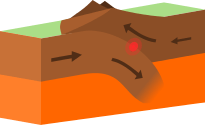
What would you be most likely to find at a CONVERGENT boundary between LAND (continental crust) and OCEAN (oceanic crust)?
Non volcanic Mountains
Volcanoes on land (in an arc)
Mid-Ocean Ridge
Rift
Volcanoes in the ocean (island arc)
What would be at a DIVERGENT boundary in an OCEAN?
Rift
Mid-Ocean Ridge
Island Arc
Flat land
What would be at a CONVERGENT boundary as two LANDS (continental plates) move into each other?
Continental Volcano
Non Volcanic Mountains
Rift
Volcanic Island Arc
Subduction happens where?
When one plate SINKs or GOES UNDER the other
Divergent Plate Boundaries
Transform Plate Boundaries
ALL Convergent Plate Boundaries
This boundary moves away from another boundary. They don't slide against each other.
divergent
convergent
transform
Earthquakes typically occur where?
At convergent plate boundaries
At transform plate boundaries
At divergent plate boundaries
ALL plate boundaries

Plate movement is caused by what?
the rotation of the Earth
ocean tides
Convection in the mantle
the moon's gravity
A boundary where two plates collide into each other.
Convergent boundary
Divergent boundary
Transform boundary
All plate boundaries
A boundary where two plates slide past each other horizontally, not into or away from each other, is what?
Divergent boundary
Convergent boundary
transform boundary
Any plate boundary can do this
Which type of plate boundary would cause tall and steep mountains to form?
Transform
Convergent
Divergent
Any plate boundary can do this
What are the two types of crust?
Continental and Oceanic
Ocean and Lithoscopic
Sedimentary and Igneous
Metamorphic and Igneous

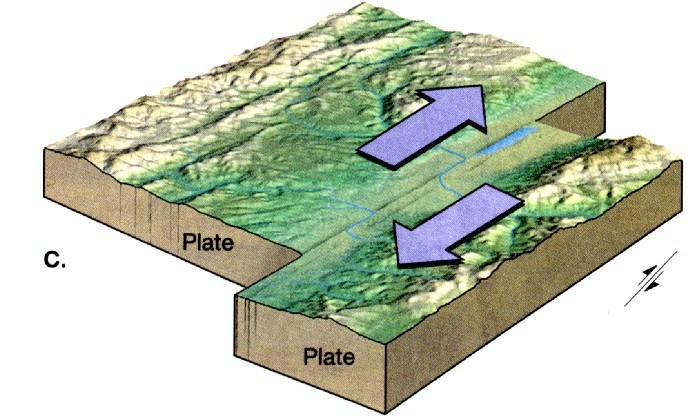
This is an image of what? It is in Southern California.
Convergent boundary
Transform boundary
Divergent boundary

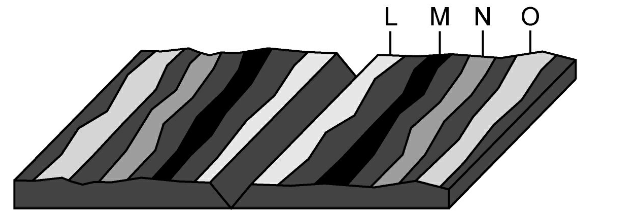
Where would the oldest rock be found?
L
M
N
O

The movement of the tectonic plates is caused by
the rotation of the Earth.
convection currents in the Asthenosphere
the gravity of the iron-nickel core.
the Moho discontinuity.
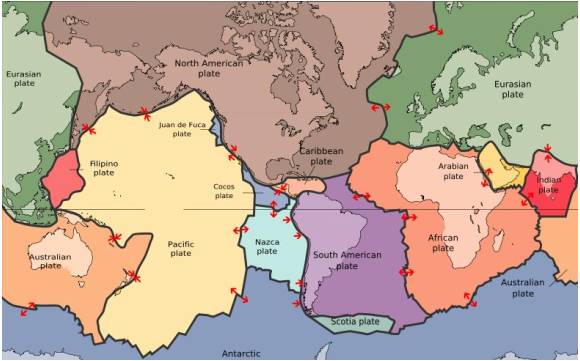
The map in the picture shows tectonic plate boundaries. This map would be useful in predicting the location of future
droughts
hurricanes
earthquakes
tornadoes
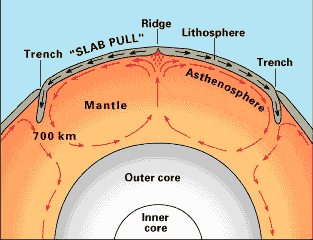
What causes plate movement?
the subducton of the sea floor
the different densities of the oceanic and crustal plates
convection currents in the asthenosphere
the friction force between the plates that move past each other
What is the difference between the inner and outer core of the Earth?
Inner core is hotter and is solid
Inner core is hotter and is melted
Outer core is hotter and is solid
Outer core is cooler and solid
What is the same as the Lithosphere, roughly?
Mantle
Crust
Inner core
Outer core
Who came up with the idea of continental drift?
James Hutton
James Madison
Alfred Wegener
Howard Hess
Obama
Which of these did the founder of continental drift not consider as an underpinning of his ideas?
Fit of the contintents
Fossil records in different parts of the world
Earth's tilt in the Solar System
Landforms, like mountains.
All of these were considered
Which of these is actually an extension of the Appalachia mountains of the eastern USA?
Parts of the United Kingdom
Florida, but not the everglades or Disney World
Northern Africa
Cuba
What is true, considering plates and rock types?
Oceanic crust is Granite
Continental crust is Basalt
Crust can be made of any kind of rock
Ocean crust is basalt, and Continental crust is granite.
About how fast do plates move about?
About 1 mm per year
About 3 cm per year
About 30 cm per year
About 100 cm per year
About 1 mile per hour
You are standing atop a volcanic mountain, which is part of a continental volcanic arc. Of what can you be sure?
You are on a hot spot
There is a continent vx. continent subduction zone nearby
An ocean crust is subducting about 100 or 200 miles away
You are on a transform boundary
Where is the Earth getting larger?
Transform boundary
Divergent boundary
Convergent boundary
Genesis boundary
What proves CONTINENTAL DRIFT?
Continental Drift
Plate Tectonics
Seafloor Spreading
Magnetic Reversals of Magma
What part of the USA is geologically active?
New York, Albany
Florida, near the pan handle
West Coast, Northern area near Oregon/Washington
Southern border, near the Texas/Florida connection
What proves SEA FLOOR SPREADING?
Continental Drift
Plate Tectonics
Seafloor Spreading
Magnetic Reversals of Magma

