
 Worksheets
plate tectonics and boundaries
Total questions: 40
Worksheet time: 1hrs 8mins
The movement of the tectonic plates is caused by
the rotation of the Earth.
convection currents in the Asthenosphere
the gravity of the iron-nickel core.
the Moho discontinuity.
There are three types of plate boundaries. Which choice is NOT a type of plate boundary?
convergent
insurgent
divergent
transform
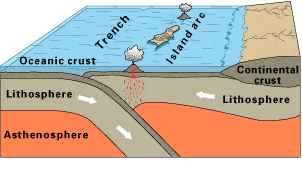
Observe this diagram of a plate boundary. One statement BEST describes what is happening. It is that
the oceanic crust is melting.
the denser oceanic crust is subducting under the less dense oceanic crust
volcanic islands are forming.
the tectonic plates are moving away from each other.
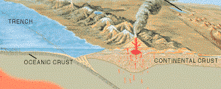
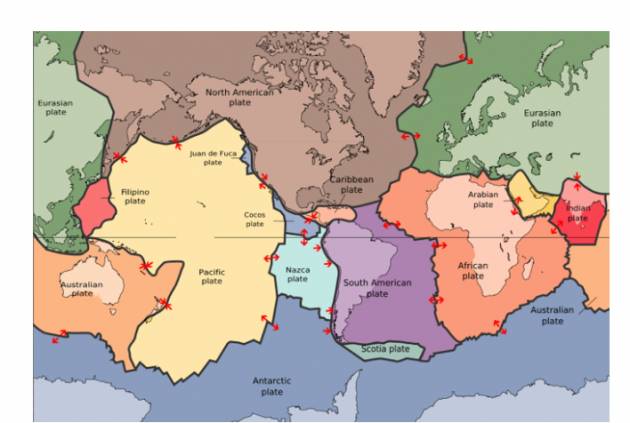
Where are earthquakes MOST LIKELY to occur?
close to the equator
close to the center of tectonic plates
at divergent or convergent plate boundaries
at transform plate boundaries
The 2004 Indian Ocean tsunami was caused by a shift in two plates that pushed one section of the sea floor under another section of the sea floor by 5 meters. What type of boundary is this?
divergent
convergent
transform
metamorphic
___________ currents in the Earth's asthenosphere cause plate to shift at their boundaries. This movement also causes earthquakes and volcanic activity.
conduction
convection
radiation
ocean
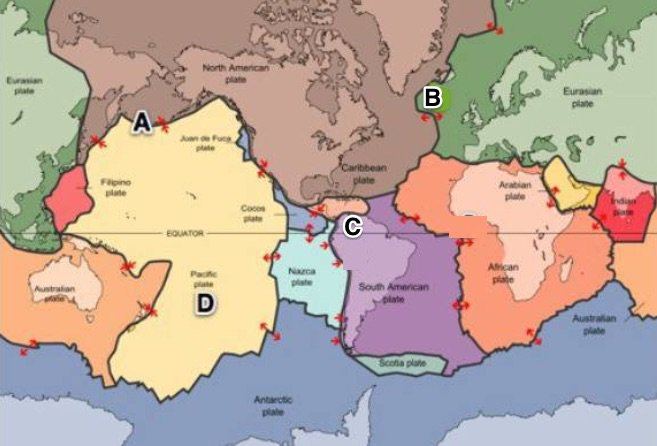
Where would sea floor spreading most likely occur?
At convergent boundaries (oceanic vs. oceanic)
At convergent boundaries (oceanic vs. continental)
At divergent plate boundaries (oceanic vs. oceanic)
At transform plate boundaries
Boundary between two colliding plates, often associated with mountain building, ocean trenches and volcanic islands
plate boundary
magma
divergent boundary
convergent boundary
proposed by Alfred Wegener, that the continents were once joined together and have since drifted apart
theory of plate tectonics
tectonic plates
plate boundary
theory of continental drift
where two plates are moving apart, magma comes up to create new crust
ridge
divergent boundary
convergent boundary
plate boundary
formed by two continental plates colliding and forcing each other upwards during convergent boundary
grassland
mountain ranges
snow
trench

The semi-liquid layer below the Earth's crust is the
core
lava
magma
mantle
The San Andréas fault in California is one example of a...
Divergent boundary
Convergent boundary
Transform boundary
All of the above
Which of these phenomenon is not directly caused by plate tectonics
Volcanic eruptions
Earthquakes
Tsunamis
Landslides
What is the Theory of Continental Drift?
New continents are continually being created
and destroyed.
The layout of the continents is the same today
as it has always been
The continents have always been separate but
may one day drift together to form a single
continent
All the continents were once one continent that
broke up and drifted apart over hundreds of
millions of years
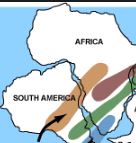
What do these color strips show between South America and Africa with the Theory of Plate Tectonics?
Similar cultures
Similar fossils
Similar languages
Similar weather
Which of the following is the thinnest layer of Earth?
Mantle
Crust
Lithosphere
Inner Core
Who is credited with proposing the hypothesis of Continental Drift?
Harry Hess
Galileo Galilei
Alfred Wegener
Isaac Newton
Albert Einstein
Which is more dense?
Continental Crust
Oceanic Crust
What happens to temperature and pressure as you get to deeper layers within Earth?
Temperature and Pressure increase
Temperature increases, Pressure decreases
Temperature decreases, Pressure increases
Temperature and Pressure decreases
What do geologists notice about the rocks along the sea floor?
They get older as they get farther away from mid ocean ridges
They get thicker closer to continents
Density is impossible to measure
Youngest parts of the crust are along the continents

What kind of boundary is shown in this image?
Divergent
Convergent: Subduction
Convergent: Collision
Transform

