wayground logo

Free Printable Worksheets

NEW

Font size

S
M
L
XL
Worksheets

Wave Quiz

Total questions: 51

Worksheet time: 2hrs 32mins

Name
Class
Date
1.
Through which of the following mediums can sound travel the fastest through?
a)
gas
b)
liquid
c)
solid
d)
no medium
2.
If the sound has a high frequency, then the sound is heard as a ____________.
a)
high-pitched sound
b)
low-pitched sound
c)
loud sound
d)
soft sound
3.
The amount of energy of a sound is determined by which property?
a)
pitch
b)
amplitude
c)
frequency
d)
wavelength
4.
Waves transport ______ over distances.
a)
gases
b)
solids
c)
liquids
d)
energy
5.
As the amplitude or height of a wave increases so does the sounds __________.
a)
pitch
b)
volume
c)
frequency
d)
wavelength
6.
A _________ wave is an example of a longitudinal wave.
a)
sound
b)
light
c)
transverse
d)
all of these
7.
______________ waves are unique because of their ability to travel through a vacuum.
a)
sound
b)
seismic
c)
water
d)
light
8.
Which type of wave occurs when the disturbance is perpendicular to the direction of the wave?
a)
transverse
b)
longitudinal
9.
What type of medium can seismic waves travel through?
a)
solids only
b)
liquids only
c)
solids and liquids
d)
They do not travel
10.
What type of electromagnetic waves carry heat?
a)
radio
b)
gamma
c)
microwaves
d)
infrared
11.
What type of electromagnetic waves can kill cancer cells?
a)
gamma
b)
radio
c)
microwaves
d)
infrared
12.
Where do we get most of our light from?
a)
Florescent Lights
b)
The Sun
c)
Fire
d)
Flashlights
13.
Which color has the shortest wavelength?
a)
green
b)
red
c)
purple
d)
blue
14.
What do we call the distance between one point on one wave to the same point on the next wave?
a)
amplitude
b)
wavelength
c)
frequency
d)
compression
15.
Seismic waves are what type of wave?
a)

transverse

b)
longitudinal
c)
all of the above
16.

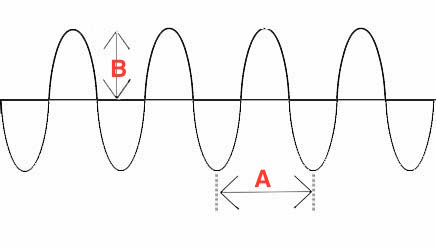
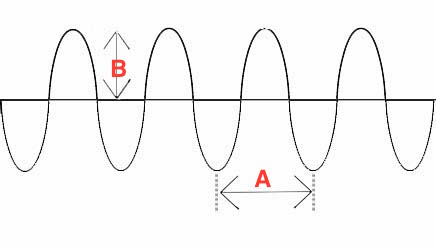
What property of this wave is represented by the letter "A"

a)

amplitude

b)

crest

c)

trough

d)

wavelength

17.
What property of the wave is represented by the letter "B"?
a)
amplitude
b)
crest
c)
trough
d)
wavelength
18.
The highest point on a wave is:
a)
the crest
b)
the trough
c)
the top
d)
the coast 
19.
The lowest point on a wave is the:
a)
Amplitude
b)
Crest
c)
Trough
d)
Wavelength
20.
The number of wavelengths that pass a point each per second is:
a)
frequency
b)
period
c)
longitudinal 
d)
transverse wave 
21.
Which vocabulary term is used to identify the distance between points C & G?
a)
Amplitude
b)
Crest
c)
Frequency
d)
Wavelength
22.
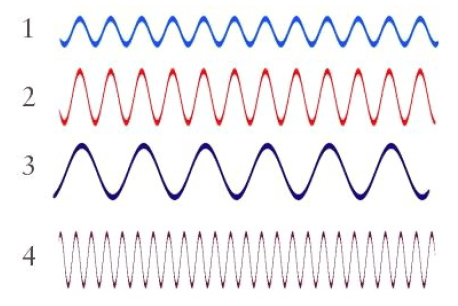
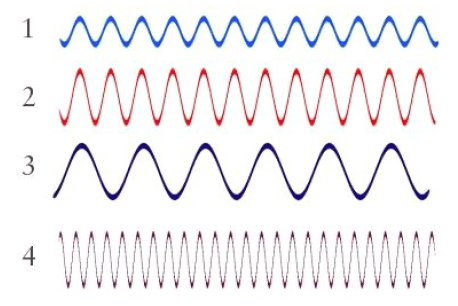
Which wave in the diagram has the greatest frequency?
a)
1
b)
2
c)
3
d)
4
23.
Which wave in the diagram has the greatest wavelength?
a)
1
b)
2
c)
3
d)
4
24.
A wave in which the particles of the medium move perpendicularly to the direction the wave is traveling
a)
A. surface wave
b)
B. transverse wave
c)
C. electromagnetic  wave
d)
D. longitudinal wave
25.
A wave in which the particles of the medium vibrate parallel to the direction of the wave motion
a)
A. mechanical wave
b)
B. surface wave
c)
C. longitudinal wave
d)
D. wave
26.
As wave frequency is increased, wave energy
a)
stays constant.
b)
is unaffected.
c)
increases. 
d)
decreases. 
27.
A mechanical wave cannot travel through...
a)
a vacuum(empty space).
b)
water.
c)
air. 
d)
glass.
28.
When the frequency of a wave increases, what happens to the wavelength?
a)
The wavelength is not directly affected by the frequency of a wave.
b)
The wavelength increases.
c)
The wavelength decreases.
d)
More specific information is needed to form a conclusion about the wavelength.
29.
What is a medium?
a)
something between a small and a large?
b)
the substance through which a wave can travel
c)
a pattern of vibration that simulates when a wave is standing still
d)
the distance from any point on a wave to an identical point on the next wave
30.
High frequency waves have _________ wavelength.
a)
varying
b)
high
c)
the same
d)
low
31.

This illustration shows three different waves traveling through the same medium. How do the waves differ from one another?

a)

The waves travel at different speeds.

b)

The waves have different wavelengths.

c)

The waves carry different amounts of energy.

d)

The waves are a different distance from the source.

32.

The illustration shows a sound wave traveling from a tuning fork through a medium. What parts of the wave are labeled X and Y

a)

x represents the compressions; Y represents the rarefactions.

b)

X represents the rarefactions; Y represents the compressions.

c)

X represents the compressions; Y represents the wavelength.

d)

X represents the rarefactions; Y represents the wavelength

33.

The illustration shows a sound wave traveling from a tuning fork through a medium. How can the wavelength be determined?

a)

by comparing the width of the bands at X and at Y

b)

by comparing the number of particles at X and Y

c)

by measuring the distance between two points labeled X

d)

by measuring the distance between a point labeled X and a point labeled Y

34.

During a 4th of July celebration, scientists were measuring sound waves as the fireworks exploded. Which illustration indicates that the fireworks were becoming louder?

a)
b)
c)
d)
35.

How are light and sound similar?

a)

They both travel at the same speed.

b)

They are both waves.

c)

They are both electromagnetic.

d)

They both travel through a vacuum.

36.

Visible light is which type of wave?

a)

seismic

b)

mechanical

c)

longitudinal

d)

electromagnetic

37.

How are electromagnetic waves different from other waves?

a)

They have very short wavelengths.

b)

They transmit energy instead of matter.

c)

They can travel through a vacuum and through matter.

d)

They can change direction by reflection when they strike an object.

38.

All of these types of waves travel from the Sun to Earth EXCEPT

a)

light waves.

b)

sound waves.

c)

infrared waves.

d)

ultraviolet waves.

39.

What is a Wave?

a)

A repeating disturbance

b)

Something in an ocean

c)

Something you do with your hand

d)

Something you do at a sporting event

40.
Sound is an example of which type of wave?
a)
Transverse
b)
Longitudinal
c)
Both
d)
Neither
41.

The two waves above are traveling at the same speed. Which statement best describes the difference between the waves?

a)

Wave A has a higher frequency than wave B.

b)

Wave A has a lower frequency than wave B.

c)

Wave A has a higher amplitude than wave B.

d)

Wave A has a lower amplitude than wave B.

42.
Which type of light has the highest energy of this group?
a)
red
b)
yellow
c)
green
d)
blue
43.
Which type of light has the lowest energy of this group?
a)
Radio
b)
Microwave
c)
Infrared
d)
Ultraviolet
44.

What is the definition of a wave?

a)

A distraction that turns energy

b)

A disturbance that transfers energy

c)

A vibration that changes energy

d)

A movement that moves energy

e)

The number of complete waves that pass a given point in a certain amount of time

45.

Waves that move the medium in a parallel direction in which the waves travel

a)

longitudinal wave

b)

transverse wave

c)

rarefaction

d)

mechanical wave

46.

Compression

a)

waves that require a medium through which to travel

b)

a repeated back and forth or up and down motion

c)

parts where the coils are close together on a spring

d)

the distance between two corresponding parts of a wave

e)

parts where the coils are spread out on a spring

47.

Sound waves travel through an object

a)

Reflect

b)

Refract

c)

Transmit

d)

Absorb

48.

What is the definition of ​amplitude?

a)

The distance from any point on one wave to a corresponding point on an adjacent wave (example. crest to crest or trough to trough)

b)

The distance a wave oscillates from its resting position.

c)

The number of wavelengths that pass a point each second

d)

A disturbance that transfers energy from one place to another without transferring matter.

49.

Parts where the wave are spread out in a longitudinal wave

a)

Rarefaction

b)

Trough

c)

Compression

d)

Crest

50.

How are mechanical waves classified?

a)

By the amplitude

b)

By how they move

c)

By the frequency

d)

By the speed

51.

How do you find the wavelength of a longitudinal wave?

a)

Crest to crest

b)

Rarefaction to rarefaction

c)

Trough to trough

d)

Compression to compression