
NEW
Font size
S
M
L
XL
 Worksheets
Cell History
Total questions: 12
Worksheet time: 4mins
Name
Class
Date
1.
There are three parts to the cell theory. Which is NOT one of those parts?
a)
All organisms are composed of one or more cells.
b)
The cell is the basic unit of structure and organization in organisms.
c)
Cells spontaneously arise from carbon and nutrients carried in the bloodstream.
d)
All cells come from pre-existing cells.
2.

What of the following is a prokaryote?
a)
animal cell
b)
bacteria
c)
virus
d)
plant cell
3.
Which scientist concluded that all PLANTS are made of cells?
a)
Robert Hooke
b)
Anton Von Leeuwenhoek
c)
Matthias Schleiden
d)
Theodore Schwann
4.
What type of cell has a nucleus?
a)
eukaryotic only
b)
prokaryotic only
c)
both prokaryotic and eukaryotic cells
5.
Eukarytoes have Many membrane-bound organelles? True or False
a)
True
b)
False
6.
Bacteria are prokaryotes.
a)
True
b)
False
7.
Which scientist named the "nucleus"
a)
Robert Brown
b)
Anton Von Leeuwenhoek
c)
Robert Hook
d)
Theodore Schwann
8.
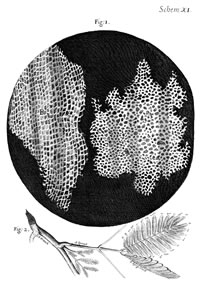
Who named the "cell" after looking at a cork slice using an early compound microscope?
a)
Robert Hooke
b)
Marcello Malpighi
c)
Francisco Redi
d)
Theodore Schwann
9.
Which scientist concluded that all ANIMALS are made of cells?
a)
Robert Hooke
b)
Anton Von Leeuwenhoek
c)
Matthias Schleiden
d)
Theodore Schwann
10.

The image shows a cell which LACKS a nucleus and other membrane bound organelles. This is known as a ______________ cell.
a)
Prokaryotic Cell
b)
Eukaryotic Cell
11.

Who observed cells dividing leading to #3 of the cell theory?
a)
Rudolph Virchow
b)
Francis Crick and James Watson
c)
Mattias Schleiden
d)
Walter Fleming
12.

Who decided that all animal tissues are made of cells, adding to the Cell Theory that the cell is the basic unit for life.
a)
Theodore Schwann
b)
Hans and Zacharias Jansen
c)
Rudolph Virchow
d)
Francis Crick & James Watson
Reset

