wayground logo

Free Printable Worksheets

NEW

Font size

S
M
L
XL
Worksheets

Energy waves: Sound and Light

Total questions: 45

Worksheet time: 26mins

Name
Class
Date
1.
A wave transfers
a)
energy
b)
water
c)
paricles
d)
air
2.
A wave that moves the medium in the same direction that the wave travels is a
a)
transverse wave
b)
longitudinal wave
c)
standing wave
d)
mechanical wave
3.
The distance between one crest and the next crest is the wave's
a)
amplitude
b)
wavelength
c)
frequency
d)
speed
4.
the number of complete waves that pass a point in a certain amount of time is a wave's
a)
amplitude
b)
frequency
c)
wavelength
d)
speed
5.
The bending of a wave due to a change in its speed is
a)
interference
b)
reflection
c)
diffraction
d)
refraction
6.
In the ear, a fluid-filled cavity that is shaped like a snail shell is the
a)
ear canal.
b)
eardrum.
c)
cochlea.
d)
larynx.
7.
A system of using reflected sound waves to detect and locate objects underwater is called
a)
sonar.
b)
acoustics.
c)
echolocation.
d)
reverberation.
8.
Electromagnetic waves are transverse waves that transfer
a)
sound energy.
b)
photons.
c)
electrical and magnetic energy.
d)
the particles of a mediu.
9.
The electromagnetic waves with the longest wavelengths and lowest frequencies are
a)
radio waves.
b)
infrared rays.
c)
X-rays.
d)
gammy rays.
10.

When scientists talk about white light, they are MOST likely referring to light that is

a)

a combination of all of the colors in the visible region of the electromagnetic spectrum.

b)

the unabsorbed refracted light produced by a black light.

c)

the narrow band corresponding to white light in the electromagnetic spectrum.

d)

a combination of all the types of electromagnetic radiation.

11.
Visible light is which type of wave?
a)
seismic
b)
mechanical
c)
longitudinal
d)
electromagnetic
12.
Light waves are arranged in the electromagnetic spectrum by
a)
wavelength and brightness.
b)
speed and color.
c)
brightness and color.
d)
wavelength and frequency.
13.
As the loudness of a sound wave increases, which will also increase?
a)
amplitude
b)
frequency
c)
velocity
d)
wavelength
14.
Which of these illustrates that sound waves can travel through a liquid?
a)
Voices can be heard as people speak to one another.
b)
Whales and porpoises signal each other by making sounds.
c)
Astronauts can’t hear each other in space unless they use a radio.
d)
Footsteps can be heard through the ceiling as someone walks on the roof.
15.
An echo is a sound wave that has been
a)
absorbed.
b)
refracted.
c)
scattered.
d)
reflected
16.
If a student playing the drums hits the drums with greater force, the sound would be
a)
quieter
b)
louder
c)
lower in pitch.
d)
higher in pitch.
17.
The MOST likely reason sound travels faster in salt water than in fresh water is that salt water
a)
is more elastic.
b)
absorbs heat faster.
c)
has a higher density.
d)
reflects sound better.
18.
A fifth-grade student fastened a piece of cardboard to his bicycle wheel so that the spokes would cause the card to vibrate. When the student rode the bike fast, the student heard a high pitch. When the student rode the bike slowly, the student heard a low pitch. Which BEST explains why the student heard both high and low pitches from the cardboard?
a)
The vibrations were faster when the student rode slowly.
b)
The vibrations were slower when the student rode faster.
c)
The cardboard vibrated at the same speed.
d)
The cardboard vibrated at different speeds.
19.
What is the MOST important property architects must consider when selecting materials for the walls, ceilings, and floors for a new concert hall?
a)
thermal properties
b)
chemical properties
c)
electrical properties
d)
acoustical properties
20.
Which is a source of sound?
a)
thermal energy
b)
potential energy
c)
a vibration
d)
a medium
21.
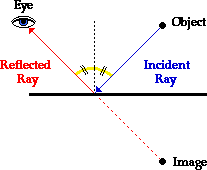
Law of reflection state that - The angle of incidence is .................. to the angle of reflection.
a)
equal
b)
double
c)
half
22.

In the diagram, which letter represents the angle of incidence?

a)

A

b)

B

c)

C

d)

D

23.
........... – the angle between the normal and the reflected ray.
a)
Angle of incidence
b)
Angle of reflection
c)
Angle of coincidence
d)
Angle of direction
24.
What is reflection?
a)
Reflection is the bouncing  of light off the surface that it strikes on.
b)
Reflection is the absorbing of light off the surface that it strikes on.
c)
Reflection is the bending of light off the surface that it strikes on.
d)
Reflection is the scattering of light off the surface that it strikes on.
25.
How does light travel
a)
It curves around corners
b)
Really slow
c)
In a straight line
d)
In circles
26.
Which term describes when light bounces off of a smooth surface?  
a)
Refraction
b)
Transmission
c)
Absorption
d)
Reflection
27.
The imaginary line perpendicular to a reflecting surface is called _____.
a)
crooked line
b)
parallel line
c)
angular line
d)
normal line
28.

What is the angle of reflection equal to?

a)

The angle of refraction

b)

The angle of incidence

c)

The angle of absorption

d)

The angle of light

29.

When you look into a mirror, what is happening to the light?

a)

It is increasing in wavelengths.

b)

It is being refracted.

c)

It is being absorbed.

d)

It is being reflected.

30.

Light has the highest velocity in which of the listed mediums?

flint glass n=1.70

barium glass n=1.60

crown glass n=1.523

water n=1.33

diamond n=2.45

a)

diamond

b)

water

c)

flint glass

d)

barium glass

31.

Light has the lowest velocity in which of the listed mediums?

flint glass n=1.70

barium glass n=1.60

crown glass n=1.523

water n=1.33

diamond n=2.45

a)

diamond

b)

water

c)

flint glass

d)

barium glass

32.

According to Willebord Snell (and the law of refraction), light passing from air to glass will cause the light to

a)

maintain its original speed

b)

accelerate while it is in glass

c)

increase its speed

d)

reduce its speed

33.
According to the Law of reflection, a light ray striking a mirror
a)
continues moving through the mirror in the same direction
b)
moves into the mirror at a slightly different angle
c)
bounces off the mirror toward the direction it came from
d)
bounces off the mirror at the same angle it hits.
34.
Glass has a _____________ index of refraction than air.
a)
Equal
b)
Greater
c)
Less
d)
Impossible to say
35.
This shows the phenomenon known as....
a)
reflection
b)
refraction
c)
mirrors
d)
focal point
36.
How does light behave as it enters these mediums?
a)
continue its path as straight line.
b)
bends toward the normal
c)
bends away from the normal
d)
reflects
37.
What does the word "converging" mean?
a)
to separate
b)
to come together
c)
parallel 
d)
perpendicular
38.
A converging lens is also known as a ____ lens.
a)
convex
b)
concave
c)
double
d)
refracted
39.
When an object is placed between the focal point and the convex lens, the image produced is ___.
a)
real, reduced, and inverted
b)
real, enlarged, and inverted
c)
virtual, enlarged, and upright
d)
virtual, reduced, and upright
40.
What does the word "diverging" mean?
a)
to spread apart
b)
to come together
c)
parallel
d)
perpendicular
41.
A diverging lens is also known as a ____lens.
a)
refracted
b)
diffracted
c)
convex
d)
concave
42.
The point where the rays meet is known as....
a)
Fire
b)
the focal point
c)
refraction
d)
Plane of the lens
43.
Is a convex lens thicker or thinner in the middle?
a)
Thicker 
b)
Thinner 
44.
What type of lens do humans have in their eyes? 
a)
Concave Lens 
b)
Convex Lens 
45.
Is a concave lens thicker or thinner in the middle? 
a)
Thicker 
b)
Thinner