
NEW
Font size
 Worksheets
Integrated Physical Science Unit 5 Review
Total questions: 46
Worksheet time: 52mins
This type of material allows heat to be transferred easily.
conductor
insulator
This type of material DOES NOT allow heat to be transferred easily.
conductor
insulator
Which of the following is NOT a unit used to measure temperature?
Kelvin
Celsius
Fahrenheit
Newtons
Which type of heat transfer involves the direct contact of two objects?
conduction
convection
radiation
Which type of heat transfer involves the rising and falling action of fluids as they heat and cool?
conduction
convection
radiation
Which type of heat transfer involves electromagnetic waves, such as visible or infrared light?
conduction
convection
radiation
If an object has HIGH specific heat, which of the following is true?
Low amounts of thermal energy are required to change the object's temperature
High amounts of energy are required to change the object's temperature
The object will heat up relatively quickly
The object could be made of metal
Which state of matter has particles with the MOST kinetic energy?
solids
liquids
gases
What happens to the temperature of an object if the kinetic energy is increased?
temperature will increase
temperature will decrease
temperature will not change
temperature could increase or decrease depending on the situation
Which of the following correctly describes thermal expansion?
temperature is increasing, volume is increasing
temperature is increasing, volume is decreasing
temperature is deceasing, volume is increasing
temperature is decreasing, volume is decreasing
Which of the following correctly describes thermal contraction?
temperature is increasing, volume is increasing
temperature is increasing, volume is decreasing
temperature is deceasing, volume is increasing
temperature is decreasing, volume is decreasing
What is the correct SI unit for measuring energy?
Newtons
meters
Joules
Watts
If you were to touch a hot frying pan with your hand, which of the following is true regarding thermal energy?
thermal energy moves from the frying pan to your hand
thermal energy moves from your hand to the frying pan
thermal energy moves to the surrounding air from your hand
thermal energy does not move from either object

Which beaker in the picture shown will have the MOST thermal energy?
the beaker on the LEFT has more thermal energy because it has less mass
the beaker on the RIGHT has more thermal energy because it has more mass
both beakers have the SAME thermal energy regardless of mass
NEITHER beaker has thermal energy
Which of the following would make a good conductor?
glass
wood
plastic
metal
Classify the following example of heat transfer:
A kitten sits in front of an infrared heater to warm up.
conduction
convection
radiation
Classify the following example of heat transfer:
Sunlight warms up the inside of a car during the summer.
conduction
convection
radiation
Classify the following example of heat transfer:
The water in a pot rises and falls as it boils.
conduction
convection
radiation
Classify the following example of heat transfer:
"Lava" inside a lava lamp rises as it warms up, and falls as it cools down.
conduction
convection
radiation
Classify the following example of heat transfer:
You touch a hot pan sitting on the stove and burn your hand.
conduction
convection
radiation
Classify the following example of heat transfer:
You sit down in your chair at the beginning of class, and it's still warm from the student before you.
conduction
convection
radiation
Which temperature scale is based on molecular motion?
Kelvin
Celsius
Fahrenheit
Newtons

What causes heat to flow from the metal pot to the water?
A difference in specific heat between the metal pot and the water
A difference in phase - the metal is solid and water is a liquid
A difference in chemical energy between the metal pot and the water
A difference in temperature between the metal pot and the water
When the temperature of a substance is taken, what characteristic of the substance is being measured?
the average potential energy of the particles in the substance
the average kinetic energy of the particles in the substance
the total specific heat of the particles in the substance
the total thermal energy being transferred by the substance
True or False: A calorimeter MEASURES the amount of thermal energy in a substance.
True
False

Consider the ice melting blocks used in class. What direction did heat flow for the block on the left?
from the block to the ice
from the ice to the block
from the block to the air
from the ice to the air
Which of the following substances will limit the heat flow by conduction?
iron
copper
wood
steel
What quantity has the following SI units:
g⋅°CJ
Energy
Specific heat
Temperature change
Work
Which of the following is NOT affected by the processes of thermal expansion and thermal contraction?


At what temperature does all molecular motion stop?
273 K
0oC
0 K
0oF
What mathematical relationship exists between the kinetic energy of the particles of a substance and the temperature of that substance?
Direct - as the average kinetic energy of the particles increases, the temperature increases
Inverse - as the average kinetic energy of the particles decreases, the temperature increases
No relationship - as the average kinetic energy of the particles changes, the temperature remains the same
Exponential - as the average kinetic energy of the particles doubles, the temperature quadruples.

1. Which has LESS thermal energy container A or B?
A, because it has a smaller mass of water
A, because it has a smaller volume
B, because it has a larger mass of water
B, because it has a larger volume


What would be the effect on the particles if more heat is transferred to the system?
The particles would slow down.
The particles would stop moving.
The particles would speed up.
The particles would not change motion.
What is the formula to calculate heat energy required to raise the temperature of any substance?
Q = m c ∆T
Q = m c
Q = ½ m v2
m = Q c
If the specific heat of water is 4.186 J/g∙°C, how much heat is required to increase the temperature of 1200 g of water from 23°C to 39°C?
Q = mcΔT
4,586.7 J
44,938.6 J
80,371.2 J
115,533.6 J
A sample of iron receives 50J of heat energy that raises the temperature of the iron 25.0°C. If iron has a specific heat of 0.10 J/g°C, what is the mass of the iron sample?
m = cΔTQ
12500 g
30 g
25 g
20 g
The specific heat of copper is 0.39 J/g °C. What is the temperature change when 100 Joules of heat is added to 20 grams?
ΔT = mcQ
12.82°C
24.12°C
5128°C
1.95°C
What is the symbol for thermal energy (or heat)?
Q
ΔT
m
c
What is the symbol for specific heat?
c
Q
m
ΔT
The temperature of an unknown material with a mass of 30.00 g changes from 25.0°C to 35.0°C when the material absorbs 350.0 J of energy. What is the specific heat of the material?
c = mΔTQ
0.47 J/g°C
1.17 J/g°C
117 J/g°C
1050 J/g°C
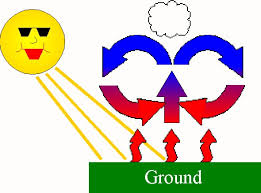
As seen in the diagram, warm air rises and the cool air sinks. Which type of heat transfer explains this observation?
conduction
convection
radiation
Insolation
Two pans of water are heated - one with 100 mL of water and the other with 1000 mL of water. Which pan of water heats up the fastest?
100 mL
1000 mL
They both heat up at the same speed
They cool down.
1. Which has MORE thermal energy container B or C?
B, because it has a lower temperature
B, because the water molecules are moving faster
C, because it has a higher temperature
C, because the water molecules are moving slower

