wayground logo

Free Printable Worksheets

NEW

Font size

S
M
L
XL
Worksheets

CH 2 & 5 Review

Total questions: 57

Worksheet time: 33mins

Name
Class
Date
1.
The nerve cell that carries impulses from a sense receptor to the brain or spinal cord is a _____________.
a)
Motor Neuron
b)
Sensory Neuron
c)
Relay Neuron
2.
The nerve cell that connects sensory and motor neurons is a _______________.
a)
Motor Neuron
b)
Sensory Neuron
c)
Interneurons 
d)
Glial cells
3.
The nerve cell that transmits impulses from the brain or spinal cord to a muscle or gland.
a)
Motor Neuron
b)
Relay Neuron
c)
Sensory Neuron
d)
Schwann cell
4.
What part of the neuron carries the impulse toward the nerve cell body?
a)
Dorsal Root
b)
Dendrites
c)
Myelin Sheath
d)
Axon
5.
What part of the neuron is myelinated?
a)
Cell Body
b)
Axon
c)
Synapse
d)
Dendrite
6.
A sudden change in the polarity of the membrane of a neuron, gland cell, or muscle fiber that causes the transmission of electrical impulses
a)
Action potential
b)
Membrane potential
c)
Resting potential
d)
Threshold
7.
The critical point at which a stimulus causes an action potential
a)
Synapse
b)
Action potential
c)
Membrane potential
d)
Threshold
8.
A chemical substance that transmits nerve impulses across a synapse 
a)
Neurotransmitter
b)
Axon
c)
Synapse
d)
Nerve
9.
Part of the nervous system made of the brain and spinal cord.
a)
central nervous system
b)
peripheral nervous system
10.
What are the two parts of the nervous system? 
a)
The brain and spinal cord
b)
The central nervous and peripheral nervous system 
c)
The neurons and the dendrites
d)
The cerebrum and the medulla
11.
If a neuron responds at all, it responds completely. This is known as the
a)
threshold
b)
all-or-none response
c)
neuronal pool
d)
withdrawal reflex
12.

The ___ allows us to constantly, or voluntarily control our skeletal muscles.

a)

Somatic nervous system

b)

Autonomic nervous system

13.

The ___ regulates events that are involuntary, such as smooth and cardiac muscles.

a)

Somatic nervous system

b)

Autonomic nervous system

14.

The ___ connects the brain to the spinal cord. It controls involuntary muscle movement such as breathing.

a)

Cerebrum

b)

Cerebellum

c)

Brain stem

15.
Two major branches of the nervous system
a)
CNS & PNS
b)
Peripheral & Motor
c)
Motor & Sensory
d)
Central & Motor
16.
The nerves in your fingertips are part of the ___ nervous system
a)
peripheral
b)
central
c)
 cardiovascular
d)
interna.
17.
This part of the brain allows you to feel fear and other emotions
a)
cerebrum
b)
parietal lobe
c)
brain stem
d)
amygdala
18.
 Concentration, language production, and decision making are features of the ___ lobe in the brain.
a)
occipital
b)
cerebellum
c)
temporal
d)
frontal
19.
These parts of the brain are MOST important for maintaining homeostasis.
a)
cerebellum and frontal lobe
b)
hypothalamus and brain stem
c)
cerebellum and hypothalamus
d)
brain stem only
20.

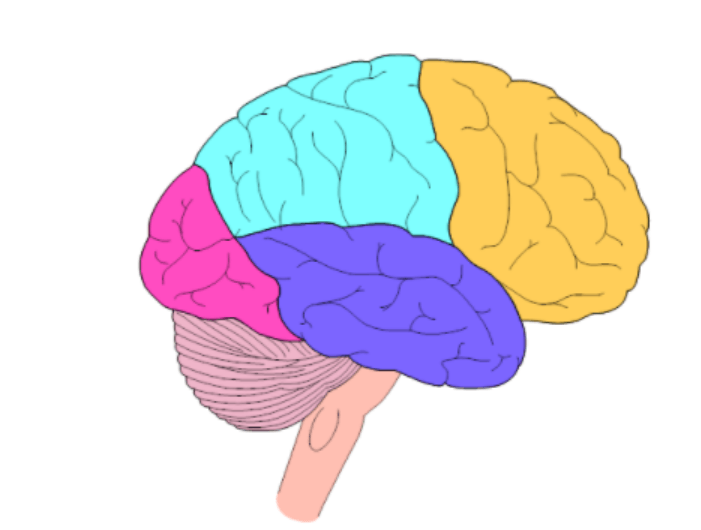
What lobe is orange in this picture?

a)

Frontal

b)

Parietal

c)

Temporal

d)

Occipital

21.

What does the green lobe do?

a)

Processes your hearing

b)

Processes your vision

c)

Contains your personality

d)

Processes your sense of touch

22.

What does the pink lobe do?

a)

Processes your hearing

b)

Processes your vision

c)

Contains your personality

d)

Processes your sense of touch

23.

Which part of the brain controls your balance and coordination?

a)

brain stem

b)

occipital lobe

c)

cerebellum

d)

frontal lobe

24.
Connects the left and right hemispheres of the brain
a)
Cerebellum
b)
Hypothalamus
c)
Medulla  Oblongata
d)
Corpus Callosum
25.
The brain's "sensory switchboard":  directs sensory messages to proper area of the brain
a)
thalamus
b)
hypothalamus
c)
hippocampus
d)
reticular formation
26.
Controls motivational behaviors, including: feeding, fight-flight response
a)
Hippocampus
b)
Amygdala
c)
Reticular Formation
d)
Hypothalamus
27.
This lobe receives and processes pain, pressure and touch from the body to create a map of the body's position in space and a map of body parts in relation to other body parts.
a)
Occipital Lobe
b)
Parietal Lobe
c)
Temporal Lobe
d)
Frontal Lobe
28.
This lobe controls responses to complex problems through reasoning, judgment, decision making and planning.
a)
Occipital Lobe
b)
Parietal Lobe
c)
Temporal Lobe
d)
Frontal Lobe
29.
Split brain operations are done to
a)
shrink tumors
b)
increase memory
c)
help speech disorders
d)
help stop seizures
30.
Speech that is jumbled and not understandable is a sign of:
a)
Wernicke's Aphasia
b)
a split brain operation
c)
Broca's aphasia
d)
sensory aphasia
31.
This area controls breathing, heart-rate, and reflexes
a)
pons
b)
medulla oblongata
c)
cerebral cortex
d)
cerebrum
32.

NEUROPLASTICITY is the ability of the brain to change continuously throughout an individual's life

a)

True

b)

False

33.
Stages of Death
a)
C. Gilligan
b)
E. Kubler Ross
34.
object permanence
a)
Seligman
b)
Piaget
c)
Premack
d)
Vygotsky
35.
Parenting Styles
a)
Baumrind
b)
Lorenz
c)
S. Hall
d)
J. Haidt
36.
imprinting
a)
Baumrind
b)
Lorenz
c)
S. Hall
d)
J. Haidt
37.
Biggest Critic of the Heinz Dilemma experiment bc Kohlberg only asked boys
a)
E. Kubler Ross
b)
Carol Gilligan
38.
The term critical period refers to:
a)
Prenatal development
b)
The initial two hours after a child’s birth
c)
The preoperational stage
d)
A restricted time for development and/or learning
39.
What is the first stage of Piaget's cognitive development?
a)
Preoperational
b)
Sensorimotor 
c)
Formal operational
d)
Concrete operational
40.
During the preoperational stage...
a)
children begin to use logic
b)
focuses on motor skills
c)
the adolescent gains ability to formulate complicated verbal arguments
d)
intense language learning takes place
41.
Children who in infancy formed secure attachments to their parents are more likely than other children to:
a)
Prefer the company of adults to that of other children
b)
Become permissive parents
c)
Show a great deal of social competence
d)
Be less achievement oriented
42.
An infant who has developed object permanence...
a)
is attached to specific objects, such as a blanket.
b)
will see all objects as being the same.
c)
knows that an object, such as a rattle, exists even if it is not in view.
d)
cries when a wanted object is taken away.
43.
If Jeremy begs for a new electronic gadget, his parents nearly always buy it for him. What type of family is this?
a)
Permissive
b)
Democratic
c)
Authoritarian
d)
Submissive
44.
This style of parenting calls for imposing rules and demanding obedience without debate or discussion between parent and child.
a)
Permissive
b)
Neglectful
c)
Authoritative
d)
Authoritarian
45.
Erikson said that when you are a teenager, your main goal is to find your . .
a)
Trust
b)
Calling
c)
Identity
d)
Integrity
46.
When the baby's cheek is stroked they turn towards the side it was stroked and begins making sucking motions
a)
rooting reflex
b)
sucking reflex
c)
grasp reflex
d)
Babinski reflex
47.
The stage that occurs between birth and one year of age is concerned with:
a)
Trust vs. Mistrust
b)
Autonomy vs. Shame and Doubt
c)
Intiative vs. Guilt 
d)
Industry vs. Inferiority 
48.
A 38-year-old woman quits her high-paying marketing job to focus on her children and become a school counselor. What stage would Erikson consider this to be:
a)
Idenitity vs. Role Confusion 
b)
Generativity vs. Stagnation
c)
Ego Integrity vs. Despair
d)
Industry vs. Inferiority
49.
Which of the following is a secondary sex characteristic:
a)
testicles
b)
ovaries
c)
clitoris
d)
breasts
50.
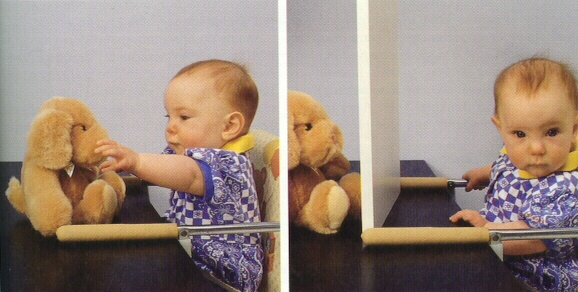
This image is an example of:
a)
imprinting
b)
cohort effect
c)
rooting reflex
d)
rooting reflex
51.
Cognitive structures:
a)
Schema
b)
Assimilation
c)
Accommodation
d)
Sclera
52.
A white racist has a black friend, yet says terrible things about all black people. This racist has not yet used _____ to create a new cognitive structure.
a)
Schema
b)
Assimilation
c)
Accommodation
d)
Sclera
53.
Erikson said that school aged children should reach: 
a)
Industry over Inferiority
b)
Trust over Mistrust
c)
Autonomy over Shame
d)
Intimacy over Isolation
54.
A midlife crisis:
a)
Should be expected
b)
Is actually rare
c)
Is a surge in hormones
d)
Means your dad will smoke pot again
55.
According to __________, we face a specific psychosocial dilemma at each stage of life.
a)
Erik Erickson
b)
Konrad Lorenz
c)
Lawrence Kohlberg
d)
Sigmund Freud
56.
Lawrence Kohlberg is known for his research in the area of __________ development.
a)
Cognitive
b)
Psychosexual
c)
Moral
d)
Psychosocial
57.
According to Kübler-Ross, the most common order of emotional reactions in preparing for death is:
a)
anger, depression, bargaining, denial, acceptance.
b)
denial, anger, bargaining, depression, acceptance.
c)
anger, depression, denial, bargaining, acceptance.
d)
depression, anger, denial, bargaining, acceptance.