wayground logo

Free Printable Worksheets

NEW

Font size

S
M
L
XL
Worksheets

changes to earths surface

Total questions: 20

Worksheet time: 42mins

Name
Class
Date
1.
Features of the surface of the Earth such as mountains, hills, dunes, oceans, and rivers are called
a)
delta
b)
erosion
c)
landforms
2.
The movement of weathered material on the Earth's surface by wind, water, and ice is
a)
erosion
b)
deposition
c)
landslides
3.
The breakdown of rock into smaller particles from the effects of wind, water and ice is
a)
deposition
b)
delta
c)
weathering
4.
The buildup of land by depositing sediment and soil in a new location is
a)
earthquake
b)
weather
c)
deposition
5.
A triangle-shaped (deposit) landform at the mouth of a river as it empties into a body of water is
a)
weather
b)
delta
c)
landform
6.
When a river flows over the Earth and carves out a hole in the surface it makes a 
a)
hill
b)
mountain
c)
canyon
7.
What is necessary for sand dunes to form?
a)
loose sand and strong wind
b)
pressure in the earth
c)
ice glaciers
8.
How long does the weathering process take?
a)
exactly one year
b)
a few days
c)
years and years
9.
Identify this landform:
a)
Dune
b)
Stream
c)
Volcano
d)
Island
10.
Volcanoes, Earthquakes, Landslides, and Floods are all examples of?
a)
Fast Changes
b)
Slow Changes
11.

How do glaciers change land?

a)

They can wear away mountains and leave behind valleys.

b)

They stop erosion of land by blocking rivers and streams.

c)

They warm up the area so that animals can live.

d)

They move very quickly and break everything in their path.

12.

What happens during a land slide?

a)

Magma moves up from the mantle and erupts.

b)

Large pieces of land break off and slide down.

c)

The ground freezes and melts when it gets warmer.

d)

Water in streams and rivers overflows the banks.
13.

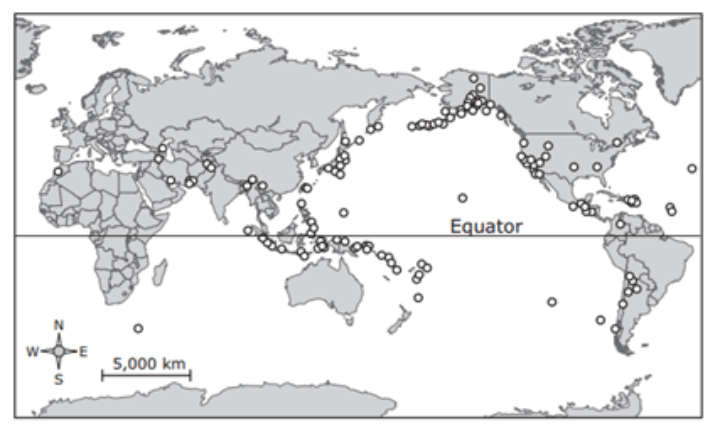
A scientist was studying a type of event that occurred on Earth in various places within a 30-day period. The circles indicate where the events happened.

What type of event do the circles on the map most likely represent?

a)

Landslides, because they are all located along ocean coastlines

b)

Response Volcanoes, because they occur only near the equator

c)

Earthquakes, because they occur on land and on the ocean floor

d)

Floods, because heavy rains can make riverbeds deeper and create deltas

14.

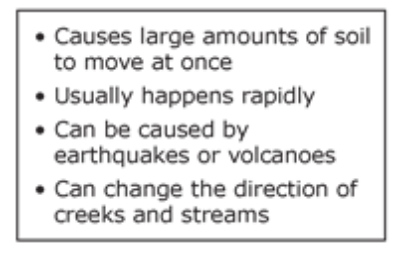
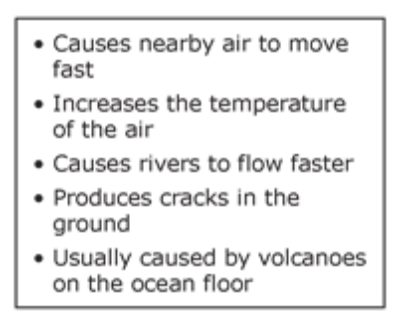
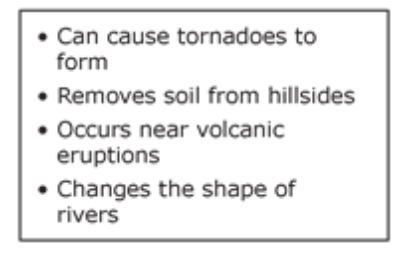
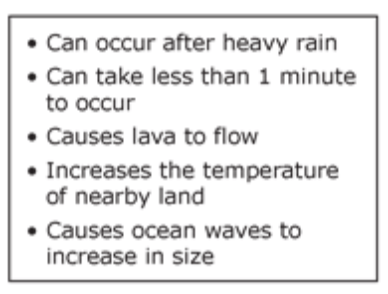
Which of list best describe a landslide?
a)
b)
c)
d)
15.
A group of students is building a model to show how water from melting glaciers moves toward the ocean.  They put clay, water, and ice cubes into a plastic bin.  They place a heat lamp next to the bin. 
 
  Which of the following would most likely help them show how water from melting glaciers moves in their model?
a)
using colored water to represent the water in the ocean
b)
using colored water to make the ice cubes that represent the glaciers
c)
using different colors of clay to represent dry land and the bottom of the ocean
d)
using different colors of light to represent sunlight shining on the glaciers and dry  land
16.
A ________ is a break or crack in rocks where Earth's crust can move. 
a)
soil
b)
ice
c)
fault
d)
plateau
17.
__________ forces wear away, tear down, or destroy Earth's features.
a)
constructive
b)
destructive
c)
lithosphere
d)
fault line
18.
__________ forces build new features such as mountains and valleys.
a)
volcanic
b)
destructive
c)
constructive
d)
atmospheric
19.
What is the name of the fault line that runs through California, where many earthquakes occur?
a)
The San Andreas Fault
b)
The California Fault
c)
The All Your Fault
d)
The San Francisco Fault
20.
These rocks were broken apart from the continuous freeze/thaw of water in the cracks of the rocks. This is an example of:
a)
ice wedging
b)
acid rain
c)
permeability
d)
abrasion