
 Worksheets
Atoms and the Periodic Table
Total questions: 25
Worksheet time: 50mins
Name
Class
Date
1.
The second energy level can hold up to how many electrons?
a)
2
b)
8
c)
10
d)
12
2.

What is the atomic mass of "F"
a)
9
b)
18
c)
17
d)
19
3.
How do you find out the number of protons in an atom?
a)
atomic number
b)
atomic mass
c)
charge
d)
atomic mass - atomic number
4.
How do you find out the number of neutrons in an atom?
a)
atomic number
b)
atomic mass
c)
charge
d)
atomic mass - atomic number
5.
All matter is made of _________.
a)
energy
b)
atoms
c)
electrons
d)
compounds
6.
How are elements ordered on the Periodic Table?
a)
Alphabetical Order
b)
By their color.
c)
By their atomic mass.
d)
By their atomic number.
7.

How many neutrons are in the atom "K"?
a)
7
b)
19
c)
39
d)
20
8.

How many protons does an atom of Carbon have?
a)
3
b)
12.011
c)
6
d)
none
9.
The first energy level can hold up to how many electrons?
a)
8
b)
4
c)
2
d)
5
10.

Which is a neutron?
a)
A
b)
B
c)
C
11.
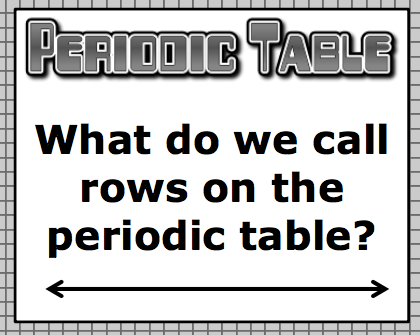
a)
Periods
b)
Groups
12.
A neutron has a charge of
a)
+2
b)
No charge
c)
-1
d)
+1
13.
Which two subatomic particles are found in the NUCLEUS of at atom?
a)
protons & nuetrons
b)
protons & electrons
c)
neutrons & electrons
d)
electrons & protons
14.
How many different elements are represented in the compound?
Na2CO3
a)
1
b)
2
c)
3
d)
4
15.
Salt water boils and the water completely evaporates, salt (NaCl) is left in the bottom of the beaker. Which of the following is left in the beaker?
a)
Compound
b)
Element
c)
Mixture
d)
None of the Above
16.
What is the name of a scientific investigation that involves going outside and observing a subject in its natural environment?
a)
Research
b)
Field Study
c)
Observation
d)
Experiment
17.
Nick wanted to see how high an ice cube would float in different temperatures of water. Identify the dependent variable.
a)
amount of water
b)
temperature the ice cube was at its' highest height
c)
temperature of water
d)
height of ice cube
18.
What form of data do scientist prefer?
a)
Measurable data/empirical evidence
b)
Qualitative data
c)
Uncontrolled evidence
d)
Single trial data/evidence
19.
How many electrons should Lithium have around its Lewis dot model?
a)
1
b)
2
c)
3
d)
4
20.

The vertical (up and down) columns in the Periodic Table are called
a)
groups
b)
towers
c)
periods
d)
atomic numbers
21.
The Modern Periodic Table of Elements is arranged by
a)
atomic mass
b)
atomic number
c)
valence electrons
d)
number of isotopes
22.
What does the atomic mass tell you?
a)
Basically,the number of electrons and protons
b)
The number of neutrons
c)
Basically, the number of protons and neutrons
d)
The number of protons.
23.
An atom with atomic number 6 would have how many protons
a)
6
b)
12
c)
3
d)
cannot be determined
24.
Explains something we see in the natural world that has been verified through repeated experiments or testing.
a)
hypothesis
b)
law
c)
theory
25.
How can we collect empirical evidence?
a)
Through our own personal beliefs and bias
b)
Through experimentation, investigations, and observations.
c)
Predictions from only mathematical models.
d)
Predictions from only 3-D physical models.
100 %

