

Wayground logo

Free Printable Worksheets

Font size

S
M
L
XL
Worksheets

Body Systems Review

Total questions: 50

Worksheet time: 42mins

Name
Class
Date
1.
What organ is 1 pointing to?
a)
Kidney
b)
Urethra
c)
Bladder
d)
Ureter
2.
The endocrine system communicates to the body using....
a)
electrical signals
b)
soluble gases
c)
digestive enzymes
d)
chemical hormones
3.
What system moves the body?
a)
Endocrine System
b)
Muscular System
c)
Cardiovascular System
d)
Skeletal System
4.
What body system breaks down food for energy?
a)
Urinary System
b)
Digestive System
c)
Lymphatic System
d)
Respiratory
Respiratory System
5.
What system carries oxygen to the blood?  
a)
Cardiovascular System
b)
Respiratory System
c)
Nervous System
d)
Endocrine System
6.
The main function of the digestive system is to...
a)
Protect the body from infections
b)
Store nutrients into the bones
c)
Break down food to be absorbed
d)
Support and protect the organs of the body
7.
What organ is 2 pointing to?
a)
Urethra
b)
Bladder
c)
Kidney
d)
Ureters
8.
What is the main function of the excretory system?
a)
Convert food into nutrients
b)
Send signals in the form of hormones
c)
Filter water and remove waste products from the body
d)
Exchange gases between the body
9.
What is the main function of the Endocrine System?
a)
Take in Oxygen
b)
Take Carbon into the lungs
c)
Produce Sperm Cells
d)
Produce Hormones
10.
Which body system delivers nutrients to the cells inside the body?
a)
Reproductive
b)
Circulatory
c)
Nervous
d)
Excretory
11.

What is the function of the system pictured?

a)

Helps pumps your blood through out your body.

b)

Helps move and protect your body.

c)

Helps take in oxygen and remove carbon dioxide.

d)

Helps maintain body your temperature.

12.
What function do the kidneys perform?
a)
eliminate carbon dioxide
b)
supply oxygen to body cells
c)
remove urea and excess water
d)
play a role in gas exchange
13.
Using the picture, what is the function of structure C?
a)
Carries urine away from the kidneys
b)
Stores urine
c)
Eliminates urea, excess water, and some other materials
d)
Carries urine away from body and eliminates it
14.
Under normal conditions, which of the following substances is found in urine?
a)
blood cells
b)
protein
c)
glucose
d)
urea
15.
What does the cerebrum control?
a)
controls thoughts and voluntary actions
b)
controls vital and involuntary actions 
c)
controls balance
d)
controls the uvula
16.

Water and CO2 are metabolic wastes removed by which organ?

a)
b)
c)
d)
e)

None of these organs

17.
The nervous system is composed of the ___, ___, and ___.
a)
heart, brain, kidneys
b)
lungs, liver, stomach
c)
brain, spinal cord, nerves
d)
eyes, pancreas, veins
18.
The gap that a message has to cross to get from one neuron to the other is called the _____
a)
synapse
b)
dendrite
c)
axon
d)
nucleus 
19.
What is the part highlighted in red?
a)
Cerebrum
b)
Cerebellum
c)
Brain Stem
d)
Diencephalon
20.
The nervous system works together with the endocrine system to regulate and maintain what?
a)
A trusting, loving relationship
b)
Homeostasis
c)
Equality for all races
d)
Balanced hormone levels
21.

The smallest unit of a living thing

a)

cell

b)

tissue

c)

organ

d)

organ system

e)

organism

22.

This particular blood vessel carries oxygenated blood to the heart coming from the lungs.

a)

super vena cava

b)

inferior vena cava

c)

pulmonary artery

d)

pulmonary vein

23.

This particular blood vessel carries deoxygenated blood away from the heart to the lungs.

a)

super vena cava

b)

inferior vena cava

c)

pulmonary artery

d)

pulmonary vein

24.
In which excretory organ is urea produced?
a)
skin
b)
liver
c)
kidneys
d)
lungs
25.
Part of the nervous system made of the brain and spinal cord.
a)
central nervous system
b)
peripheral nervous system
26.

The pulmonary veins carry oxygenated blood back to the ___

a)

right atrium

b)

left atrium

c)

right ventricle

d)

left ventricle

27.

What type of product is secreted by endocrine glands?

a)

Sweat

b)

Hormones

c)

Saliva

d)

Tears

28.

These type of cells are responsible for transmitting electrical signals from nervous system to various parts of the body.

a)

Neuron

b)

Blood

c)

Villi

d)

Somatic

29.
Where does digestion begin?
a)
mouth
b)
esophagus
c)
stomach
d)
intestines
30.
This tube is made of smooth muscle and carries food from your mouth to your stomach.
a)
trachea
b)
intestines
c)
esophagus
d)
urethra
31.
This system controls everything you do.
a)
nervous system
b)
olfactory system
c)
digestive system
d)
circulatory system
32.
When tissues come together, they form ___________.
a)
cells
b)
atoms
c)
organs
d)
systems
33.
How many bones make up a human adult?
a)
205
b)
206
c)
207
d)
208
34.

Flap of tissue that covers the opening to the windpipe during swallowing

a)

Pharynx

b)

Trachea

c)

Epiglottis

35.
Which part of the body is the control center for the nervous system? 
a)
spinal cord
b)
stomach
c)
brain
d)
heart
36.

The involuntary propulsion of foodstuff is accomplished by circular muscle fibers that squeeze along the alimentary canal. That way food is moved involuntarity. What is the name of this process?

a)

swallowing

b)

peristalsis

c)

defecation

d)

absorption

37.
Tiny tubes that branch off of bronchi
a)
capillaries
b)
alveoli
c)
bronchioles
d)
pluera
38.
Which excretory organ eliminates water and some chemical wastes in perspiration?
a)
lungs
b)
skin
c)
liver
d)
kidneys
39.

Which sequence correctly indicates the branching pattern of the human respiratory system?

a)

trachea -> bronchi -> bronchioles -> alveoli

b)

trachea -> bronchioles -> bronchi -> alveoli

c)

alveoli -> trachea -> bronchioles -> bronchi

d)

alveoli -> bronchioles -> trachea -> bronchi

40.
“Grape-like”, Tiny, thin walled sacs where oxygen and carbon dioxide are exchanged.
a)
alveoli
b)
epiglottis
c)
nasal cavity
d)
bronchioles
41.
cleans, moistens, and warms the air
a)
trachea
b)
larynx
c)
nasal passage
d)
windpipe
42.
What body system protects your organs?
a)
Nervous System
b)
Cardiovascular System
c)
Respiratory System
d)
Skeletal System
43.

Food is moved through the digestive tract by muscular contractions called

a)

voluntary

b)

peristalsis

c)

pushing

d)

enzymes

44.
Isabel goes jogging for two miles on a sunny day. At the end of the run, she is warmer. What function does the skin perform to help stabilize her body temperature?
a)
Her skin exchanges oxygen and carbon dioxide.
b)
Her skin produces red blood cells.
c)
Her skin releases hormones.
d)
Her skin discharges water.
45.
Isabel goes jogging for two miles on a sunny day. At the end of the run, she is warmer. What function does the skin perform to help stabilize her body temperature?
a)
Her skin exchanges oxygen and carbon dioxide.
b)
Her skin produces red blood cells.
c)
Her skin releases hormones.
d)
Her skin discharges water.
46.

What is the relationship between the respiratory system and the circulatory system?

a)

The respiratory system exchanges oxygen and carbon dioxide with the circulatory system. The circulatory system transports the oxygen to the body.

b)

The respiratory system exchanges oxygen and carbon monoxide with the circulatory system.The circulatory system transports the carbon monoxide to the body.

c)

The respiratory system exchanges oxygen and sugar with the circulatory system.The circulatory system transports the oxygen to the body.

d)

The respiratory system exchanges oxygen and nitrogen with the circulatory system.The circulatory system transports the oxygen to the body.
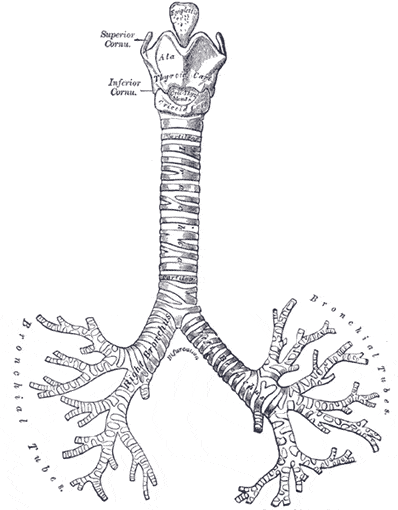
47.
What is the correct order of organization
a)
tissues-cells-organs-organ systems-organism
b)
cell-tissue-organs-organ systems-organism
c)
organism-cells-tissues-organ systems-organism
d)
tissues-cells-organs-organ sytems-organism
48.
A group of tissues that perform a similar function is called_____. (Examples include the heart, lungs or stomach)
a)
cells
b)
tissues
c)
organs
d)
organ system
49.
The two main branches from the trachea (one to each lung)
a)
bronchi
b)
alveoli
c)
capillaries
d)
bronchioles
50.

The structure supported by rings of cartilage

a)

Pharynx

b)

Larynx

c)

Epiglottis

d)

Trachea
