wayground logo

Free Printable Worksheets

Font size

S
M
L
XL
Worksheets

Thanksgiving Day Review

Total questions: 85

Worksheet time: 2hrs 47mins

Name
Class
Date
1.
TV dinners were created as the result of a 26 ton turkey surplus.
a)
TRUE
b)
FALSE
2.
What is this?
a)
apple pie
b)
pumpkin pie
c)
banana pie
d)
chocolate pie
3.
What are these?
a)
black berries
b)
blueberries
c)
strawberries
d)
cranberries
4.
What is this? 
a)
chicken
b)
turkey
c)
fish
d)
beef
5.
________________ is a federal holiday celebrated on the fourth Thursday in November.
a)
Halloween
b)
Thanksgiving
c)
Christmas
d)
Easter
6.
The first Thanksgiving was in 1621.  The Pilgrims invited the Native Americans to celebrate harvest.  The celebration lasted ______ days.
a)
1
b)
2
c)
3
d)
4
7.
The ______________ were a small group of people who sailed to America to start a new life.
a)
Native Americans
b)
Pilgrims
c)
English
d)
Americans
8.
The Pilgrims sailed on the _________________.
a)
Flower
b)
May
c)
Mayflower
d)
Flowery
9.
The Pilgrims came from __________ to America.
a)
England
b)
Guatamala
c)
Thailand
d)
Mexico
10.
The Pilgrims landed at ________________.
a)
Plymouth Rock
b)
California
c)
South Dakota
d)
Texas
11.
Many Americans watch NFL ____________ on Thanksgiving.
a)
Basketball
b)
Baseball
c)
Soccer
d)
Football
12.
Thanksgiving is on the _____________ Thursday in November.
a)
first
b)
second
c)
third
d)
fourth
13.
Name the picture.
a)
cornucopia
b)
candy
c)
corn
d)
apples
14.
____________ is a popular dessert after Thanksgiving dinner.
a)
Pumpkin pie
b)
Mashed potatoes
c)
Corn
d)
Apples
15.
Thanksgiving is in the ___________.
a)
Winter
b)
Spring
c)
Summer
d)
Fall
16.
What is the missing angle?
a)
61
b)
50
c)
60
d)
69
17.

Find the missing angle.

a)

55

b)

35

c)

45

d)

135

18.

A ________ is described as a location.

a)

point

b)

line

c)

plane

d)

collinear points

19.

A _____ is described as a straight, continuous arrangement of an infinite number of points.

a)

point

b)

line

c)

plane

d)

collinear points

20.

These are points that are all located on the same line.

a)

coplanar lines

b)

points

c)

collinear points

d)

skew lines

21.

This is described as a flat surface.

a)

point

b)

lines

c)

plane

d)

skew lines

22.

Coplanar lines are ___________.

a)

Two or more lines located on the same plane.

b)

Two or more lines located on different planes.

c)

Two or more parallel lines.

d)

Two or more non-parallel lines in different planes.

23.

These are lines that do not intersect and are not parallel.

a)

Skew lines

b)

Perpendicular lines

c)

Coplanar lines

d)

Collinear points

24.

The endpoint of a ray is _____________.

a)

The single point where a ray begins.

b)

The single point of a line.

c)

The end of infinity.

25.
What does the word BISECT mean?
a)
To cut something into more than five pieces.
b)
It is a plane with two sets of wings.
c)
A shape that has three sides. 
d)
To cut something into two congruent pieces or in half.
26.
A line that extends from a point in one direction and travels forever is called a ...
a)
perpendicular line
b)
line segment
c)
ray
d)
parallel line
27.
How would you describe points I, L, C?
a)
collinear
b)
non-coplanar
c)
symmetric
d)
coplanar
28.
Find HG.
a)
8
b)
9
c)
10
d)
11
29.
This point divides a line segment into 2 equal parts.
a)
point
b)
vertex
c)
midpoint
d)
segment
30.

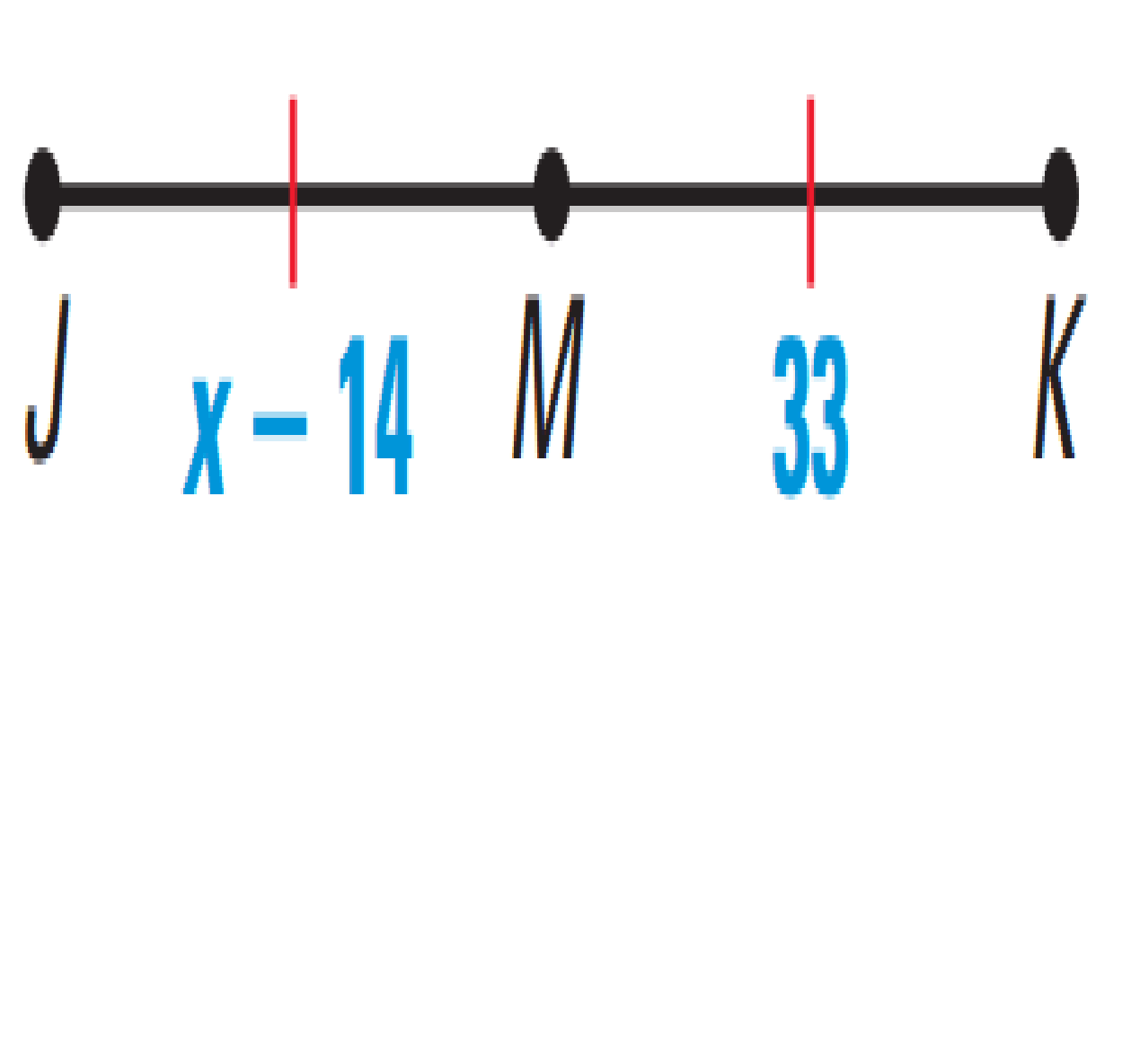
M is the midpoint of the line segment. Find the value of x.

a)

x=47

b)

x=19

c)

x=33

d)

x= -47

31.
What is the relationship of the angles?
a)
Corresponding angles
b)
Same Side Interior
c)
Alternate Interior
d)
Alternate Exterior
32.
Are lines j and k skew?
a)
yes
b)
no
33.
Lines DE, AB, and GC appear to be _________
a)
parallel
b)
perpendicular
c)
skew
34.
Find the value of ∠A.
a)
25°
b)
30°
c)
35°
d)
90°
35.
What is the midpoint between (-4,4) and (-2,2)?
a)
(3,2)
b)
(-3,3)
c)
(4,5)
d)
(6,7)
36.
Name the angle relationship.
a)
Alternate Interior
b)
Alternate Exterior
c)
Corresponding
d)
Vertical Angles
37.
What are supplementary angles?
a)
Angles that add up to 180°
b)
Angles that add up to 90°
c)
Angles that are equal to each other
d)
Angles that are opposite of each other when lines intersect
38.
Solve for y.
a)
y = 20
b)
y = 120
c)
y = 60
d)
y = 10
39.
What are complementary angles?
a)
Angles that add up to 180°
b)
Angles that add up to 90°
c)
Angles that are equal to each other
d)
Angles that are opposite of each other when lines intersect.
40.
State the angle relationship and find the measure of angle 1
a)
Alternate Interior
49
b)
Same Side Interior
131
c)
Same Side Interior
49
d)
Alternate Interior
131
41.
Which could be used to prove the lines are parallel?
a)
Converse of Alternate Interior Angle Theorem
b)
Converse of the Corresponding Angle Theorem
c)
Vertical Angles Theorem
d)
Cannot be proved parallel
42.
Which could be used to prove the lines are parallel?
a)
Converse of the Alternate Interior Angle Theorem
b)
Converse of the Same Side Interior Angle theorem
c)
Converse of the Corresponding Angle Theorem
d)
Cannot be proved parallel
43.
Which could be used to prove the lines are parallel?
a)
Converse of the Alternate Interior Angle Theorem
b)
Converse of the Corresponding Angles Theorem
c)
Converse of the Alternate Exterior Angle Theorem
d)
Cannot be proved parallel
44.
A turn is also called a ___________.
a)
Translation
b)
Reflection
c)
Rotation
d)
Transformation
45.
Identify the transformation from ABCD to A'B'C'D'.
a)
Translation
b)
Reflection across the y-axis
c)
Reflection across the x-axis
d)
90o counter clockwise Rotation
46.
Identify the transformation.
a)
Reflection across y-axis
b)
90 Rotation counter clockwise
c)
Translation 5 units left, 1 unit up.
d)
Translation 5 units right, 1 unit down
47.
Point (-5,2) is reflected over the y axis.  Where is the new point located?
a)
(5,2)
b)
(-5,-2)
c)
(-5,2)
d)
(5,-2)
48.
Choose the correct scale factor:
a)
2
b)
3
c)
1/3
d)
1/2
49.
What Transformation is visible?
a)
Reflection
b)
Translation
c)
Dilation
d)
Rotation
50.
What Transformation is visible?
a)
Translation
b)
Rotation
c)
Reflection
d)
Dilation
51.
What Transformation is visible?
a)
Reflection
b)
Rotation
c)
Dilation
d)
Translation
52.
What Transformation is visible?
a)
Translation
b)
Reflection
c)
Rotation
d)
Dilation
53.

What is this picture an example of?

a)

Translation

b)

Reflection

c)

Rotation

d)

Dilation

54.
Name the transformation.
a)
Translation
b)
Reflection
c)
Rotation
55.
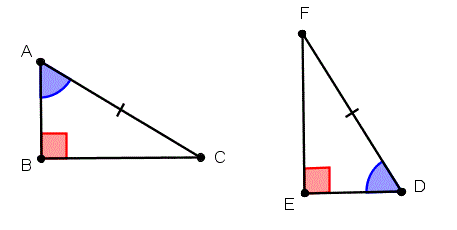
∠A ≅∠?
a)
∠B
b)
∠E
c)
∠D
d)
∠F
56.
∆PRQ≅∆SRT
a)
TRUE
b)
FALSE
57.
Solve for x
a)
30
b)
40
c)
50
d)
60
58.
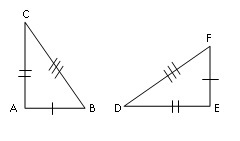
Are the triangles congruent, if yes, why?
a)
SSS
b)
SAS
c)
ASA
d)
Not Congruent
59.
Are the triangles congruent, if yes, why?
a)
SAS
b)
ASA
c)
SSS
d)
Not Congruent
60.
Are the triangles congruent, if yes, why?
a)
SSS
b)
ASA
c)
AAA
d)
Not Congruent
61.
Are the triangles congruent, if yes, why?
a)
SSS
b)
SAS
c)
ASA
d)
Not Congruent
62.
Name the postulate, if possible, that makes the triangles congruent.
a)
SSS
b)
SAS
c)
HL
d)
Not Possible
63.
Name the postulate, if possible, that makes the triangles congruent.
a)
SSS
b)
SAS
c)
ASA
d)
AAS
64.
Name the postulate, if possible, that makes the triangles congruent.
a)
SSS
b)
SAS
c)
ASA
d)
Not Possible
65.
The hypotenuse of a triangle is...
a)
Invisible
b)
A myth
c)
The side opposite the right angle in a right triangle
66.
What does CPCTC stand for?
a)
Congruent parts of congruent triangles are congruent
b)
Corresponding parts of congruent triangles are congruent
c)
Corresponding parts of corresponding triangles are corresponding
d)
Corresponding parts of congruent triangles are Canadian.
67.
Fill in the blank.
a)
Given
b)
Reflexive Property
c)
Transitive Property
d)
They're the same side!!!!!! 
68.
What is the reason?
a)
Definition of Angle
b)
Definition of Congruence
c)
Definition of bisects
d)
Definition of midpoint
69.
The figure is an example of a(n) ...
a)
median
b)
altitude
c)
midsegment
d)
sangle bisector
70.
Which of the following segments represents a median?
a)
Segment BX
b)
Segment AZ
c)
Segment AC
d)
Segment BZ
71.
The figure is an example of a(n) ...
a)
angle bisector
b)
perpendicular bisector
c)
median
d)
midsegment
72.
The figure is an example of a(n) ...
a)
altitude 
b)
perpendicular bisector
c)
midsegment
d)
angle bisector
73.
The figure is an example of a(n) ...
a)
angle bisector
b)
midsegment
c)
altitude
d)
median
74.
The figure is an example of a(n) ...
a)
midsegment
b)
perpendicular bisector
c)
altitude
d)
midsegment
75.

G is the centroid of triangle ABC

a)

22

b)

11

c)

3

d)

66

76.
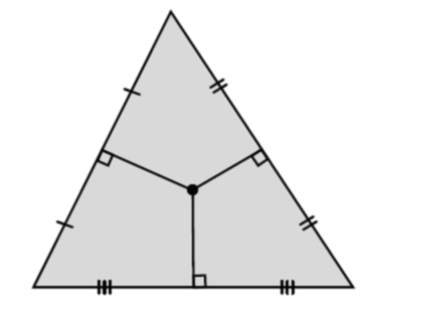
Name the point of concurrency shown.
a)
Circumcenter
b)
Incenter
c)
Supercenter
d)
Neither
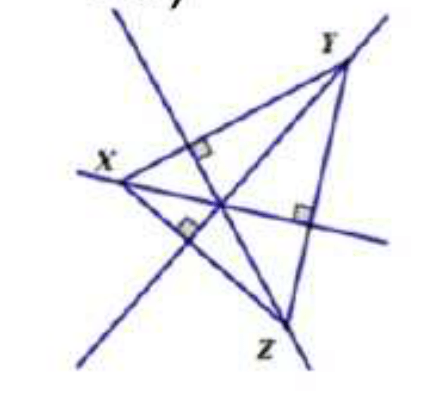
77.

What is the point of concurrency?

a)

Orthocenter

b)

Centroid

c)

Circumcenter

d)

Incenter

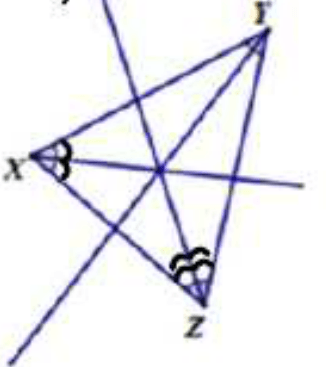
78.

What is the point of concurrency?

a)

Orthocenter

b)

Circumcenter

c)

Incenter

d)

Centroid

79.

Do these sides make a triangle? 9,19,30

a)

Yes

b)

No

80.

Do these sides make a triangle? 6, 5, 9

a)

Yes

b)

No

81.

Write an inequality showing the possible 3rd side of a triangle. 5 & 15

a)

5<x<15

b)

10<x<20

c)

15<x<5

d)

20<x<10

82.

Using hinge theorem which side is bigger?

a)

AR

b)

RB

c)

AC

d)

CR

83.

It divides each median into two sections at a 2:1 ratio.

a)

circumcenter

b)

incenter

c)

centroid

d)

orthocenter

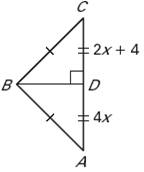
84.
Find the length of AD
a)
2
b)
4
c)
6
d)
8
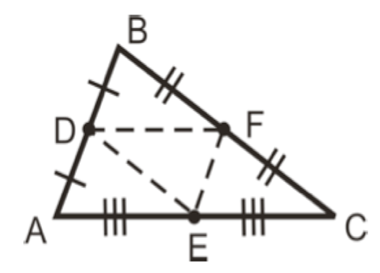
85.
If AC=42, find DF
a)
21
b)
84
c)
14
d)
28