
NEW
Font size
 Worksheets
Quiz No. 1 - Quick Mathematical Review
Total questions: 30
Worksheet time: 1hrs 7mins
Arises in data structure and algorithm because the running times of loops naturally give rise to summations.
Summation
Loop Invariant
Logarithms and Exponents


is a boolean statement that is true at the start of the loop (beginning) and at the end of each iteration (the loop invariant must be immediately true after exiting the loop)
Summation
Loop Invariant
Logarithms and Exponents
Some claims are of the generic form, “There is an element x in a set S that has property P”. To justify such a claim, we need only produce a particular x ∈ S that has property P. Likewise, some hard-to-believe claims are of the generic form, “Every element x in a set S has a property P.” To justify that such a claim is false, we need to only produce a particular x from S that does not have property P.
Counterexample
Contrapositive
Contradiction
Requires a bool condition satisfied
Pre condition
Post condtion
Loop condition
Ensures a bool condition is satisfied
Pre condition
Post condtion
Loop condition

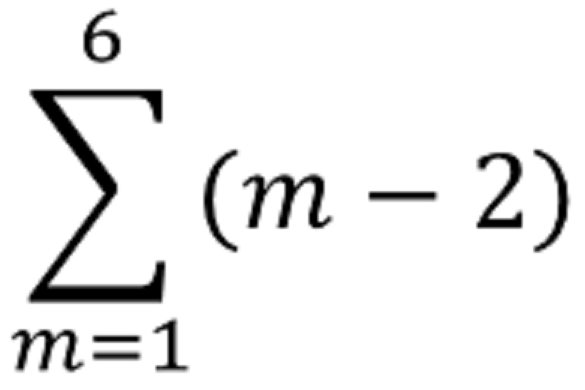
Determine the sum of the series.
144
180
176
68

Determine the sum of the series.
8.25
9
5
2.25

Determine the sum of the series.
194
388
197.5
216

Determine the sum of the series.
45
49
90
47

Determine the sum of the series.
-1
244
270
255

Determine the sum of the series.
1091
1149
540
1235

What is the contrapositive?
int count = 0;
while (count < 100) {
// Point A
System.out.println("Welcome to Java!");
count++;
// Point B
}
// Point C
is a sample space S together with a probability function, Pr, that maps subsets of S to real numbers in the interval [0, 1].
Probability Space
Probability Sample
Probability Function

What is the probability you will choose either a black or a white marble?
*remember to simplify*

which is defined as the set of all possible outcomes from some experiment.
Sample Space
Probability Space
Probability Function
Which of the following statements are true?
I. Sample Space = All possible outcomes
II. Sample Point = Each outcome (Each die from 1 to 6) or One possible outcome
III. Event = One or more of the possible outcomes (e.g. Probability <3 then 1 and 2 would be the only event)
I and III only
I and II only
II and III only
I, II, and III are all true
Theorem 1.13: For any integer n ≥ 1, we have i=1∑ni =2n(n+1)
True
False

Which of the following statements are true?
2,4,6,8 only
1,3, 5, 7 only
1,4,5,8 only
All of the above
Theorem 1.12: For any integer n ≥ 0 and any real number 0 < a ≠ 1, consider i=0∑nai = 1 + a + a2 +.... an remebering that a^0if a>0. This summation is equal to 1−an(1−an)+1
True
False
A notation that appears again and again in the analysis of data structures and algorithms is the summation, which is defined asi=a∑bf(i)=f(a)+f(a+1)+f(a+2)+...+f(b)
True
False

