
Font size
 Worksheets
dilations and transformations
Total questions: 40
Worksheet time: 1hrs 14mins

Which of the following describes the sequence of transformations shown?
Reflect across the x-axis and then rotate -90 degrees cw around the origin
Rotate 90 degrees cw around the origin and then translate down.
Reflect across the x-axis and then reflect across the y-axis.
Translate up and then rotate 90 degrees ccw about the origin.


(2, 6) -- Translate up 3, left 1 and rotate 180°
(-1,-9)
(1, -9)
(5,5)
(-5,5)
(-3, -1) -- Reflect across the line y=x and translate down 1.
(-1, -4)
(-1, -2)
(3, 0)
(-2, -3)

Choose the correct transformations
rotate 90 degrees counter-clockwise around the origin, and then reflect over the x-axis
right 1, down 4, and then reflection over the y-axis
right 6, and then reflection over the x-axis
reflection over the line y=x, and then translate up 4, right 2


(x , y + 6) the figure will move _____.
(x - 4, y) the figure will move _____.


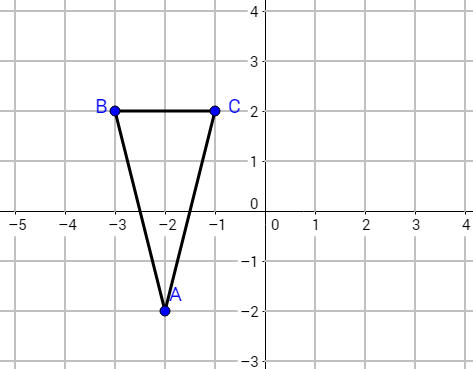
When A(3, 6) is under a dilation of 2 what are the coordinates of A'?
(3, 6)
(1.5, 3)
(6, 12)
(12, 6)

Triangle EFG is dilated with a scale factor of 1/2. The measure of <F is 36 degrees. What is m<F' ?
18
36
72
A triangle is dilated with a center of dilation at the origin. Point P is on the figure and P' is the corresponding point on the image of the dilation. Point P is at (-2,3) and P' is at (-8,12). What is the scale factor?
2
4
6
9

What is the length of BC?
6 2/3 cm
5 cm
4 cm
6 cm
Triangle ABC is dilated to produce A'B'C' with a scale factor of 3/4. Which describes the relationship between the two triangles?
A'B'C' is an enlargement
A'B'C' is a reduction
A'B'C' is congruent to ABC
A'B'C' is a mirror image of ABC
A triangle has vertices at (1,1), (1,2), and (3,2). It is dilated by a scale factor of 3 with the origin as the center of dilation. What are the coordinates of the image?
(4,1) (4,2) (6,2)
(1,4) (1,5) (3,5)
(3,3) (3,6) (9,6)


Given the triangles are similar. Which is the length of UV?
3.6 inches
2.4 inches
8.1 inches
4 inches
Which of the following are true about dilations? Select all that apply.
Dilations have the same shape as the original.
Dilations can be enlargements of the original image.
Dilations can be reductions of the original image.
Dilations are always congruent.

Rectangle ABCD is dilated to form rectangle A'B'C'D'.
What is the scale factor?
2
1/2
(1,2)
(2,1)
Suppose <G=<S, <R=<T, <M=<N.
Which statement is correct? Select all that apply.
The sides are proportional
The sides are congruent
GRM is similar to NST
MGR is congruent to NST


