
 Worksheets
States of Matter 1st yr JCT COL
Total questions: 35
Worksheet time: 24mins
Name
Class
Date
1.
Anything that takes up space.
a)
matter
b)
volume
c)
mass
2.
The amount of space that matter takes up.
a)
matter
b)
volume
c)
mass
3.
The amount of matter in an object.
a)
matter
b)
volume
c)
mass
4.
Why does a substance change from one state of matter to another?
a)
The substance’s size changes.
b)
The substance’s temperature changes.
c)
The substance turns into a different kind of matter.
5.
What are the states of matter?
a)
solid, liquid, and juice
b)
solid and liquid
c)
solid and gas
d)
solid, liquid, and gas
6.
Matter that has its own shape and takes up space.
a)
solid
b)
liquid
c)
gas
7.
How is a gas defined?
a)
no shape, no volume
b)
Definite shape, definite volume
c)
Found in stars
d)
Definite volume, no shape
8.
Molecules are closest together in a
a)
Solid
b)
Liquid
c)
Gas
d)
plasma
9.
Define a liquid
a)
no shape, no volume
b)
Definite shape, definite volume
c)
Found in stars
d)
Definite volume, no shape
10.

Bonus Question: Change of state from a solid directly to a gas is called
a)
deposition
b)
melting
c)
evaporation
d)
sublimation
11.
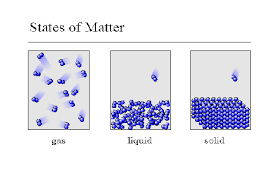
At higher temperatures
a)
particles in an object have less energy
b)
particles in an object move faster
c)
a gas contracts
12.
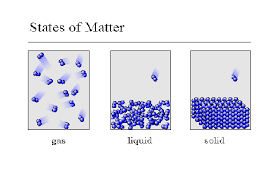
A gas
a)
has a definite shape but no definite volume
b)
has a definite volume but no definite shape
c)
has fast-moving particles
13.
Freezing
a)
Solid to gas
b)
Liquid to solid
c)
Gas to solid
d)
Liquid to gas
14.
Boiling
a)
liquid to gas
b)
gas to solid
c)
gas to liquid
d)
solid to liquid
15.
Particles of a liquid
a)
are tightly packed together and stay in a fixed position.
b)
have no viscosity.
c)
decrease in volume with increasing temperature.
d)
are free to move around one another but still touch.
16.
What term describes a solid changing to a gas?
a)
Deposition
b)
Sublimation
c)
Evaporation
d)
Freezing
17.
What is condensation?
a)
gas to solid
b)
gas to liquid
c)
liquid to solid
d)
solid to liquid
18.
Which has a greater distance between particles?
a)
Solid
b)
Liquid
19.
The slower the particles in a substance move,
a)
the colder it is.
b)
the warmer it is.
c)
the more energy it has.
d)
the less energy it has.
20.
A chemical change
a)
doesn't really change much.
b)
creates a new substance
c)
is a change in the state of matter
21.
A physical change is...
a)
a change that doesn't change the identity
b)
a change that makes something new.
c)
a chemical reaction
22.
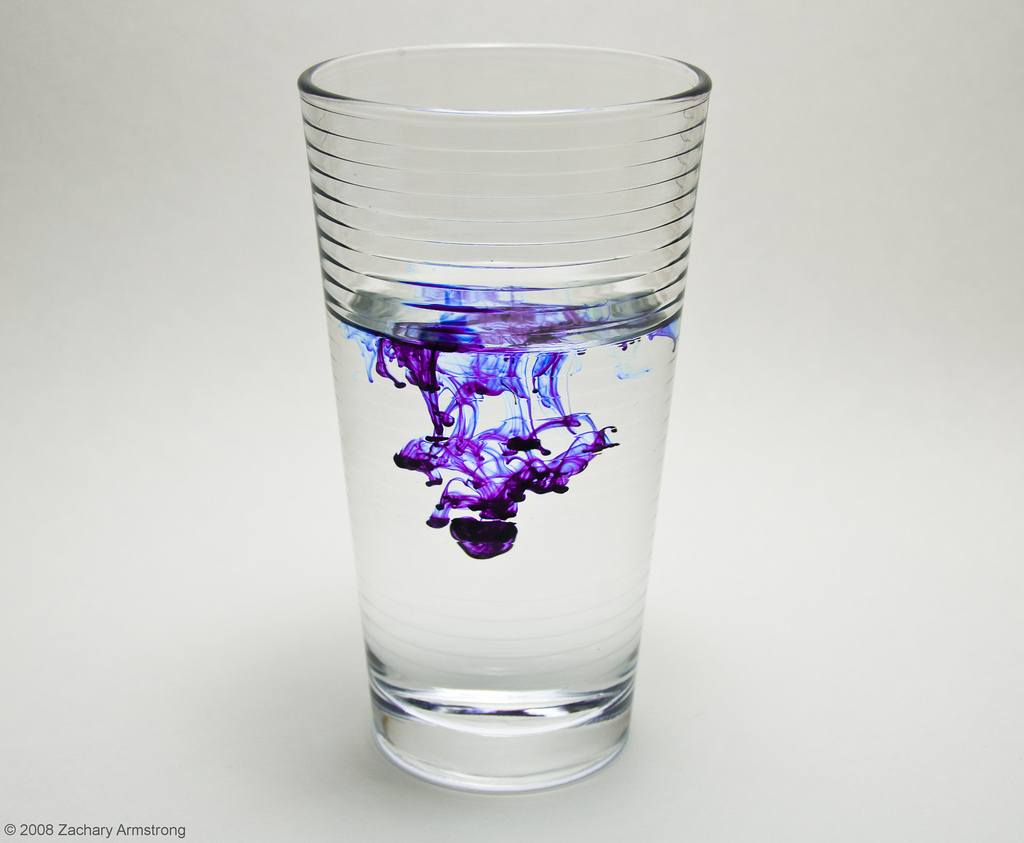
Where is there a low concentration of dye?
a)
at the bottom of cup
b)
in the color
c)
at the top of cup
d)
no concenteraion gradient
23.
An increase in temperature does what to diffusion?
a)
Speeds it up
b)
Slows it down
c)
Has no effect
d)
I wish i knew. Really I do.
24.
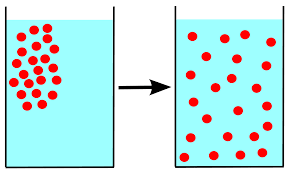
The picture below is an example of _________________.
a)
osmosis
b)
isotonic
c)
diffusion
d)
active transport
25.
Evidence of Chemical Change.
a)
New Substance
b)
Size change
c)
State change
d)
Mixture
26.
Evidence of a physical change.
a)
New substance
b)
Shape Change
c)
Light produced
d)
Gas released.
27.
Water boiling is a _______ change.
a)
Physical Change
b)
Chemical Change
28.
Water boiling is a _______ change.
a)
Physical Change
b)
Chemical Change
29.
Fireworks Exploding are a ________ change.
a)
Physical Change
b)
Chemical Change
30.
What kind of change occurs if matter changes in amount, size, or shape?
a)
substance change
b)
chemical change
c)
physical change
d)
elemental change
31.
Ice melting
a)
Chemical Change
b)
Physical Change
32.
Blue liquid and yellow liquid mixed to make a green liquid
a)
Chemical Change
b)
Physical Change
33.
Glass bottle that is shattered
a)
Chemical Change
b)
Physical Change
34.
Is melting butter for popcorn a chemical or physical change?
a)
chemical
b)
physical
35.

Is burning wood a chemical or physical change?
a)
chemical
b)
physical
100 %

