Wayground logo

Free Printable Worksheets

Font size

S
M
L
XL
Worksheets

Science: Elements and Separation Technique

Total questions: 30

Worksheet time: 19mins

Name
Class
Date
1.

How can we separate an insoluble solid from a liquid?

a)

chromatography

b)

evaporation

c)

filtration

d)

condensation

2.
Water and alcohol are easily separated by distillation because of their
a)
different densities
b)
different boiling points
c)
different colours
d)
different melting points
3.

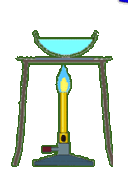
Which one of the following is the name for separation technique in the picture below

a)

distillation

b)

filtration

c)

evaporation

d)

chromatography

4.

Dyes in water soluble markers may be separated by means of

a)

Distillation

b)

Filtration

c)

Chromatography

d)

Evaporation

5.

Which separation technique is shown below

a)

filtration

b)

crystallization

c)

sublimation

d)

evaporation

6.

Which separation technique is shown below

a)

using a magnet

b)

separating funnel

c)

Centrifuging

d)

Chromatography

7.
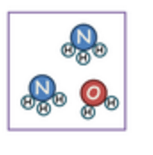
This picture represents: 
a)
Element
b)
Compound
c)
Mixture of Elements
d)
Mixture of Compounds
8.

Salt dissolved in water.

What method would you use to separate this mixture so that you can get the salt AND the water?

a)

evaporation

b)

distillation

c)

chromatography

d)

filtration

9.
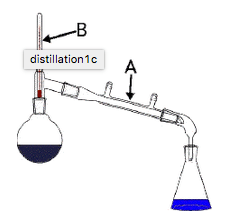
In the distillation apparatus shown, what are the parts labelled A and B?
a)
A = funnel, B = thermometer
b)
A = thermometer, B = funnel
c)
A = condenser, B = flask
d)
A = condenser, B = thermometer
10.
No matter what you do, sand will not dissolve in water, sand is _________ ?
a)
dissolved
b)
soluble
c)
insoluble
d)
aqueous
11.
Evaporation is a process that removes a...
a)
solvent (liquid part of solution)
b)
solute (material that dissolves in the solvent)
c)
distillate (liquid collected after a solution is distilled)
d)
impurity
12.
An example of a mixture is 
a)
Water and oil
b)
Cereal and Milk 
c)
Sand and water 
d)
All of the above
13.
Which one of the following solids is insoluble in water?
a)
sugar
b)
sand
c)
copper sulfate
d)
salt
14.
Two or more substances mingled together, but not chemically combined are known as a
a)
residue
b)
solution
c)
distillate
d)
mixture
15.

Which one of the following is NOT considered a mixture?

a)

Sugar

b)

Paint

c)

Crude oil

d)

Air

16.

A separation technique which uses a fractionating column to separate different liquid components within a mixture by the different boiling points is called...

a)

Fractional distillation

b)

filtration

c)

crystallization

d)

evaporation

17.
Boiling point is a point at which liquid turns in to..
a)
solid
b)
liquid
c)
molten
d)
gas
18.
What is a solvent?
a)
The substance that does the dissolving in a solution.
b)
The substance that is being dissolved in a solution.
c)
The mixing of different substances.
d)
The process in which neutral molecules lose or gain electrons
19.

In the above picture, a powder is about to be poured into the liquid. Which of the following should be done to make this powder dissolve faster?

a)

stir the powder in the liquid

b)

freeze the mixture

c)

add more powder to the liquid

d)

store the mixture in a dark place

20.

This picture represents which of the following?

a)

element

b)

compound

c)

mixture

d)

suspension

21.

This picture represents which of the following?

a)

element

b)

compound

c)

mixture

d)

suspension

22.
What is the picture displayed?
a)
atom
b)
element
c)
molecule
d)
compound
23.

Which example is a compound?

a)

N2

b)

O2

c)

Cu

d)

H2O2

24.
A combination of two or more substances that can be easily separated.
a)
dissolve
b)
mixture
c)
solution
d)
physical property
25.
One or more substances dissolve in another and cannot be easily separated.
a)
mixture
b)
solution
c)
dissolve
d)
solute
26.
the substance to be dissolved in a liquid
a)
solute
b)
solvent
c)
dissolve
d)
mixture
27.
characteristics that can be used to classify matter
a)
mixture
b)
solution
c)
solute
d)
physical property
28.
True or false: A mixture can be separated by physical means.
a)
True
b)
False
29.
How is a compound different from an element?
a)
An element has only one atom, while a compound has more than one
b)
A compound always has subscripts, while an element does not
c)
A compound has more than one type of atom in each molecule, while an element has the same type of atoms
d)
An element is a pure substance, while a compound is not
30.

Chalk is a compound made of ....

a)

calcium, carbon, oxygen

b)

calcium, oxygen,hydrogen

c)

oxygen, carbon, nitrogen

d)

oxygen, carbon, hydrogen