wayground logo

Free Printable Worksheets

Font size

S
M
L
XL
Worksheets

GEO 500

Total questions: 500

Worksheet time: 125hrs 0mins

Name
Class
Date
1.
Translations, reflections and rotations are all known as ________________________.
a)
Geometry
b)
Transformations
c)
Congruent
2.
Name the transformation.
a)
Translation
b)
Reflection
c)
Rotation
3.
When you translate, (x-4,y) will move _____.
a)
4 units right
b)
4 units left
c)
4 units up
d)
4 units down
4.
When you translate, (x,y+6) will move _____.
a)
6 units right
b)
6 units left
c)
6 units up
d)
6 units down
5.
Write a rule for the translation.
a)
 (x -1, y  + 2)
b)
 (x -2, y  + 1)
c)
 (x +2, y  - 1)
d)
(x +1, y  -  2)
6.
Identify the transformation from ABC to A'B'C'.
a)
90o clockwise rotation
b)
90o counter clockwise rotation
c)
Reflection across the y-axis
d)
Reflection across the x-axis
7.
Identify the transformation.
a)
Reflection across y-axis
b)
90 Rotation counter clockwise
c)
Translation 5 units left, 1 unit up.
d)
Translation 5 units right, 1 unit down
8.
The result of a transformation.
a)
Pre-image
b)
Image
9.
The original figure prior to a transformation.
a)
Pre-image
b)
Image
10.
Which answer shows a reflection across the y-axis?
a)
a
b)
b
c)
c
d)
d
11.
Name the transformation
a)
Reflection
b)
Rotation
c)
Translation
d)
Dilation
12.

Supply the second reason.

a)

Linear Pair Postulate

b)

Alternate Interior Angles Theorem

c)

Vertical Angles Theorem

d)

Corresponding Angles Postulate

13.

Supply the third reason.

a)

Vertical Angle Theorem

b)

Corresponding Angles Postulate

c)

Alternate Interior Angles Postulate

d)

Same Side Interior Angles Theorem

14.

The last statement is <4 = <6. What is the last reason

a)

Prove

b)

Definition of congruent angles

c)

Transitive Property

d)

Alternate Interior Angles Theorem

15.

1) Which statement restates the Given from the question?

a)
b)
c)
16.

2) Which statement represents what you have to prove from the question?

a)
b)
c)
17.

3) What is the reason for statement 2?

a)

Given

b)

Vertical Angle Theorem

c)

Corresponding Angles Postulate

d)

Alternate Interior Angles Theorem

18.

13) What is the reason for Statement 4?

a)

Substitution

b)

Converse of Alternate Exterior Angles Theorem

c)

Converse of Corresponding Angles Postulate

d)

Converse of Same-side Interior Angles Theorem

19.

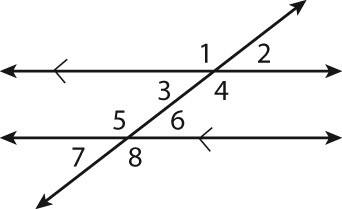
What is the relationship of ∠4 and ∠7?

a)

Corresponding Angles

b)

Alternate Interior Angles

c)

Alternate Exterior Angles

d)

Consecutive Interior Angles

e)

Linear Pair

20.

What is the relationship of ∠16 and ∠8?

a)

Corresponding Angles

b)

Alternate Interior Angles

c)

Alternate Exterior Angles

d)

Consecutive Interior Angles

e)

Linear Pair

21.

What is the relationship of ∠3 and ∠7?

a)

Corresponding Angles

b)

Alternate Interior Angles

c)

Alternate Exterior Angles

d)

Consecutive Interior Angles

e)

Vertical Angles

22.

What is the relationship of ∠12 and ∠14?

a)

Corresponding Angles

b)

Alternate Interior Angles

c)

Alternate Exterior Angles

d)

Consecutive Interior Angles

e)

Vertical Angles

23.

If A=B and B=C, then A=C. What is this property?

a)

Transitive

b)

Reflexive

c)

Symmetric

d)

Substitution

24.

If you know that angles 1 and 2 are vertical, what else do you know?

a)

Angles 1 and 2 are congruent

b)

Angles 1 and 2 are supplementary

c)

Angles 1 and 2 are right angles

d)

Angles 1 and 2 are corresponding angles

25.

Calculate m∠ABC.

a)

45°

b)

60°

c)

105°

d)

15°

26.

Calculate m∠DEF.

a)

180°

b)

60°

c)

120°

d)

80°

27.
a)

x = 6°

b)

x = 7°

c)

x = 12°

d)

x = 144°

28.
a)

x = 5°

b)

x = 11°

c)

x = 33°

d)

x = 55°

29.
a)

50°

b)

58°

c)

115°

d)

226°

30.

If m∠RST = (12x -1)°, m∠RSU = (9x -15)°,

and m∠UST = 53°, find each measure.

a)

x = 13

m∠RST = 155°

m∠RSU = 102°

b)

x = 3

m∠RST = 35°

m∠RSU = 12°

c)

x = 22

m∠RST = 263°

m∠RSU = 183°

d)

x = 8

m∠RST = 95°

m∠RSU = 57°

31.
Find the value of ∠A.
a)
25 degrees
b)
30  degrees
c)
35 degrees
d)
90 degrees
32.
What is another name for ∠H
a)
∠KGH
b)
∠LGH
c)
∠LHG
d)
∠K
33.

∠1 and ∠2 form a linear pair.

If m∠1 = (5x + 9)° and m∠2 = (3x + 11)°, find the measure of each angle.

a)

m∠1 = 110° and m∠2 = 70°

b)

m∠1 = 109° and m∠2 = 71°

c)

m∠1 = 70° and m∠2 = 110°

d)

m∠1 = 71° and m∠2 = 109°

34.

∠K and ∠L are complementary angles.

If m∠K = (3x + 3)° and m∠L = (10x -- 4)°, find the measure of each angle.

a)

m∠K = 24° and m∠L = 66°

b)

m∠K = 66° and m∠L = 24°

c)

m∠K = 40° and m∠L = 50°

d)

m∠K = 30° and m∠L = 60°

35.
Which of the following terms best describes Angle d?
a)
Remote interior angle
b)
Corresponding angle
c)
Exterior angle
d)
Interior angle
36.

Which two angles are the remote interior angles to Angle W?

a)

Angle X and Angle Y

b)

Angle X and Angle Z

c)

Angle Y and Angle Z

d)

Angle Z and Angle W

37.

Find the indicated angle. (What is ?)

a)

91°

b)

81°

c)

89°

d)

109°

38.
What is the measure of angle b?
a)
36o
b)
56o
c)
63o
d)
117o
39.

Find the indicated angle measure. (What is ?)

a)

51°

b)

37°

c)

167°

d)

41°

40.

Choose a correct equation to find x.

a)

4x - 2 + 12x + 1 = 75

b)

4x - 2 + 75 = 12x + 1

c)

4x - 2 + 75 + 12x + 1 = 180

d)

4x - 2 - 75

41.
Find the value of x.
a)
A
b)
B
c)
C
d)
D
42.
Solve for x.
a)
6
b)
8
c)
15
d)
13
43.
Fill in the reason for number 2. 
a)
Definition of congruent angles
b)
Complement Theorem
c)
Congruent Complement theorm
d)
Congruent Supplement Theorem
44.
Fill in the reason for number 5. 
a)
Definition of congruent angles
b)
Angle Addition Postulate
c)
Substitution Property
d)
Transitive Property
45.
Fill in the reason for number 3. 
a)
Angle Addition Postulate
b)
Addition Property
c)
Definition of congruent angles
d)
Given
46.
Fill in the reason for number 3. 
a)
Angle Addition Postulate
b)
Addition Property
c)
Definition of congruent angles
d)
Given
47.
Fill in the statement for number 4. 
a)
m<ABC = m<1 + m<2 ; m<EFG = m<3 + m<4
b)
m<ABC = m<1 + m<4 ; m<EFG = m<3 + m<2
c)
<ABC= <1+ <2 ;   <EFG=  <3+ <4
d)
<ABC = <1 + <4 ;  <EFG =  <3 +  <2
48.
Fill in the reason for number 5. 
a)
Addition Property
b)
Substitution
c)
Subtraction Property
d)
Transitiive
49.
Fill in the statement for number 3. 
a)
HA = AY
b)
HA = AP
c)
A is the midpoint of HP
50.
Fill in the reason for number 3. 
a)
Reflexive property
b)
Symmetric Property
c)
Transitive property
d)
Substitution property
51.
Fill in the statement for number 4. 
a)
RA=RE +AE
b)
EL = EA + AL
c)
RE +EA= EA +AL
d)
RA = EL
52.
Fill in the reason for 5. 
a)
Addition Postulate
b)
Substitution property
c)
Definition of midpoint
d)
Segment Addition Postulate
53.
Find the value of x.
a)
52
b)
63
c)
53
d)
58
54.
Find the value of x.
a)
22
b)
28
c)
23
d)
30
55.
Find the value of x.
a)
19
b)
15
c)
14
d)
11
56.
A turn is also called a ___________.
a)
Translation
b)
Reflection
c)
Rotation
d)
Transformation
57.
What would the new point be if you rotated the point (3,-5) 270° clockwise?
a)
a.  (-3,-5) 
b)
b.  (-5,-3) 
c)
c.  (5,3)
58.
Triangle B is rotated 90° counterclockwise with the origin as the center of rotation to create a new figure. Which triangle shows the new location?
a)
A
b)
B
c)
C
d)
D
59.
Dilate Point B by a scale factor of 1/2
a)
(1.5,-4)
b)
(-1.5,1)
c)
(-1,-1.5)
d)
(-2,-2)
60.
Dilate the point (6, 3) by a scale factor of 3. 
a)
(9, 6)
b)
(18, 9)
c)
(2, 1)
d)
(9, 9)
61.
The red triangle has been dilated by a scale factor of 1/4, which triangle is it's new image? 
a)
green triangle 
b)
red triangle 
c)
black triangle
d)
none of these 
62.
Triangle ABC is dilated using a scale factor of 1/2. What are the new coordinates of point A'?
a)
(-3, 3)
b)
(-12, 12)
c)
(-2, 2)
d)
(-4, 4)
63.
Triangle A is rotated 90° clockwise with the origin as the center of rotation to create a new figure. Which triangle shows the new location?
a)
A
b)
B
c)
C
d)
D
64.
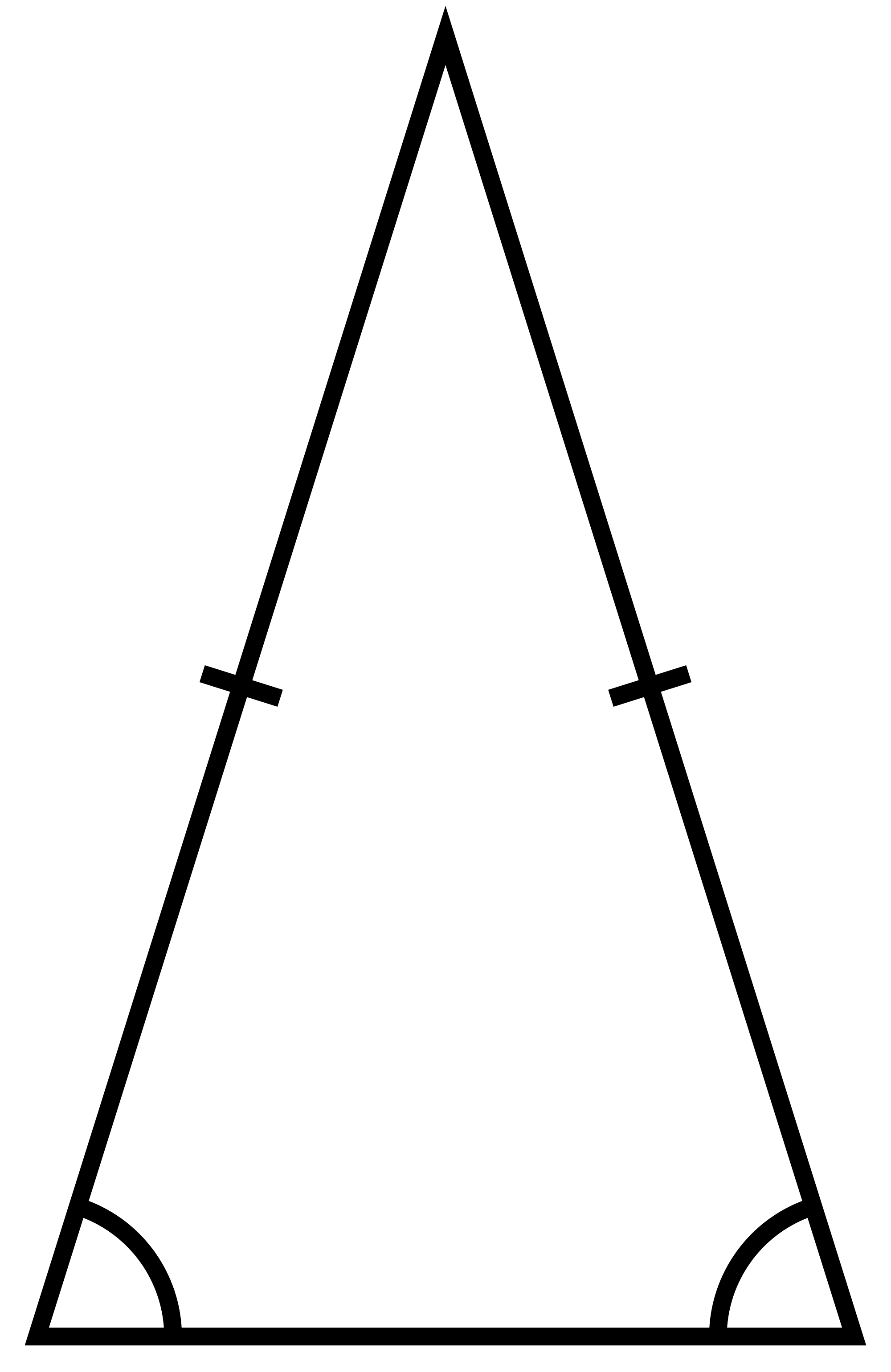
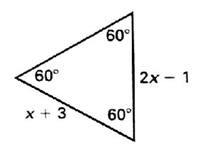
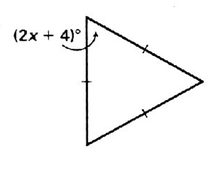
Classify the triangle by angles and sides.
a)
Right Scalene
b)
Acute Isosceles
c)
Obtuse Isosceles
d)
Equiangular Equilateral
65.
Classify the triangle by angles and sides.
a)
Equiangular Equilateral 
b)
All of the above
c)
Acute Equilateral 
d)
Acute Isosceles
66.
Classify the triangle by angles and sides.
a)
Right Scalene
b)
Right Isosceles
c)
Acute Isosceles
d)
Right Obtuse
67.
Classify the triangle by angles and sides.
a)
Obtuse Scalene
b)
Obtuse Isosceles
c)
Acute Isosceles
d)
Equiangular Scalene
68.
Classify the triangle by angles and sides.
a)
Obtuse Scalene
b)
Obtuse Isosceles
c)
Right Scalene
d)
Acute Isosceles
69.
Classify the triangle by angles and sides.
a)
Equiangular Equilateral
b)
Right Isosceles
c)
Right Scalene
d)
Acute Isosceles
70.
Classify the triangle by angles and sides.
a)
Equiangular Scalene
b)
Acute Scalene
c)
Acute Equilateral
d)
None of the above
71.
Classify the triangle by angles and sides.
a)
Right Scalene
b)
Equiangular Equilateral
c)
Obtuse Isosceles
d)
None of the above
72.
If L is the midpoint of TJ, what must be true?
a)
TL=JT
b)
JL=TJ
c)
TL=LJ
d)
T is also the midpoint of JL
73.
If DA bisects IE, then
a)
ID=ED
b)
IA=EA
c)
<IDA=<EDA
d)
<IAD and <EAD are right angles
74.
If AD bisects <EDI, then
a)
<ADE=<IDA
b)
IA=AE
c)
ID=ED
d)
All of the above
75.
If DA is perpendicular to IE, then we can immediately conclude that
a)
IA=AE
b)
<IAD = <DAE
c)
<IDA=<EDA
d)
<IAD and <DAE are right angles
76.
If DA bisects EI, then
a)
<IDA = <EDA
b)
AI=EA
c)
Both 1 and 2 are correct
d)
DI=ED
77.
If DA is the perpendicular bisector or EI, then
a)
<IAD and <DAE are right angles
b)
DI=DE
c)
EA=IA
d)
Both 1 and 3 are correct
78.
An angle bisector cuts an angle into two congruent _________
a)
Angles!
b)
Segments
c)
Mysteries
79.
A segment bisector cuts a segment into two congruent
a)
Segments!
b)
Angles
c)
Mysteries
80.
In this picture, we know for sure that
a)
<TEB=<ETS
b)
<BTE=<SET
c)
BE=ST
d)
Both 1 and 2 are correct
81.
In this picture,
a)
<BCA=<DCE because they are vertical angles and vertical angles are always congruent to each other
b)
<C=<C because they are vertical angles and vertical angles are always congruent to each other
c)
<EDC=<ACB because they are vertical angles and vertical angles are always congruent to each other
d)
None of the above; we don't actually have vertical angles
82.
If we know that <IAD and <DAE are both right angles, then we know for sure that 
a)
<ADI=<ADE
b)
IA=EA
c)
They are congruent to each other
d)
All of the above
83.

A line is named by...

a)

Any 2 points on the line, or a lowercase script letter.

b)

Any 3 points on the line.

c)

Any 1 point on the line.

d)

Any 3 points on the line, or a uppercase script letter.

84.
A plane is named by...
a)
Any 1 point on the plane.
b)
Any 3 collinear points on the plane or a lowercase script letter.
c)
Any 3 non-collinear points on the plane or an uppercase script letter.
d)
All points on the plane that aren't part of a line.
85.
An example of 2 non-collinear points.
a)
D, E
b)
C, B
c)
M, E
d)
F, B
86.
Give another name for line k.
a)
Line BC
b)
Line BCE
c)
Line ED
d)
Line k is the only name, there isn't another name.
87.
Two lines intersect at a ....
a)
angle
b)
point
c)
line
d)
intersection
88.
A line that contains point M.
a)
Line q
b)
Line p
c)
Line r
d)
Line NH
89.
A plane containing point A.
a)
Plane DEA
b)
Plane k
c)
Plane CDF
d)
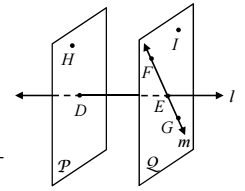
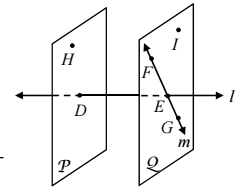
Plane F
90.
Are points D and E collinear or coplanar?
a)
Collinear
b)
Coplanar
91.
Give another name for plane Q.
a)
Plane FEGI
b)
Plane FEG
c)
Plane m
d)
Plane FGI
92.
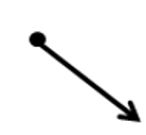
Part of a line. Has one endpoint and continues on forever in one direction.
a)
Line Segment
b)
Line
c)
Ray
d)
Point
93.
What is the term for a part of a line with two endpoints?
a)
point
b)
ray
c)
angle
d)
line segment
94.
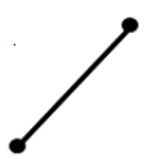
Name the image
a)
Line
b)
Ray
c)
Line segment
d)
Angle
95.
Slope is know as rise/
a)
run
b)
fall
c)
none
d)
rise
96.
What is the slope in the picture?
a)
Positive
b)
Negative
c)
Zero
d)
Undefined
97.
What is the slope in the picture?
a)
Positive
b)
Negative
c)
Zero
d)
Undefined
98.
What type of slope?
a)
undefined
b)
positive slope
c)
negative slope
d)
zero slope
99.
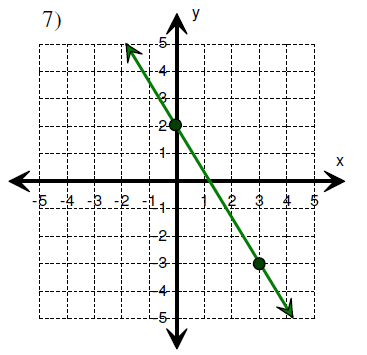
Find the slope
a)
-5/7
b)
7/5
c)
-7/5
d)
5/7
100.
Find the slope
a)
-5/3
b)
-3/5
c)
5/3
d)
3/5
101.
Find the slope
a)
5/2
b)
-5/2
c)
2/5
d)
-2/5
102.
Find the slope of the line that passes through
(10, 1) and (5, 2)
a)
1/5
b)
-1/5
c)
5
d)
-5
103.
Find the slope of the line that passes through 
(-4, 7) and (-6, -4)
a)
2/11
b)
-2/11
c)
11/2
d)
-11/2
104.
Find the slope of the line that passes through the points (2, 4) and (6, 12)
a)
1/2
b)
-1/2
c)
2
d)
-2
105.
In the equation y=mx+b, what does the m represent?
a)
slope
b)
y-intercept
c)
linear
d)
point-slope
106.
What is the slope in the equation y=2x + 3?
a)
2
b)
3
c)
5
d)
Cannot be Determined 
107.
What is the slope of all horizontal lines?
a)
0
b)
undefined
c)
1
d)
-1
108.
What is the distance between (-5, 5) and (1, -2)
a)
9.2
b)
12.6
c)
14
d)
7.8
109.
What is the midpoint between (8, -3) and (2, 5)
a)
(5, 1)
b)
(10, 2)
c)
(-5, -1)
d)
(3, 4)
110.
What is the distance between (-4, 2) and (-4, -4)
a)
1
b)
6
c)
5.8
d)
6.7
111.
What is the distance between the two points?
a)
6.3
b)
6.5
c)
6.7
d)
16
112.
Find the midpoint of point J and K
a)
(-3,3)
b)
(1,3)
c)
(-1,3)
d)
(2, 2.5)
113.
Find the point P that partitions the line segment AB given the ratio.
A (-5, 8) B(9, 3) with the ratio 2:5
a)
(12, 1.6)
b)
(-1, 7.6)
c)
(-1, 6.6)
d)
(13, 1.6)
114.
Find the point P that partitions the line segment AB given the ratio.
A (3, 5) B(4, 3) with the ratio 3:1
a)
(3.75, 2.5)
b)
(3.75, 3.5)
c)
(4.75, 1.5)
d)
(5.75, 1.5)
115.

Find the point P that partitions the line segment AB given the ratio.

A (3, 5) B(4, 3) with the ratio 1:3

a)

(3.75, 2.5)

b)

(3.25, 4.5)

c)

(4.75, 1.5)

d)

(5.75, 1.5)

116.
Point M with coordinates (3,4) is the midpoint of the line AB and A has the point (-1,6). What is the point of B?
a)
(1,5)
b)
(2,10)
c)
(7,2)
d)
(1,2)
117.

What is the endpoint of the line segment if the other endpoint is (5, 1) and the midpoint is (3, 3)?

a)

(1, 5)

b)

(3, 3)

c)

(5, 1)

d)

None of the above

118.
Find m< JKM
a)
90
b)
76
c)
38
d)
83
119.
Find HG
a)
28
b)
14
c)
41
d)
7
120.
Find LK
a)
3
b)
5
c)
-3
d)
6
121.
Find PQ
a)
10
b)
3
c)
-2
d)
5
122.
Find AD AND BC
a)
5;12
b)
16;4
c)
12; 16
d)
5;16
123.
Find the measure of QA
a)
28
b)
39
c)
14
d)
20
124.
Find the measure of Angle NJZ
a)
50 degrees
b)
40 degrees
c)
38 degrees
d)
76 degrees
125.
a)
x=67
b)
x=43
c)
x=55
d)
x=12
126.
If < ABC= 103⁰, find m< ABD
a)
45
b)
13
c)
57
d)
46
127.
What is the length of DC
a)
4
b)
1
c)
2
d)
3
128.
Find x
a)
10
b)
32
c)
116
d)
16
129.
Find X if abc is an equilateral triangle.
a)
2
b)
4
c)
6
d)
8
130.

Find the value of x.

a)

17°

b)

21°

c)

23°

d)

26°
131.
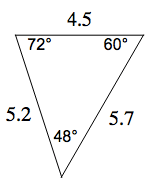
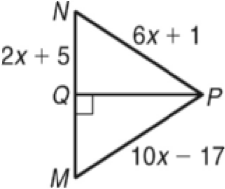
Look at the sides of this triangle. What type of triangle is this?
a)
Equilateral
b)
Isosceles
c)
Scalene
d)
Obtuse
132.
Solve for x.
a)
-8
b)
-6
c)
7
d)
-1
133.
Find the measure of the indicated angle. 
a)
34
b)
46
c)
62
d)
36
134.
Find x.
a)
x = 118
b)
x = 31
c)
x = 23
d)
x = 62
135.
Find x
a)
3
b)
4
c)
2
d)
10
136.
Find x
a)
60
b)
48
c)
30
d)
28
137.
Identify any common angles or sides
a)
JK
b)
Angle MJK
c)
LK
d)
Angle MKJ
138.
Identify common angles or sides
a)
Angle E
b)
Angle D
c)
Angle F
d)
Angle DGF
139.
The red (ΔKNM) and blue (ΔPLM) triangles are congruent. Identify a common side or angle.
a)
Angle M
b)
Angle P
c)
Angle K
d)
Angle MLP
140.
The red and blue triangles are congruent. Identify a common side or angle.
a)
Side DF
b)
Angle E
c)
Angle G
d)
Angle GDE
141.
The red and blue triangles are congruent. Identify a common side or angle.
a)
Side XY
b)
Side XZ
c)
Angle TWZ
d)
Side YT
142.
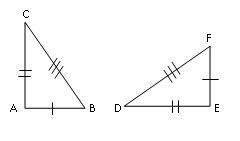
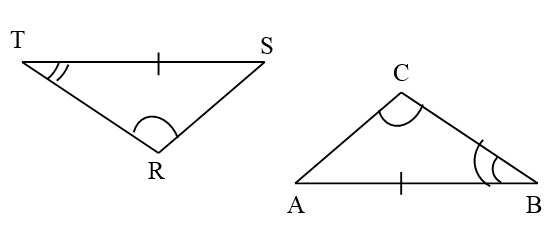
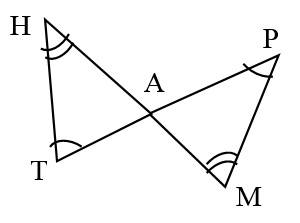
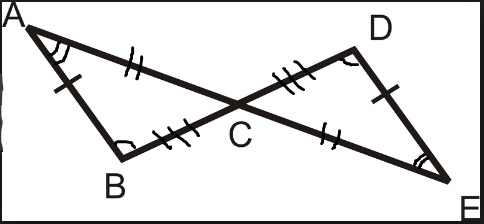
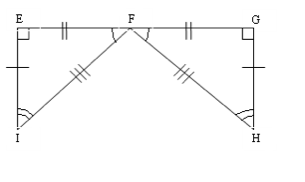
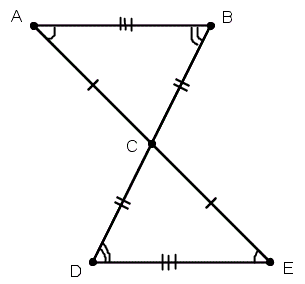
Name the postulate, if possible, that makes the triangles congruent.
a)
SSS
b)
SAS
c)
ASA
d)
Not Possible
143.
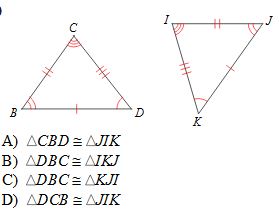
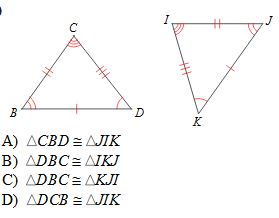
Which is a correct congruence statement.
a)
A
b)
B
c)
C
d)
D
144.
Name the postulate, if possible, that makes the triangles congruent.
a)
SAS
b)
ASA
c)
AAS
d)
Not Possible
145.
Name the postulate, if possible, that makes the triangles congruent.
a)
SAS
b)
ASA
c)
AAS
d)
Not Possible
146.
Name the postulate, if possible, that makes the triangles congruent.
a)
SSS
b)
ASA
c)
AAS
d)
Not Possible
147.
Name the postulate, if possible, that makes the triangles congruent.
a)
SAS
b)
ASA
c)
AAS
d)
Not Possible
148.
Name the postulate, if possible, that makes the triangles congruent.
a)
SSS
b)
SAS
c)
ASA
d)
AAS
149.
Which of the following is not a valid reason to prove congruent triangles?
a)
SSA
b)
AAS
c)
SAS
d)
SSS
150.
What additional information is required for the 2 triangles to be congruent by SAS?
a)
A
b)
B
c)
C
d)
D
151.
Which triangle congruence theorem can be used to prove the triangles are congruent?
a)
ASA
b)
SSS
c)
SAS
d)
HL
152.
Do we have enough information to say these two triangles are congruent? If so, what allows us to say this?
a)
No
b)
Yes, SSS
c)
Yes, HL
d)
Yes, SAS
153.
Define: CIRCUMCENTER OF A TRAINGLE
a)
the intersection point of the three perpendicular bisectors of a triangle 
b)
when a circle passes through the three vertices of a triangle 
c)
the point of intersection of three or more lines 
d)
the intersection point of the three angle bisectors of a triangle 
154.
Define: INCENTER OF A TRIANGLE
a)
the intersection point of the three angle bisectors of a triangle 
b)
when three or more lines intersect at a single point 
c)
the intersection point of the three perpendicular bisectors of a triangle 
d)
the point of intersection of three or more lines 
155.
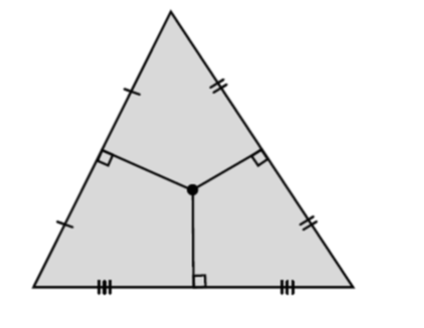
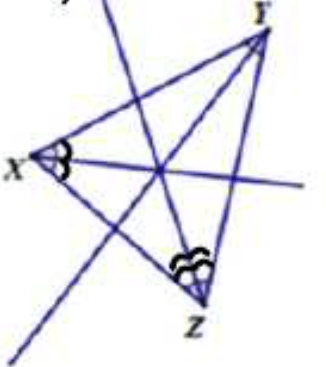
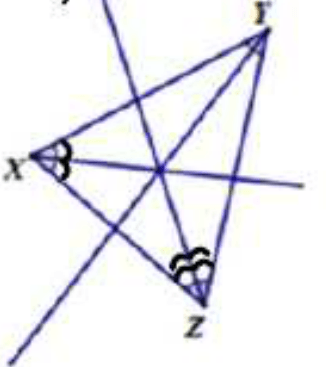
Which of the images represents the Circumcenter of a Triangle
a)
First
b)
Second
c)
Third
156.
Which of the images represents the Incenter of a Triangle
a)
First
b)
Second
c)
Third
157.
Which point is equidistant from the vertices?
a)
Circumcenter
b)
Incenter
c)
Neither
d)
Bilateral
158.
Which point is equidistant from the sides?
a)
Circumcenter
b)
Incenter
c)
Neither
d)
Bilateral
159.
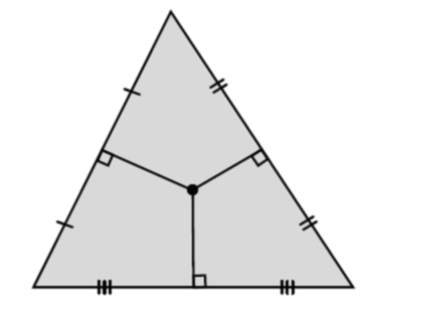
Name the point of concurrency shown.
a)
Circumcenter
b)
Incenter
c)
Supercenter
d)
Neither
160.
Name the point of concurrency shown.
a)
Circumcenter
b)
Incenter
c)
Supercenter
d)
Neither
161.
Name the point of concurrency shown.
a)
Circumcenter
b)
Incenter
c)
Supercenter
d)
Neither
162.
Name the point of concurrency shown.
a)
Circumcenter
b)
Incenter
c)
Neither
d)
Center-center
163.
Name the point of concurrency shown.
a)
Circumcenter
b)
Incenter
c)
neither
d)
Pokecenter
164.
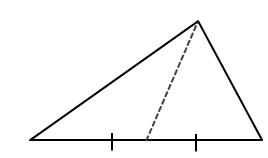
The figure is an example of a(n) ...
a)
angle bisector
b)
perpendicular bisector
c)
median
d)
midsegment
165.
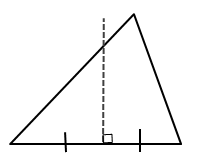
The figure is an example of a(n) ...
a)
altitude 
b)
perpendicular bisector
c)
midsegment
d)
angle bisector
166.
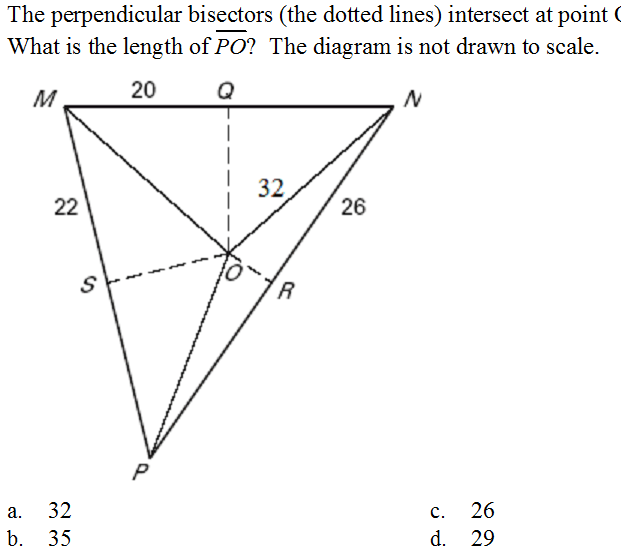
Find the length of PO.
a)
32
b)
35
c)
26
d)
29
167.
Given:  AG = 10, find the length of BG.
a)
10
b)
20
c)
5
d)
30
168.
If m∠CAP = 34° , find ∠CAB.
a)
17°
b)
34°
c)
68°
d)
90°
169.
Find the length of TU
a)
15
b)
12
c)
26
d)
13
170.
HK and JK are angle bisectors of the triangle. Find the distance from K to side GJ.
a)
50
b)
16
c)
21
d)
not enough information
171.
1.  If m<LJK = 28°, what is m<MLK?
a)
56
b)
112
c)
62
d)
124
172.
1.  PQ  is the perpendicular bisector of MN. What is QN?
a)
7
b)
14
c)
10.5
d)
28
173.
1.  Point Z is the circumcenter of ΔRST. What is TZ?
a)
3
b)
5
c)
4
d)
6
174.
1.  Point Z is the circumcenter of ΔRST. What is TZ?
a)
3
b)
5
c)
4
d)
6
175.
If m<CAP=340 , find m<CAB.
a)
170
b)
340
c)
680
d)
900
176.
What is the length of AB?
a)
7.1
b)
7.8
c)
8.7
d)
8.9
177.
Find the point P that partitions the line segment AB given the ratio.
A (-5, 8) B(9, 3) with the ratio 2:5
a)
(12, 11/7)
b)
(-1, 53/7)
c)
(-1, 46/7)
d)
(13, 11/7)
178.
What is statement #2?
a)
∠ABC≅∠EDC
b)
∠BCA≅∠DCE
c)
BC≅CD
d)
∠E≅∠A
179.
What is reason #4?
a)
ASA
b)
SAS
c)
HL
d)
AAS
180.
Determine if the triangles are congruent, if "yes" state the theorem.
a)
not congruent
b)
yes, SSS
c)
yes, SAS
d)
yes, ASA
181.
Write a rule for the translation.
a)
 (x -1, y  + 2)
b)
 (x -2, y  + 1)
c)
 (x +2, y  - 1)
d)
(x +1, y  -  2)
182.
Identify the transformation from ABC to A'B'C'.
a)
90o clockwise rotation
b)
90o counter clockwise rotation
c)
Reflection across the y-axis
d)
Reflection across the x-axis
183.
What is the angle of rotation for this counterclockwise rotation about the origin?
a)
90°
b)
180°
c)
270°
d)
360°
184.
What is the measure of angle b?
a)
36o
b)
56o
c)
63o
d)
117o
185.
a)
A
b)
B
c)
C
d)
D
186.
Which of the following constructions is illustrated?
a)
An angle is congruent to a given angle
b)
The bisector of a given angle
c)
The bisector of a given segment
d)
The perpendicular bisector of a given segment.
187.
Name the construction.
a)
Angle bisector
b)
Perpendicular line to a point not on a line
c)
Perpendicular line to a point on the line
d)
Perpendicular bisector of a line segment
188.
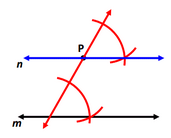
Name the construction.
a)
Corresponding angles
b)
Parallel line to a point not on the line
c)
Perpendicular line to a point not on the line
d)
Angle bisector
189.
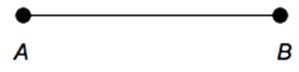
When copying line segment AB using a straight edge and a compass, the compass should be used to:
a)
Draw an arc above point A
b)
Measure the length of segment AB
c)
Draw an arc between point A and point B
d)
Measure half the length of line segment AB
190.
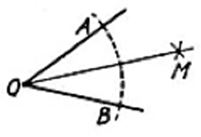
When bisecting an angle, the straightedge should be used to:
a)
Mark the point M
b)
Measure the angle AOB
c)
Copy the angle with an arc
d)
Connect point M and vertex O
191.
What type of construction do you see?
a)
midpoint
b)
angle bisector
c)
perpendicular bisector
d)
altitude
192.
What was duplicated?
a)
line
b)
line segment
c)
ray
d)
angle
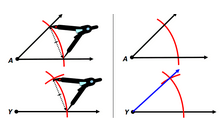
193.
Name the construction.
a)
Angle bisector
b)
Di-sect an angle
c)
Copy an angle
d)
Vertical angles
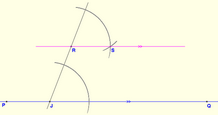
194.
In the image, line RS is _______ to line JQ.
a)
parallel
b)
congruent
c)
similar
d)
perpendicular
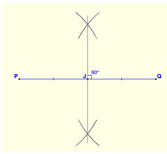
195.
Which one is the correct construction for a perpendicular bisector?
a)
1
b)
2
c)
3
d)
4
196.
This construction forms a __________.
a)
Perpendicular Bisector
b)
Perpendicular Line
c)
A lowercase "t" flipped to the side
d)
Line Segment
197.
What does the word BISECT mean?
a)
To cut something into more than five pieces.
b)
It is a plane with two sets of wings.
c)
A shape that has three sides. 
d)
To cut something into two congruent pieces or in half.
198.

Find the value of x.

a)

15

b)

16

c)

18

d)

19

199.

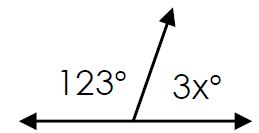
Tell whether the angles are complementary or supplementary. Then find the value of x.

a)

Complementary; x=25

b)

Complementary; x=5

c)

Supplementary; x=25

d)

Supplementary; x=5

200.

What are complementary angles?

a)

Angles that add up to 180°

b)

Angles that add up to 90°

c)

Angles that are equal to each other

d)

Angles that are opposite of each other when lines intersect.

201.

What are supplementary angles?

a)

Angles that add up to 180°

b)

Angles that add up to 90°

c)

Angles that are equal to each other

d)

Angles that are opposite of each other when lines intersect

202.
a)

x = 118

b)

x = 108

c)

x = 28

d)

x = 58

203.

Solve for x

a)

20

b)

25

c)

120

d)

180

204.

Solve for x

a)

5

b)

90

c)

25

d)

10

205.

Find the value of x.

a)

61

b)

40

c)

54

d)

47

206.

Find the value of x.

a)

17

b)

28

c)

68

d)

39.5

207.

Find the value of x.

a)

13

b)

5

c)

55

d)

54

208.
a)

x = 56

b)

x = 66

c)

x = 156

d)

x = 166

209.

These angles are...

a)

Complementary

b)

Supplementary

c)

Neither

210.

Find the value of x.

a)

70

b)

10

c)

3

d)

103

211.

Find the value of x.

a)

41

b)

44

c)

128

d)

38

212.

Choose all that apply: Which angle measurements below are supplementary to each other?

a)

144 and 36

b)

36 and 54

c)

40 and 50

d)

126 and 54

e)

21 and 159

213.

Choose all answers that apply: Find the angle measurements that are complementary to each other.

a)

75 and 105

b)

75 and 15

c)

25 and 65

d)

34 and 146

e)

38 and 52

214.

Choose all answers that apply. Which of the following angles are supplementary?

a)

42 and 48

b)

12 and 78

c)

78 and 102

d)

38 and 142

215.

Solve for x.

a)

7

b)

10

c)

14

d)

17

216.

Find the value of x.

a)

31

b)

61

c)

91

d)

1

217.

Find the value of x.

a)

15

b)

30

c)

45

d)

60

218.
These angles are...
a)
Complementary
b)
Supplementary
c)
Neither
219.
These angles are...
a)
Complementary
b)
Supplementary
c)
Neither
220.
Find the missing angle.
a)
60
b)
70
c)
50
d)
140
221.
Find the missing angle.
a)
41
b)
32
c)
51
d)
31
222.
What is the measure of the missing angle?
a)
76
b)
86
c)
166
d)
156
223.
What kind of angles are shown?(45 + 135 = 180)
a)
complementary
b)
supplementary
c)
adjacent
d)
corresponding
224.
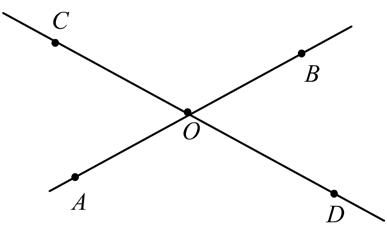
Which are pairs of vertical angles?
a)
∠COB & ∠COA
b)
∠AOD & ∠AOC
c)
∠COB & ∠AOD
d)
∠BOD & ∠AOD
225.
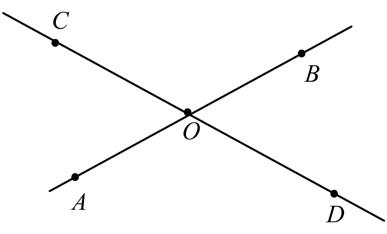
Which are pairs of adjacent angles?
a)
∠COB & ∠DOA
b)
∠AOD & ∠AOC
c)
∠COB & ∠AOD
d)
∠BOD & ∠AOC
226.
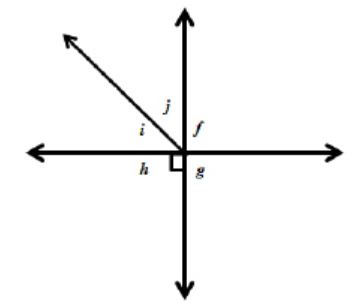
Name the vertical angle to
∠h.
a)
∠f
b)
∠i
c)
∠g
d)
∠j
227.
Which names a pair of adjacent angles?
a)
∠CXD and ∠FXE
b)
∠CXF and ∠DXE
c)
∠CXD and ∠DXE
228.
Find the missing angle.  Find x.
a)
20o
b)
70o
c)
160o
d)
180o
229.
What angle pair is pictured?
a)
Alternate Interior Angles
b)
Supplementary Angles
c)
Vertical Angles
d)
Corresponding Angles
230.
Vertical angles are always
a)
acute
b)
total 180 degrees
c)
congruent (equal measures)
d)
adjacent angles
231.
What is the value of x?
a)
37
b)
72
c)
108
d)
18
232.
Find the value of x.
a)
14
b)
60
c)
35
d)
180
233.
What does X equal?
a)
X=51
b)
X=45
c)
X=39
234.
Are the triangles congruent?
a)
Yes
b)
No
235.
How are the triangles congruent?
a)
AAS
b)
SAS
c)
ASA
d)
SSS
236.
How are the triangles congruent?
a)
SAS
b)
SSS
c)
AAS
d)
HL
237.
How are the triangles congruent?
a)
HL
b)
SAS
c)
ASA
d)
AAS
238.
How are the triangles congruent?
a)
Not congruent
b)
AAS
c)
SAS
d)
ASA
239.
How are the triangles congruent?
a)
AAS
b)
SAS
c)
ASA
d)
Not congruent
240.
Which property states that ∠A ≅ ∠A?
a)
Distributive Property
b)
Addition Property
c)
Multiplication Property
d)
Reflexive Property
241.
Which is NOT a criteria for triangles to be congruent by the HL Theorem?
a)
Right triangles
b)
congruent hypotenuses
c)
Two pairs of congruent legs
d)
One pair of congruent legs
242.
How are the triangles congruent?
a)
Not congruent
b)
SSS
c)
ASA
d)
SAS
243.
How are the triangles congruent?
a)
SAS
b)
SSS
c)
ASA
d)
HL
244.
How are the triangles congruent?
a)
HL
b)
SSS
c)
SAS
d)
AAS
245.
How are the triangles congruent?
a)
ASA
b)
AAS
c)
SAS
d)
SSS
246.
How are the triangles congruent?
a)
SAS
b)
SSS
c)
HL
d)
ASA
247.
How are the triangles congruent?
a)
ASA
b)
SAS
c)
AAS
d)
SSS
248.
How are the triangles congruent?
a)
SAS
b)
ASA
c)
HL
d)
SSS
249.
a)
A
b)
B
c)
C
d)
D
250.
a)
A
b)
B
c)
C
d)
D
251.
a)
A
b)
B
c)
C
d)
D
252.
The Pythagorean Theorem ONLY works on which triangle? 
a)
obtuse
b)
scalene
c)
isosceles
d)
right
253.
What is the opposite of squaring a number?
a)
divide
b)
multiply 
c)
fractions
d)
square root
254.
The Pythagorean Theorem is
a2 + b= c4
a)
false
b)
true
255.
a)
9.2 in
b)
11 in
c)
13 in
d)
9.6 in
256.
Find the length of the missing side.
a)
20 in.
b)
68 in.
c)
16 in.
d)
80 in.
257.
A 10-foot ladder is leaning against the wall.  The bottom of the ladder is 4 feet from the base of the wall.  Which of the following is closest to the distance from the top of the ladder to the base of the wall?
a)
9ft
b)
11ft
c)
6ft
d)
14ft
258.
Would a triangle with these side lengths be a right triangle?
4, 5, 6
a)
Yes
b)
No
259.
Casey travels from her house directly west to the bank and then directly north from the bank to the mall. She then travels home on the road connecting the mall and her house. What is her total distance traveled?
a)
17 miles
b)
32 miles
c)
37 miles
d)
40 miles
260.
a = 2.1, b = 7.2, c = 7.5
Is this a right triangle?
a)
yes 
b)
no
261.

Which of the following sets of side lengths could produce a triangle. SELECT ALL THAT APPLY.

a)

4, 4, 4

b)

5, 5, 10

c)

3, 6, 9

d)

5, 7, 11

e)

13, 5, 6

262.

Will these three sides form a triangle?

a)

yes

b)

no

263.

Will these line segments form a triangle?

a)

yes

b)

no

264.
Find the measure of the angle indicated. 
a)
139°
b)
66°
c)
138°
d)
116°
265.
The Triangle Sum Theorem states that the sum of all angles in a triangle is ______. 
a)
45°
b)
90°
c)
180°
d)
360°
266.
Find the measure of the missing angle.
a)
90o
b)
100
c)
130o
d)
50o
267.
Solve for x.
a)
16
b)
11
c)
50
d)
6
268.
Solve for x THEN find the degrees for angle A.
a)
44o
b)
96o
c)
-14o
d)
63o
269.
If all three angles are exactly the same measure, how big is each angle?
Hint:    x + x + x  = 180
a)
180 degrees
b)
90 degrees
c)
50 degrees
d)
60 degrees
270.
Angles that are exactly 90 degrees are called _____ ______.
a)
tight angles
b)
acute angles
c)
obtuse angles
d)
right angles
271.
If 2 of the angles of a triangle are 30 and 70 degrees, the third angle measures...
a)
80
b)
100
c)
60
d)
90
272.
Find the measure of the indicated angle. 
a)
26
b)
36
c)
85
d)
144
273.
What is the third angle of a triangle whose 1st angle is 79 and the 2nd angle is 43?
a)
43
b)
58
c)
72
d)
101
274.
What angle pair is pictured?
a)
Alternate Interior Angles
b)
Supplementary Angles
c)
Vertical Angles
d)
Corresponding Angles
275.

Find the missing angle.

a)

43

b)

47

c)

57

d)

67

276.
What is the measure of the missing angle?
a)
92
b)
102
c)
82
d)
72
277.
What kind of angles are shown?
a)
complementary
b)
supplementary
c)
adjacent
d)
corresponding
278.
∠1 and ∠3 can best be described as - 
a)
complementary angles
b)
supplementary angles
c)
vertical angles
d)
adjacent angles
279.
∠1 and ∠3 can best be described as - 
a)
complementary angles
b)
supplementary angles
c)
vertical angles
d)
adjacent angles
280.
Solve for b
a)
141
b)
90
c)
180
d)
39
281.
a)
x = 118
b)
x = 108
c)
x = 28
d)
x = 58
282.
Find the missing angle.  Find x.
a)
20o
b)
70o
c)
160o
d)
180o
283.
a)
100°
b)
80°
c)
90°
d)
180°
284.
This is what kind of angle?
a)
obtuse
b)
right
c)
straight
d)
acute
285.
This is what kind of angle?
a)
obtuse
b)
right
c)
straight
d)
acute
286.
How are these angles related?
a)
Vertrical
b)
Complementary 
c)
Adjacent
d)
Supplementary 
287.
a)
100°
b)
80°
c)
90°
d)
180°
288.
What are supplementary angles?
a)
Angles that add up to 180°
b)
Angles that add up to 90°
c)
Angles that are equal to each other
d)
Angles that are opposite of each other when lines intersect
289.
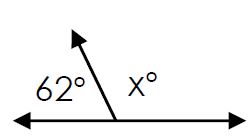
Find the missing angle.
a)
41°
b)
32°
c)
51°
d)
31°
290.
a)

31

b)

51

c)

149

d)

169

291.
a)

55

b)

125

c)

145

d)

45

292.
Name the angle relationship.
a)
Alternate Interior
b)
Alternate Exterior
c)
Corresponding
d)
Vertical Angles
293.
Name the angle relationship.
a)
Alternate Interior
b)
Alternate Exterior
c)
 Correpsonding
d)
Vertical Angles
294.
What type of angle pair is ∠1 and ∠3?
a)
alternate interior angles
b)
 supplementary angles
c)
corresponding angles
d)
vertical angles 
295.
Name the angle relationship.
a)
Consecutive Interior
b)
Alternate Interior
c)
Corresponding
d)
Vertical Angles
296.
Name the alternate interior angle to angle 3.
a)
4
b)
5
c)
6
d)
8
297.
Angles 4 and 6 are
a)
Corresponding
b)
Alternate Interior
c)
Alternate Exterior
d)
Vertical
298.
Angles 2 and 8 are
a)
Corresponding
b)
Alternate Interior
c)
Alternate Exterior
d)
Vertical
299.
Angles 1 and 5 are
a)
Same Side interior
b)
Alternate Interior
c)
Alternate Exterior
d)
Vertical
300.
Which of these angles is NOT congruent to angle 5?
a)
Angle 6
b)
Angle 8
c)
Angle 1
d)
Angle 4
301.
Which pair of angles are alternate exterior angles?
a)
Angle 7 and Angle 4
b)
Angle 2 and Angle 6
c)
Angle 8 and Angle 1
d)
Angle 2 and Angle 8
302.
Find the measure of angle 1.
a)
28o
b)
136o
c)
44o
d)
6o
303.
Angle 1 = 27o
Find the measure of angle 4
a)
27o
b)
153o
c)
63o
d)
90o
304.
Angle 1 = 27o
Find the measure of angle 4
a)
27o
b)
153o
c)
63o
d)
90o
305.
Lines r and s are cut by a transversal. What value of x proves r ∥ s?
a)
43
b)
37
c)
143
d)
37
306.
Solve for  y.
a)
y = 20
b)
y = 120
c)
y = 60
d)
y = 10
307.
What is the value of x?
a)
22
b)
26
c)
24
d)
23
308.
What is the measure of ∠8?
a)
55
b)
155
c)
135
d)
45
309.
Find the value of x.
a)
20
b)
135
c)
31
d)
145
310.

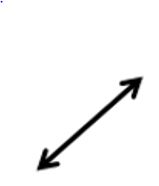
What is this?

a)

Line

b)

Parallel

c)

Point

d)

Line Segment

311.

What is this?

a)

parallel

b)

vertex

c)

Line

d)

Line segment

312.

What is this?

a)

vertical

b)

Line

c)

Line Segment

d)

horizontal

313.

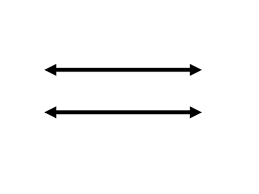
What kind of lines are these?

a)

Parallel lines

b)

Line segments

c)

Perpendicular Lines

d)

Intersecting lines

314.

Parallel lines cross one another, or intersect.

a)

true

b)

false

315.

.

.

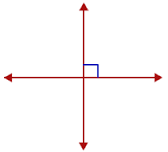
What kind of intersecting lines are these?

a)

Parallel Lines

b)

Perpendicular Lines

c)

adjacent

d)

opposite

316.
What are parallel lines?
a)
Lines that form square corners
b)
lines that never intersect
c)
lines that pass through the same point
d)
lines that curve on an angle
317.

This line is what?

a)

horizontal

b)

vertical

c)

parallel

d)

perpendicular

318.

This line is

a)

vertical

b)

horizontal

c)

adjacent

d)

opposite

319.

A point where two lines meet is called a

a)

parallel

b)

opposite

c)

adjacent

d)

vertex

320.

Another name for a square corner is...

a)

right angle

b)

square

c)

rectangle

d)

parallel line

321.
The figure is an example of a(n) ...
a)
angle bisector
b)
midsegment
c)
altitude
d)
median
322.
The figure is an example of a(n) ...
a)
altitude 
b)
perpendicular bisector
c)
midsegment
d)
angle bisector
323.
Which point is equidistant from the vertices?
a)
Circumcenter
b)
Incenter
c)
Neither
d)
Bilateral
324.
Name the point of concurrency shown.
a)
Circumcenter
b)
Incenter
c)
Supercenter
d)
Neither
325.
Find the length of PO.
a)
32
b)
35
c)
26
d)
29
326.
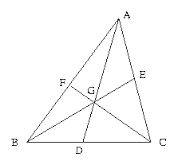
If G is the centroid of triangle ABC and GF= 4. Find the length of GC.
a)
4
b)
8
c)
12
d)
Not Enough Information
327.

What type of special segments are being used?

a)

Altitudes

b)

Perpendicular Bisectors

c)

Medians

d)

Angle Bisectors

328.

What is the point of concurrency?

a)

Orthocenter

b)

Circumcenter

c)

Incenter

d)

Centroid

329.
When you draw the perpendicular bisectors of a triangle it creates the point of concurrency called the _____________.
a)
Centroid
b)
Incenter
c)
Circumcenter
d)
Orthocenter
330.
The circumcenter of a triangle is equidistant from the _______ of the triangle.
a)
vertices
b)
sides
c)
center
d)
midsegment
331.
The incenter of a triangle is equidistant from the __________ of a triangle.
a)
vertices
b)
sides
c)
angle bisector
d)
circumcenter
332.
The circumcenter is _________________ in the triangle.  
a)
always
b)
sometimes
c)
never
d)
definitely
333.
When performing a rigid motion which property is not always preserved? 
a)
Angle size
b)
location of the plane
c)
Distance between points
d)
Number of vertices
334.
Which transformation alters the size of a figure? 
a)
rotation
b)
reflection
c)
translation
d)
dilation
335.
Which rotation results in an identity transformation (maps back to itself)? 
a)
90 degrees
b)
180 degrees
c)
270 degrees
d)
360 degrees
336.
Which rotation results in an identity transformation (maps back to itself)? 
a)
90 degrees
b)
180 degrees
c)
270 degrees
d)
360 degrees
337.

Which transformation is not a rigid motion?

a)

translation

b)

reflection

c)

dilation

d)

rotation

338.
What rigid motion is present? 
a)
translation
b)
reflection
c)
dilation
d)
rotation
339.
What rigid motion is present? 
a)
reflection
b)
rotation
c)
dilation
d)
translation
340.
What construction is being performed? 
a)
copying an angle
b)
segment bisector
c)
equilateral triangle
d)
angle bisector
341.
Which is a factor scale that is a reduction? 
a)
1
b)
0
c)
1/3
d)
3
342.
What angle type is present? 
a)
alternate exterior
b)
corresponding
c)
alternate interior
d)
consecutive interior
343.

If angle 1 measures 56 degrees what does angle 2 measure?

a)

34

b)

56

c)

124

d)

180

344.

What is the slope parallel to the equation: y=4x+3

a)

-1/4

b)

4x

c)

4

d)

1/4

345.

Slopes of parallel lines are...

a)

opposite reciprocals.

b)

opposites.

c)

identical.

d)

always 7.

346.
Slopes of perpendicular lines are...
a)
opposite reciprocals.
b)
opposites.
c)
identical.
d)
always 7.
347.
y = 3x +2
y = 3x - 3
These lines are...
a)
Parallel
b)
Perpendicular
c)
Neither
d)
The same line
348.
y = -2/3x + 2
y = 3/2x + 9
These lines are...
a)
Parallel
b)
Perpendicular
c)
Neither
349.
A line is perpendicular to    y = 2x - 7.
What is the slope of this line? 
a)
-2
b)
1/2
c)
-1/2
d)
2
350.
y = 3/2x + 2
y = 2/3x + 6
These lines are...
a)
Parallel
b)
Perpendicular
c)
Neither
351.
What slope is parallel to:  
m = 3/4
a)
4/3
b)
3/4
c)
-3/4
d)
-4/3
352.
What slope is perpendicular to:  
m = 5/8
a)
-5/8
b)
5/8
c)
-8/5
d)
8/5
353.

What slope is perpendicular to:

m = 3

a)

-3

b)

3

c)

-1/3

d)

1/3

354.
Find SV
a)
18
b)
36
c)
21
d)
9
355.
Find HG
a)
28
b)
14
c)
41
d)
7
356.
Find m< JKM
a)
90
b)
76
c)
38
d)
83
357.
Find x, then the measure of TS
a)
x=6, TS=15
b)
x=6, TS=30
c)
x=5, TS=15
d)
x=5, TS=30
358.
Find x, then the measure of AC
a)
x=2, AC=8
b)
x=2, AC=16
c)
x=4, AC=8
d)
x=4, AC=16
359.
Find x, then the measure of ∠1
a)
x=8, m∠1=8
b)
x=6, m∠1=58
c)
x=8, m∠1=29
d)
x=6, m∠1=8
360.
Find x, then the measure of JK
a)
x=10, JK=50
b)
x=10, JK=100
c)
x=15, JK=100
d)
x=15, JK=50
361.
Find x, then the measure of ∠2
a)
x=-2, ∠2=70
b)
x=8, ∠2=70
c)
x=-2, ∠2=35
d)
x=8, ∠2=35
362.
Find n, then the measure of PR
a)
n=5.4, PR=19.8
b)
n=5, PR=19
c)
n=5, PR=38
d)
n=5.4, PR=39.6
363.
Find x, then the measure of AD+CD
a)
x=5, AD+CD=19
b)
x=5, AD+CD=38
c)
x=1, AD+CD=19
d)
x=1, AD+CD=38
364.
Find x, then the measure of AD
a)
x=5, AD =36
b)
x=5, AD =16
c)
x=1, AD =8
d)
x=1, AD =4
365.
Find x, then the measure of AD
a)
x=5, AD=19
b)
x=5, AD=38
c)
x=1, AD=19
d)
x=1, AD=38
366.
Find x, then the measure of ZW+YW
a)
x=2, ZW+YW=15
b)
x=8, ZW+YW=27
c)
x=8, ZW+YW=54
d)
x=2, ZW+YW=30
367.
Find x
a)
6
b)
-6
c)
2
d)
-2
368.
Find x
a)
3
b)
18
c)
36
d)
4
369.

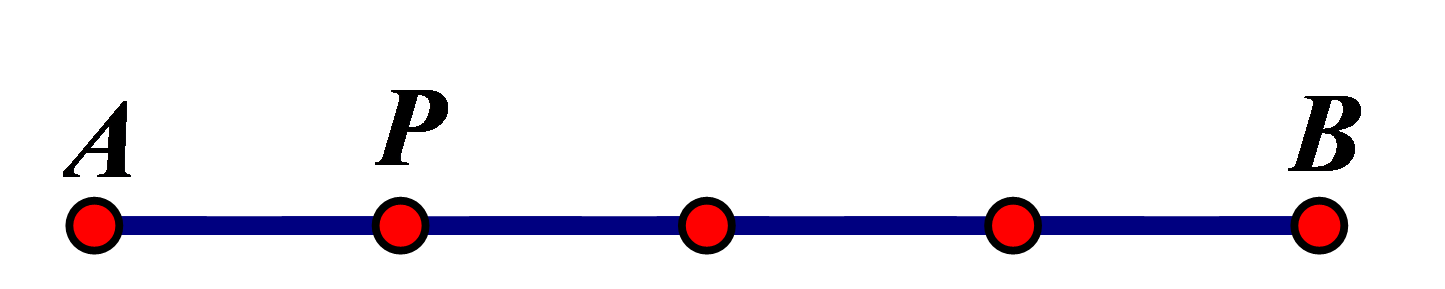
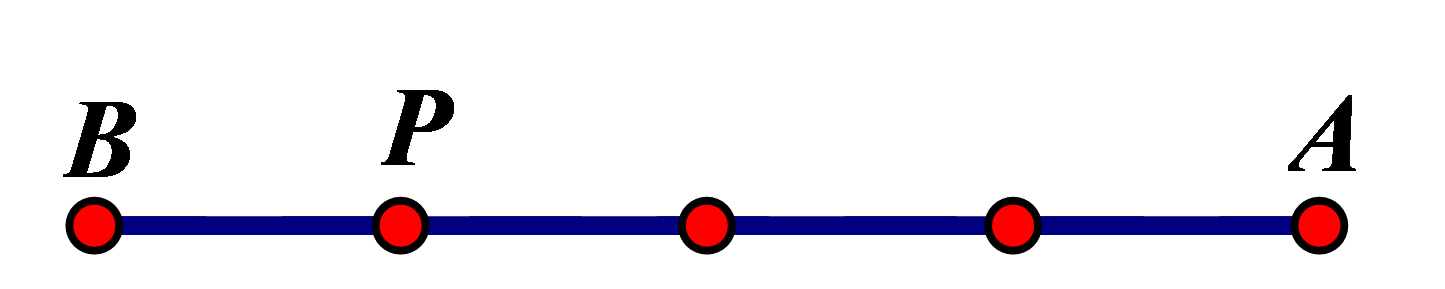
Directed line segment AB is partitioned by point P into a ratio of 1:3. Which of the following represent this relationship?

a)
b)
c)
d)
370.

Directed line segment AB is partitioned by point P into a ratio of 1:4. Which of the following represent this relationship?
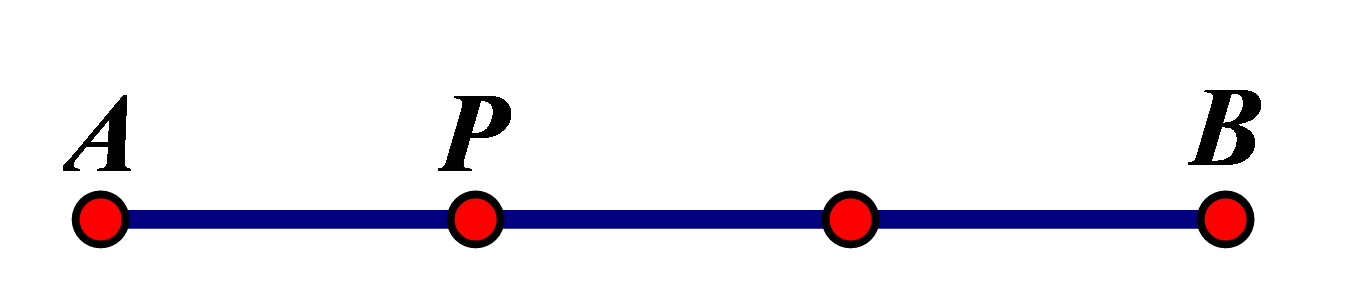
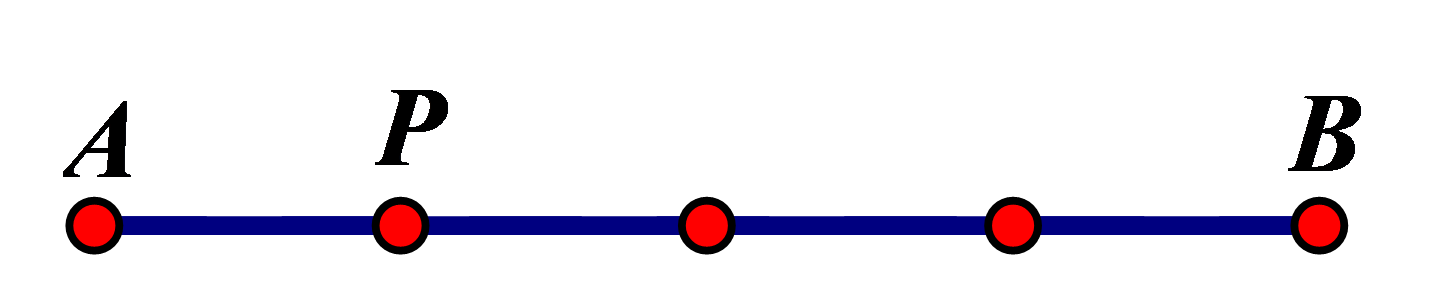
a)
b)
c)
d)
371.

Directed line segment MN partitioned into a ratio of 1:2 is the same as directed line segment NM partitioned into a ratio of 2:1.

a)

True

b)

False

372.

6) The ratio is 3:1. How many parts are there?

a)

2

b)

3

c)

4

d)

5

373.

Find the point that is 2/5 of the distance from C to D.

a)

(-1, 2)

b)

(0, 0)

374.
Given the points A(-1,2) and B(7,14), find the coordinates of the point P on directed line segment AB that partitions AB into a ratio 1:3. 
a)
(1,5)
b)
(3,7)
c)
(4,4)
d)
(5,8)
375.

Determine the coordinate of P that partitions JK at a ratio of 1:1

a)

(-3,3)

b)

(1,3)

c)

(-1,3)

d)

(2, 2.5)

376.
Name the angles from SMALLEST to LARGEST
a)
Q, R, P
b)
P, Q, R
c)
R, P, Q
d)
R, Q, P
377.
Name the sides from SMALLEST to LARGEST
a)
RS, ST, TR
b)
ST, RT, RS
c)
RT, ST, RS
d)
RT, RS, ST
378.
Name the angles from LARGEST to SMALLEST
a)
R, S, T
b)
S, T, R
c)
S, R, T
d)
T, S, R
379.
Name the sides from LARGEST to SMALLEST
a)
KJ, KH, JH
b)
JH, KH, KJ
c)
KH, KJ, JH
d)
KH, JH, KJ
380.
Can a triangle be formed with side lengths:
4, 7, 10
a)
yes
b)
no
c)
not enough information
381.
Can a triangle be formed with side lengths:
10, 12, 22
a)
yes
b)
no
c)
not enough information
382.
Can a triangle be formed with side lengths:
17, 9, 30
a)
yes
b)
no
c)
not enough information
383.
Find the largest side in Δ BCD
a)
Segment BC
b)
Segment DB
c)
Segment DC
d)
Segment AB
384.
Find the largest angle in Δ PRQ
a)
∠R
b)
∠P
c)
∠Q
d)
∠S
385.
Order the sides from least to greatest. 
a)
DE, VE, DV
b)
VE, DE, DV
c)
DV, VE, DE
d)
DE, DV, VE
386.
What is the correct order of the lengths of the streets from longest to shortest?
a)
A
b)
B
c)
C
d)
D
387.
Where would the largest angle of a triangle be located?
a)
Across from the longest side.
b)
Across from the shortest side
c)
I need more information to get an answer.
388.
The longest side of a triangle would be located where on a triangle?
a)
Across from the smallest angle
b)
Across from the largest angle
c)
Cannot tell.
d)
Adjacent to the smallest side.
389.
The dotted line represents a ?...
a)
median
b)
centroid
c)
midsegment
d)
midpoint
390.
What is an angle bisector?
a)
Makes two 90 degree angles
b)
splits a 90 degree angle in half
c)
splits any angle in half
d)
splits 2 sides in half
391.
The figure is an example of a(n) ...
a)
angle bisector
b)
perpendicular bisector
c)
median
d)
midsegment
392.
The figure is an example of a(n) ...
a)
altitude 
b)
perpendicular bisector
c)
midsegment
d)
angle bisector
393.
Which of the following segments represents a median?
a)
BX
b)
AZ
c)
AC
d)
BZ
394.
Which of the following segments represents an altitude?
a)
BX
b)
AZ
c)
AC
d)
BZ
395.
Given: AM is the median,
AB=4x-6, BM=2x-2 , MC=3x-14 , CA=5x-20 . Find the value of x.
a)
x = 12
b)
x = 2
c)
x = 14
d)
x = -8
396.

Which one of these represent SAS?

a)
b)
c)
d)
e)
397.

Which one of these represent SSS?

a)
b)
c)
d)
e)
398.

Order the sides of the triangle from shortest to longest.

a)

UV, UT, VT

b)

UV, VT, UT

c)

VT, UT, UV

d)

VT, UV, UT

399.
Which of the following is a possible  length for segment AC
a)
10
b)
15
c)
17
d)
9
400.

Order the angles from largest to smallest

a)

∠S, ∠R, ∠T

b)

∠S, ∠T, ∠R

c)

∠T, ∠R, ∠S

d)

∠T, ∠S, ∠R

401.
Using the hinge theorem, we can say that AB _____ DC
a)
Greater than
b)
Less than
c)
Equal to
d)
Half of 
402.
Using the hinge theorem, we can say that Angle 1 _____ Angle 2.
a)
Less than
b)
Greater than
c)
Equal to 
d)
Half of
403.

Can a triangle be formed with line segments that have lengths 2, 8 and 14 units?

a)

No, because these line segments wouldn't satisfy the triangle inequality theorem

b)

No, because there are only two sides to a triangle

c)

Yes, because these line segments satisfy the triangle inequality theorem

d)

Yes, because 8< 14

404.
Can the following lengths be made into a triangle?
4 cm,  7 cm,  2 cm
a)
Yes
b)
No
c)
180º
d)
Complementary
405.
Two sides of a triangle are 14 cm and 19 cm.  What is a possible length for the third side?
a)
5 cm
b)
11 cm
c)
33 cm
d)
40 cm
406.
Compare measure of angle Y and measure of angle M.
a)
measure of angle Y = measure of angle M
b)
measure of angle Y > measure of angle M
c)
measure of angle Y < measure of angle M
d)
Not enough information is given.
407.

In which of the following triangles is ∠K the smallest angle?

a)
b)
c)
d)
408.

How do you find the area of a triangle?

a)

base x height

b)

take half of the base times the height

c)

add up all of the sides

409.

What is the formula for the area of a triangle?

a)

A = 1/2 bh

b)

A = bh

c)

A = s + s + s

410.

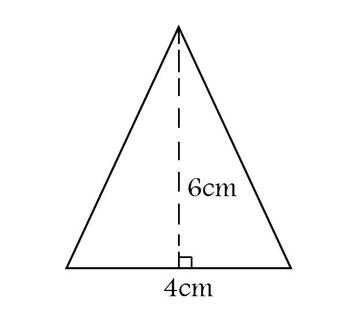
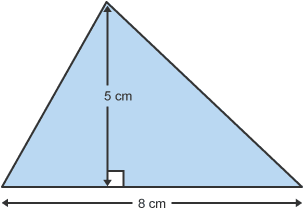
Find the area of the triangle.

a)

10 cm2

b)

24 cm2

c)

12 cm2

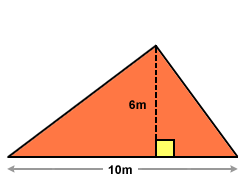
411.

Find the area of the triangle.

a)

30 m2

b)

60 m2

c)

16 m

d)

30 m

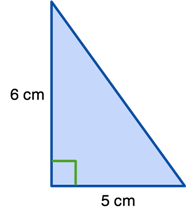
412.

Find the area of the triangle.

a)

11 cm2

b)

15 cm2

c)

30 cm2

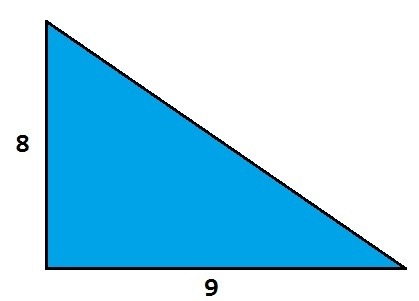
413.

Find the area of the triangle.

a)

36

b)

72

c)

36 units2

d)

72 units2

414.

Find the area of the triangle.

a)

20 in

b)

40 cm2

c)

13 cm2

d)

20 cm2

415.

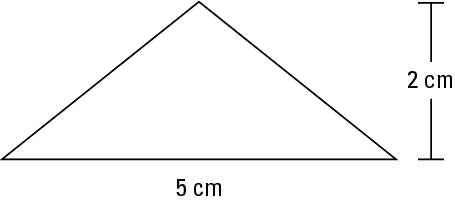
Find the area of the triangle.

a)

5 cm2

b)

10 cm2

c)

7 cm2

416.

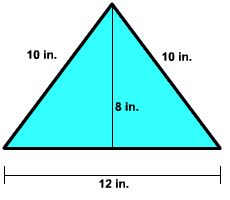
Find the area of the triangle.

a)

96 in2

b)

48 in2

c)

20 in2

417.
What is the perimeter?
a)
15
b)
10
c)
3
418.
What is the perimeter?
a)
20
b)
40
c)
60
419.
What is the perimeter?
a)
20
b)
5
c)
4
420.
What is the perimeter of the shape?
a)
4
b)
10
c)
12
421.
What is the missing measurement? 
a)
9 cm
b)
18 in
c)
18 cm
d)
9 in 
422.
What is the perimeter of this figure
a)
22
b)
21
c)
18
d)
20
423.
Perimeter of rectangle?
a)
84 cm
b)
38 cm
c)
72 cm
d)
19 cm
424.
What is the perimeter of the fence?
a)
25
b)
30
c)
35
d)
40
425.
A perimeter of a rectangle is 34 meters.  The width is 4 meters.  What would the length be?
a)
17 m
b)
13 m
c)
15 m
426.
What does perimeter mean?
a)
the amount of space inside a shape
b)
the distance around the shape
c)
the amount of space inside a shape divided by two
d)
half the distance around a shape
427.
What is the perimeter?
a)
9 units
b)
12 sq units
c)
12  units
d)
None of the above
428.
What is the perimeter of the square?
a)
2
b)
8
c)
10
d)
4
429.
Farmer Bob's son built a track to walk his pet pig.  The track goes around the pig pen.  The pig pen is 15 feet long and 21 feet wide.  If the pig walks all the way around the track, how many feet did he walk?
a)
72 feet
b)
36 feet
c)
36 square feet
430.
Farmer Bob needs to build a fence for his chickens.  The area he wants to build a fence around is 40 feet long and 20 feet wide.  How many feet of fence does he need to buy?
a)
800 feet
b)
120 feet
c)
60 feet
431.
What is the perimeter of this rectangle? 
a)
60 in
b)
34 cm
c)
60 cm
d)
34 in
432.
What is the perimeter of the shaded figure?
a)
28
b)
24
c)
22
d)
26
433.
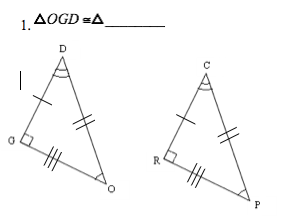
Complete the congruence statement.
a)
CRP
b)
PCR
c)
RPC
d)
PRC
434.
Use the congruency statement to answer the following: 
<F = ___
a)
<H
b)
<I
c)
<G
d)
not congruent to another angle
435.
∆ABC≅∆XYZ
which is true?
a)
AB≅XY
b)
AB≅YX
c)
AB≅XZ
d)
BC≅CB
436.
∆ABC ≅ ∆LMN. Which statement is NOT true?
a)
LM ≅ AB
b)
∆CAB ≅ ∆NLM
c)
∠C ≅ ∠N
d)
BC ≅ ML
437.
∠E ≅ ∠ __
a)
A
b)
B
c)
C
d)
D
438.
a)
A
b)
B
c)
C
d)
D
439.
Which segment is congruent to EF? 
a)
HG
b)
HF
c)
GF
d)
IE
440.
Name the corresponding angle or side.
a)
A
b)
B
c)
C
d)
D
441.

Find the value of x.

a)

4

b)

1

c)

-5

d)

-1/2

442.

△BAC ≅ △QPR. If ∠B = 2x and ∠Q = 10, find the value of x.

a)

2

b)

4

c)

5

d)

-5

443.
What does CPCTC stand for?
a)
Congruent parts of congruent triangles are congruent
b)
Corresponding parts of congruent triangles are congruent
c)
Corresponding parts of corresponding triangles are corresponding
d)
Corresponding parts of congruent triangles are Canadian.
444.
Complete the congruence statement.
a)
CRP
b)
PCR
c)
RPC
d)
PRC
445.
Which is a correct congruence statement.
a)
A
b)
B
c)
C
d)
D
446.
These triangles are congruent. If ∠E is 45o and ∠B is 55o what is the measure of ∠C?
a)
45o
b)
55o
c)
80o
d)
100o
447.

What is the measure of ∠C?

a)

b)

25º

c)

100º

d)

125º

448.

What is Reason B?

a)

Definition of Congruence

b)

Definition of Vertical Angles

c)

Reflexive Property

d)

Vertical Angle Theorem

449.

What is Reason C?

a)

Definition of Congruence

b)

Definition of Vertical Angles

c)

Reflexive Property

d)

Vertical Angle Theorem

450.

What is Reason B?

a)

Definition of Congruence

b)

Definition of Equality

c)

Definition of Midpoint

451.

What is Reason D?

a)

SSS Congruence

b)

SAS Congruence

c)

ASA Congruence

d)

AAS Congruence

e)

HL Congruence

452.

What is Reason C?

a)

Definition of Congruence

b)

Definition of Equality

c)

Definition of Midpoint

453.

What is Reason D?

a)

Vertical Angle Theorem

b)

Reflexive Property

c)

Definition of Congruence

d)

Definition of Vertical Angles

454.

What is Reason F?

a)

SSS Congruence

b)

SAS Congruence

c)

ASA Congruence

d)

AAS Congruence

e)

HL Congruence

455.

What is Reason E?

a)

Vertical Angle Theorem

b)

CPCTC

c)

Definition of Congruence

d)

Definition of Vertical Angles

456.

What is Reason B?

a)

Definition of Congruence

b)

Definition of Equality

c)

Definition of Midpoint

457.

What is Reason B?

a)

Definition of Congruence

b)

Thm 1 - Congruence of Segments is Reflexive

c)

Reflexive Property

d)

CPCTC

458.

What is Reason C?

a)

SSS Congruence

b)

SAS Congruence

c)

ASA Congruence

d)

AAS Congruence

e)

HL Congruence

459.
State if the two triangles are congruent.  If they are, state how you know.
a)
A
b)
B
c)
C
d)
D
460.
State if the two triangles are congruent.  If they are, state how you know.
a)
A
b)
B
c)
C
d)
D
461.
Suppose we wish to construct angle EFG congruent to angle DBC using a compass and straightedge. Which step would be correct to do first?
a)
Place the compass point at B
b)
Place the compass point at C
c)
Place the straightedge along A and C
d)
Place the straightedge along C and D
462.
Reflect (3,5) over the y-axis.
a)
(2,2)
b)
(3,-5)
c)
(-3,-5)
d)
(-3,5)
463.
Find the measure of angle c.  Lines l2 and l3 are parallel.
a)
45 degrees
b)
50 degrees
c)
53 degrees
d)
60 degrees
464.
Solve for x.
a)
4
b)
-6
c)
-4
d)
6
465.
Solve for x.
a)
7
b)
-4
c)
8
d)
9
466.
Solve for x.
a)
9
b)
-7
c)
4
d)
6
467.
Solve for x.
a)
4
b)
11
c)
9
d)
7
468.

If CF = 4, CD = 11, and EF = 4, what is the perimeter of ΔCDE?

a)

A

b)

B

c)

C

d)

D

469.

Select the statements about the figure that

MUST be true.

a)

A

b)

B

c)

C

d)

D

e)

E

470.

If m<XWY = 16, m<XWZ = 32, and XY = 17,

what is the value of YZ?

a)

8

b)

32

c)

16

d)

17

471.

Where is the incenter of an acute triangle located?

a)

A

b)

B

c)

C

472.

Which point is the center of a circle that touches all three sides of ΔRST?

a)

A

b)

B

c)

C

d)

D

473.

What is the radius of the inscribed circle of ΔHJK?

a)

A

b)

B

c)

C

d)

D

474.

In △ABC, X is the centroid. If CW = 21, what are CX and XW?

a)

CX = 11, XW = 10

b)

CX = 7, XW = 14

c)

CX = 14, XW = 7

d)

CX = 2/3 XW = 1/3

475.

Which diagram shows a point P an equal distance from points A, B, and C?

a)

A

b)

B

c)

C

d)

D

476.

In △ABC, X is the centroid. If XZ = 8, what are AX and AZ?

a)

AX = 16, AZ = 24

b)

AX = 24, AZ = 32

c)

AX = 8, AZ = 16

d)

AX = 24 AZ = 16

477.

Which diagram shows a point P an equal distance from sides AB, BC, and CA?

a)

A

b)

B

c)

C

d)

D

478.

Order the sides of the triangle from longest to shortest.

a)

KL, ML, KM

b)

KL, KM, ML

c)

KM, ML, KL

d)

KM, KL, ML

479.

Order the angles from smallest to largest.

a)

∠D, ∠E, ∠C

b)

∠D, ∠C, ∠E

c)

∠C, ∠E, ∠D

d)

∠C, ∠D, ∠E

480.

Order the angles from smallest to largest.

a)

∠D, ∠E, ∠C

b)

∠D, ∠C, ∠E

c)

∠C, ∠E, ∠D

d)

∠C, ∠D, ∠E

481.

Order the angles from largest to smallest

a)

∠S, ∠R, ∠T

b)

∠S, ∠T, ∠R

c)

∠T, ∠R, ∠S

d)

∠T, ∠S, ∠R

482.
Which is NOT a possible measure for ∠DCB?
a)
27º
b)
30º
c)
34º
d)
35º
483.
Fill in the missing proofs.
a)
Transitive Property, SAS(Side-Angle-Side)
b)
Reflexive Property, SAS(Side-Angle-Side)
c)
Reflexive Property, Vertical Angles Thm.
d)
Transitive Property, SSS(Side-Side-Side)
484.
What is the "statement" for step 3 of the proof?
a)
AD=DA
b)
AN = AH
c)
HD=ND
d)
HD=DN
485.
What is the "statement" for step 3 of the proof? 
a)
∡EDA≅∡DCB
b)
∡AED≅∡BEC
c)
DE=CE
d)
∡AED≅∡CED
486.
What is the "statement" for step 2 of the proof?
a)
∡JHI≅∡JKL
b)
JL=JI
c)
∡H≅∡K
d)
HI=KL
487.
What is the measure of angle 2?
a)
50
b)
65
c)
115
488.
Solve for x.
a)
-8
b)
-10
c)
11
d)
10
489.
What is the length of DC
a)
4
b)
1
c)
2
d)
3
490.
Find m<A. 
a)
12
b)
24
c)
132
d)
36
491.
Find the measure of <B. 
a)
90
b)
45
c)
180
d)
135
492.
Two sides of each triangle in the circle are formed
from the radii of the circle. Compare EF and FG.
a)
EF = FG
b)
EF < FG
c)
EF > FG
d)
Not enough information is given.
493.
What additional information is required for the 2 triangles to be congruent by SSS?
a)
A
b)
B
c)
C
d)
D
494.
What additional information is required for the 2 triangles to be congruent by ASA?
a)
A
b)
B
c)
C
d)
D
495.
Does a triangle with these side lengths exist?
15, 12, 9
a)
Yes
b)
No
c)
I don't know.
496.
Are the triangles congruent, if yes, why?
a)
SSS
b)
SAS
c)
ASA
d)
Not Congruent
497.
Can the sides of a triangle have lengths 3, 8, and 9?
a)
Yes
b)
No
498.
Which would be the best classification for the triangle shown?
a)
acute isosceles
b)
right scalene
c)
acute scalene
d)
obtuse scalene
499.
Which would be the best classification for the triangle shown?
a)
acute isosceles
b)
equiangular scalene
c)
equiangular isosceles
d)
equiangular equilateral
500.
What is the value of x?
a)
75
b)
80
c)
63
d)
60