
 Worksheets
Neuron Phys & Synapse
Total questions: 22
Worksheet time: 15mins
Neurotransmitters are released from the
Dendrites
Post-synaptic neuron
Presynaptic neuron
Schwann Cells
What generates a nerve impulse on the post-synaptic membrane?
Calcium binding with a receptor site
Potassium leaking into the post-synaptic membrane
Neurotransmitter binding with receptor sites on protein channels
Neurotransmitter being removed from the synapse
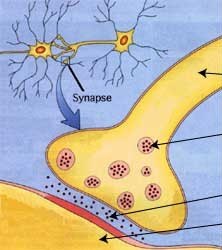
The location of neurotransmitters
axon terminals
dendrites
Schwann cells
cell body

What ion channel opens by the action potential in the presynaptic neuron that causes the vesicles containing neurotranmitters to move toward the synaptic cleft?
calcium
potassium
sodium
phosphorus
The operation of the sodium-potassium "pump" moves:
sodium & potassium ions into the cell
sodium & potassium ions out of the cell
sodium ions into the cell & potassium ions out of the cell
potassium ions into the cell & sodium ions out of the cell

What number on the graph represents the Threshold potential or voltage?
1
3
4
6

The sodium-potassium pump
uses diffusion to attain -70mV
uses ATP to create a membrane differential along a resting neuron.
is stimulated by neurotransmitters
is an example of passive transport across a membrane
The influx (entry) of calcium is responsible for
signaling the release of the neurotransmitter
signaling N+ to be released into the membrane
signaling the release of K+ out of the membrane
serving as the neurotransmitter
When does the stimuli cause an action potential?
When the membrane potential reaches threshold
When the membrane potential is just below the threshold.
When the membrane potential is just above threshold

Identify the chemical labeled "Z".
Dendrite
Axon Terminal
Neurotransmitters
Synapse

Identify the area labeled "X".
Axon Terminal End
Neurotransmitters
Dendrite
Synaptic Cleft
The proper name for brain chemicals
Hormones
Neurons
Neurotransmitters
Synapse

Which ion plays the most direct role in exocytosis of the synaptic vesicles?
K+
Na+
Ca++
Cl-

What type of channels are located in the structures labeled "A"?
chemically-gated sodium channels
chemically-gated calcium channels
voltage-gated sodium channels
voltage-gated calcium channels
voltage-gated potassium channels
What 2 types of channels are located in the structures labeled "D" & "G"?
chemically-gated sodium channels
chemically-gated calcium channels
voltage-gated sodium channels
voltage-gated calcium channels
voltage-gated potassium channels
What type of channels are located in the structures labeled "H"?
chemically-gated sodium channels
chemically-gated calcium channels
voltage-gated sodium channels
voltage-gated calcium channels
voltage-gated potassium channels
What number on the graph represents the Hyperpolarization phase?
1
2
3
4

Identify the structure labeled "Y".
Axon Terminal (Pre-synaptic bulb)
Neurotransmitters
Dendrite
Synapse

