
 Worksheets
Nervous & Muscle System BTEC
Total questions: 27
Worksheet time: 22mins
Name
Class
Date
1.
Which 2 body systems interact and initiate movement?
a)
muscular and nervous system
b)
skeletal and muscular system
c)
respiratory and nervous system
d)
circulatory and nervous system
2.
This part of the neuron receives chemical messages from the neurotransmitters of other neurons.
a)
Axon Terminal
b)
Dendrites
c)
Myelin Sheath
d)
Cell Body
3.
The part of the neuron that insulates the axon and increases the speed of the neural message within the neuron.
a)
Synapse
b)
Dendrite
c)
Myelin Sheath
d)
Axon Terminal Button
4.
This part of the neuron stores then releases neurotransmitters into the synapse.
a)
Axon
b)
Dendrite
c)
Myelin Sheath
d)
Axon Terminal
5.
The part of the neuron where action potentials take place.
a)
Axon Terminal Button
b)
Myelin Sheath
c)
Dendrite
d)
Axon
6.
The correct direction of the neural impulse within one neuron.
a)
Axon Terminal to Dendrite
b)
Dendrite to Axon Terminal
c)
Cell Body to Axon
d)
Axon Terminal to Cell Body
7.
Which ions are involved in an action potential?
a)
Na; Cl
b)
Na; K
c)
K; Cl
d)
Na; Ca
8.
What is the normal resting potential of a neuron cell membrane?
a)
+40mV
b)
-30mV
c)
+55mV
d)
-70mV
9.
Which is the correct order of events in depolarisation then repolarisation?
a)
Sodium channels close, potassium channels open
b)
Sodium channels open, potassium channels open,
c)
Sodium channels open, potassium channels close
d)
Potassium channels open, sodium channels open
10.

At which point on the diagram does depolarisation of the axon occur?
a)
A
b)
B
c)
C
d)
D
11.
The sodium potassium pump restores the resting potential. By which process does this work?
a)
Osmosis
b)
Diffusion
c)
Facilitated diffusion
d)
Active transport
12.
When a neuron is not engaged in an impulse.
a)
Resting potential
b)
Action potential
c)
Neural potential
d)
Synaptic potential
13.
When a neuron is resting, the inside of the axon has a ____________ charge.
a)
positive
b)
negative
14.

A membrane potential becoming less negative is called
a)
hyperpolarization
b)
depolarization
c)
repolarization
d)
polarization
15.
In resting potential, neurons have more _________ on the outside of the cell membrane.
a)
K+
b)
NaCl
c)
Na+
d)
Cl-
16.
In resting potential, neurons have more ____________ on the inside of the cell membrane.
a)
NaCl
b)
Na+
c)
K+
d)
Cl-
17.

What number(s) on the graph represents the THRESHOLD level of stimulus?
a)
1 and 5
b)
2
c)
3
d)
6
18.
___are thin filaments.
a)
troponin
b)
tropomyosin
c)
actin
d)
myosin
19.
___are thick filaments.
a)
actin
b)
myosin
c)
troponin
d)
tropomyosin
20.
A ___extends from one Z disc to another Z disc.
a)
Sarcolemma
b)
Neuromuscular junction
c)
Sarcomere
d)
Motor end plate
21.
___provides energy for muscle contraction and relaxation.
a)
cAMP
b)
ADP
c)
ATP
d)
M line
22.
___slides inward during muscle contraction.
a)
actin
b)
myosin
23.
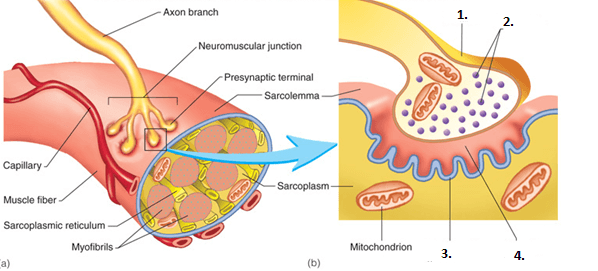
The gap between a neuron and a muscle cell: (#4 in the diagram)
a)
synaptic cleft
b)
sarcolemma
c)
vesicle
d)
Ca2+ ion
24.
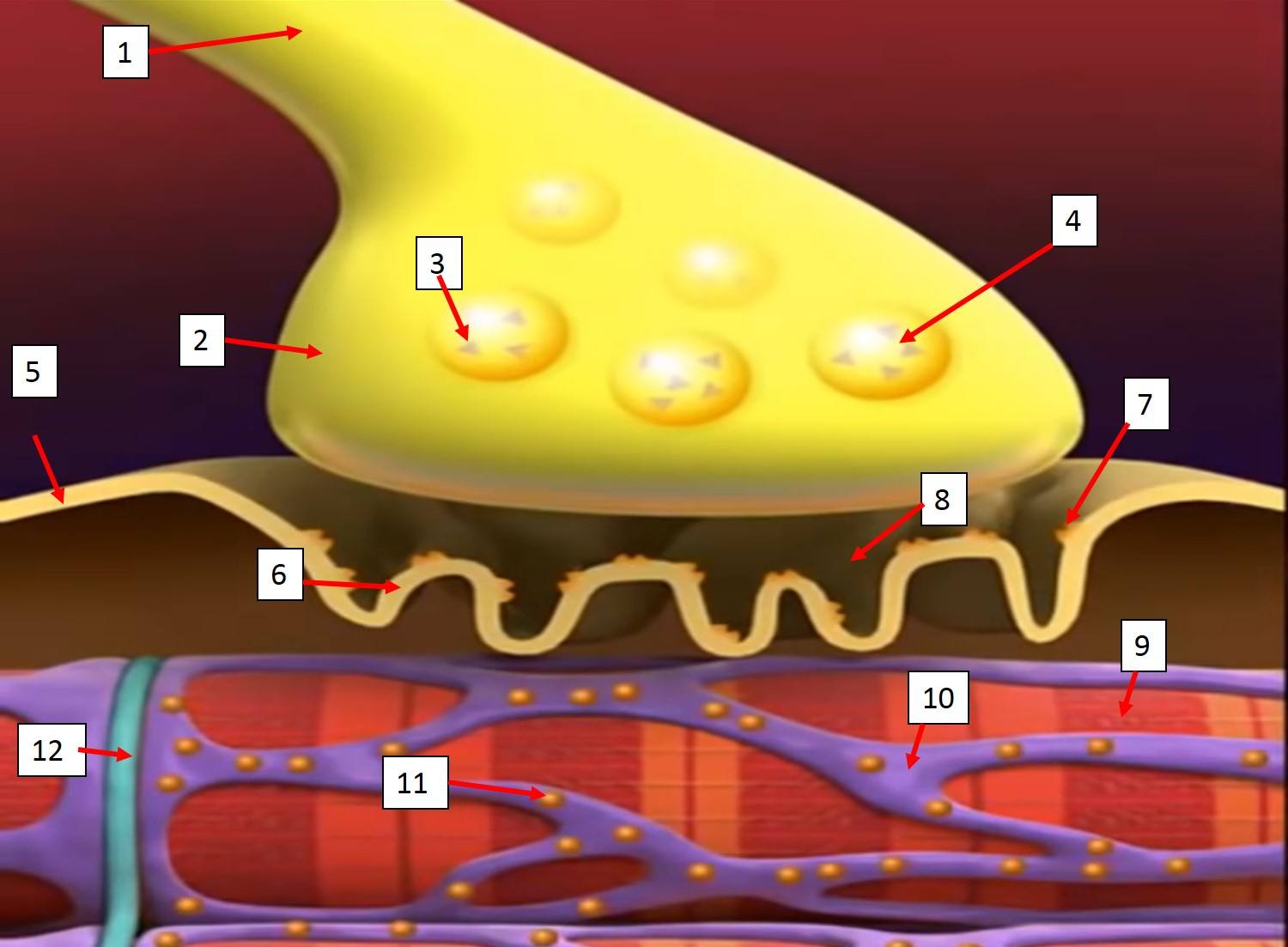
The neurotransmitter stored in the axon terminal identified as #3
a)
Acetylcholine
b)
Protein Channel
c)
Calcium Ion (Ca2+)
d)
Syanptic Cleft
25.
This is a neurotransmitter used to create a muscle impulse
a)
Acetylcholine
b)
Calcium Ions (Ca2+)
c)
Sodium Ions (Na+)
d)
Protein Channels
26.
Contractile unit of a muscle.
a)
sarcomere
b)
motor unit
c)
fascicle
d)
myofibril
27.

The plasma membrane of a skeletal muscle cell is called the:
a)
sarcomere
b)
myofilament
c)
sarcolemma
d)
sarcoplasm
100 %

