
 Worksheets
EES 2.5.2
Total questions: 15
Worksheet time: 20mins
Name
Class
Date
1.
How do we name air masses?
a)
Water and temperature
b)
Air pressure
c)
Humidity and temperature
d)
Cold and warm
2.
How do we characterize an air mass that forms over the ocean?
a)
Dry
b)
Wet
c)
Cold
d)
Warm
3.
How do we characterize an air mass that forms over land?
a)
Dry
b)
Wet
c)
Cold
d)
Warm
4.
How do we characterize an air mass that forms over near the equator?
a)
Dry
b)
Wet
c)
Cold
d)
Warm
5.
How do we characterize an air mass that forms near the poles?
a)
Dry
b)
Wet
c)
Warm
d)
Cold
6.
What types of air masses form over oceans?
a)
Maritime
b)
Continental
c)
Polar
d)
Tropical
7.
What's the humidity and temperature of a continental tropical air mass?
a)
Wet and cold
b)
Dry and warm
c)
Wet and warm
d)
Dry and cold
8.
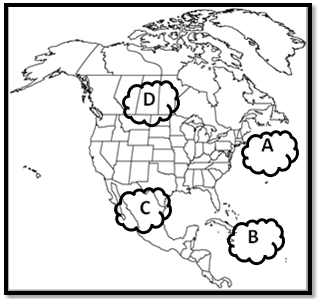
Which type of air would you find at air mass A?
a)
cold, dry
b)
warm, humid
c)
warm, dry
d)
cold, humid
9.
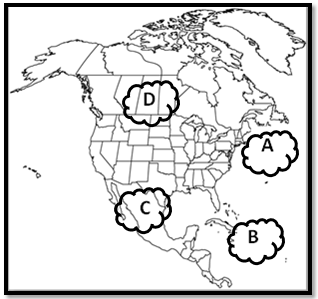
Which type of air would you find at air mass B?
a)
cold, dry
b)
warm, humid
c)
warm, dry
d)
cold, humid
10.
Air travels
a)
from high pressure to low pressure
b)
from low pressure to high pressue
11.
What type of front brings warm and humid weather to an area?
a)
cold front
b)
warm front
c)
stationary front
d)
occluded front
12.
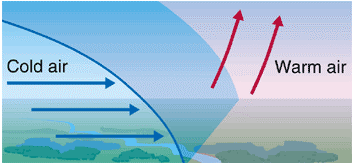
This event can best be identified as what?
a)
cold front
b)
warm front
c)
stationary front
d)
occluded front
13.
What type of front brings cool, cold weather to an area?
a)
cold front
b)
warm front
c)
stationary front
d)
occluded front
14.
Occluded fronts include
a)
2 cold air masses and 1 warm
b)
2 warm air masses and 1 cold
15.
Which type of weather is associated with a cold front?
a)
heavy rain, snow, thunderstorms, and snow for short periods of time
b)
Steady, light rain or snow can occur for longer periods of time
100 %

