
 Worksheets
electrostatics
Total questions: 10
Worksheet time: 13mins
Which statement is true of a positively charged object?
Positively charged objects do not contain any electrons.
Positively charged objects do not contain neutrons or electrons.
There is a lack of electrons on a positively charged object.
The protons and the electrons are both positively charged on such objects.
What is the end result of charging by contact?
Both object have the same charge, so they will attract one another
Both object have the same charge, so they will repel one another
Both object have the opposite charge, so they will attract one another
Both object have the opposite charge, so they will repel one another
When a charged object contacts another object (one is usually a conductor), there is a transfer of electrons. How do you determine which object acquires the transferred electrons?
Always transfer from the bigger to the smaller object, to make it even
Transfer is based on the initial charge of the two objects
Transfer is based on how much electron affinity that each object has
Always transfer from the more negative to the more positive object
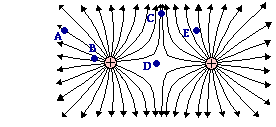
Which of the following labeled points is in the region with the strongest force of electric charge
A
B
C
D
When the distance between two charges is halved, the electrical force between the charges
quadruples
reduces to one fourth
halves
doubles
Two similar metal spheres, A and B, have charges of +2.0 x 10⁻⁶ coulomb and +1.0 x 10⁻⁶ coulomb, respectively. The magnitude of the electrostatic force on A due to B is 4.0N newtons. What is the magnitude of the electrostatic force on B due to A?
2.0N
4.0N
8.0N
1.0N

