wayground logo

Free Printable Worksheets

Font size

S
M
L
XL
Worksheets

PC Exam Review First Semester

Total questions: 120

Worksheet time: 8hrs 50mins

Name
Class
Date
1.
Simplify √-4
a)
2i
b)
-2i
c)
2
d)
4i
2.
Calculate:
(4 − 7i) − (-3 + 6i)
a)
7 − 13i
b)
7 − i 
c)
1 − 13i
d)
1 − i 
3.
i13
a)
-1
b)
1
c)
i
d)
-i
4.
what does i ^ 129 =?
a)
-i
b)
i
c)
1
d)
-1
5.

Which quadratic has COMPLEX roots?

a)
b)
c)
d)
6.

Solve for x:

3x2 - 6x + 6 = 0

a)

x = 1± i

b)

x = 3, -6

c)

x = 4.8, 2.7

d)

Undefined

7.
6i (-5 + 10i)
a)
-30i + 60i2
b)
30i − 16i2
c)
11i + 60i2
d)
-11i2+ 16i
8.
Using the pictured graph, what is f(-3)? 
a)
-3
b)
-1
c)
1
d)
3
9.
On the graph, which portion of the piecewise function is represented in red?
a)
x
b)
0.5x + 2.5       
c)
-1
d)
0.5x + 2
10.
What is g(7) if:
a)
-17
b)
-13 
c)
13       
d)
17
11.
Find f(-2)
a)
-3
b)
6
c)
8
d)
-6
12.

When x is less than or equal to 2, what equation is shown in the graph?

a)

f(x) = 3

b)

f(x) = x

c)

f(x) = | x |

d)

f(x) = | x - 1 |

13.
Which piecewise function corresponds to this graph? (Take your time)
a)
f(x) = { x  if x < 4;   -x+1  if x ≥ 4
b)
f(x) = { x  if x ≤ 4;  -x+1  if x > 4
c)
f(x) = { -x+1  if x < 4;  x  if x ≥ 4
d)
f(x) = { -x+1  if x ≤ 4;  x if x > 4
14.

Select the correct graph for the following piecewise function.

a)
b)
c)
d)
15.

f(x) = 2x3 - 3x2 + 4x -10

State the maximum number of turns the graph of f(x) could make.

a)

3

b)

2

c)

1

d)

0

16.

f(x) = 2x3 - 3x2 + 4x -10

What is the degree of f(x)?

a)

3

b)

2

c)

1

d)

0

17.

f(x) = -3x4 + x3 - 2x2 + x - 1

What is the y-intercept of f(x)?

a)

(-1, 0)

b)

(0, -1)

c)

(-3, 0)

d)

(0, -3)

18.
Classify the function:
a)
quadratic
b)
cubic 
c)
quartic
d)
linear
19.

The function shown has:

a)

Degree two with negative leading coefficient.

b)

Degree three with negative leading coefficient.

c)

Degree four with negative leading coefficient.

d)

Degree four with positive leading coefficient.
20.

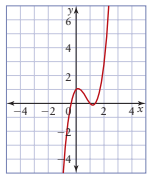
Which of the following could be a possible equation for the function shown?

a)

f(x) =-2x3 + x2 - 5x + 1

b)

f(x) = 2x3 - 4x2 + x + 1

c)

f(x) = 3x2 + 5x + 1

d)

f(x) = -2x3 +3x - 1

21.

State the minimum degree of the function shown:

a)

3

b)

4

c)

5

d)

6

22.

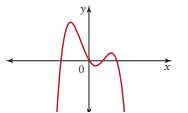
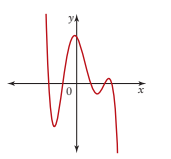
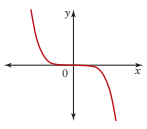
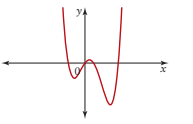
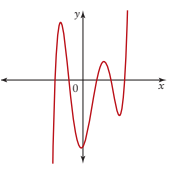
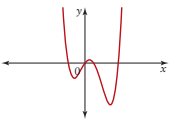
Select all the graphs which show even degree functions.
a)
b)
c)
d)
23.

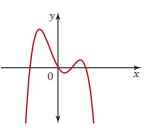
Which description best matches the function shown:

a)

Odd degree with positive leading coefficient.

b)

Even degree with positive leading coefficient.

c)

Degree three, with negative leading coefficient.

d)

Degree four, with negative leading coefficient.

24.
Find the factored form of the function graphed:
a)
y = -(x + 1)(x - 1)(x - 2)
b)
y= (x + 1)2(2 - x)
c)
y = (-x + 1)2(x - 2)
d)
y = -(x - 1)2(x + 2)
25.
What is another way to say "where a function crosses the x-axis"?
a)
x-intercept
b)
zero
c)
root
d)
all of these.
26.
Find the sum.
(3y2 + y3 - 5) + (4y2 -4y + 2y3 + 8)
a)
3y+ 7y- 4y + 3
b)
4y2 + 3y3 - y + 3
c)
-y4 + 2y-y - 4
d)
4y+ 3y-3y + 1
27.
Simplify the expression.
-3x2( 7x- x + 4)
a)
-21x4 + 3x3 -12x2
b)
7x2 - x + 4 (-3x2)
c)
21x+ 3x+ 12x2
d)
-12x+ 3x-21x4
28.
For synthetic division, what would be the number in the left hand box?
a)
0
b)
1
c)
2
d)
3
29.
(3x3 + 5x - 1)
 ÷
(x + 1)
a)
3x3 - 3x2 + 8x - 9
b)
3x2 - 3x + 8 - 9/x+1
c)
3x2 + 3x + 8 + 7/x+1
d)
3x3 + 3x2 + 8x + 7
30.
a)
This is correct
b)
This is incorrect
31.
a)
This is correct
b)
This is incorrect
32.
Describe the transformation that is applied to the parent function. 
f(x) =  3 Ix+8I
a)
Stretches by 3, Shifts left 8
b)
Stretches by 3, Shifts right 8
c)
Stretches by 3, Shifts up 8
d)
Stretches by 3, Shifts down 8
33.
What is the equation to this graph?
a)
f(x)= Ix+2I +1
b)
f(x)= Ix-2I +1
c)
f(x)= Ix+2I -1
d)
f(x)= Ix-2I -1
34.
If x is -8, what is y?
a)
y = -21
b)
y = 1
c)
y = 10
d)
y = 9
35.
If the blue function is f(x)=x2, then the red function must be
a)
g(x)=x2-5
b)
g(x)=x2+5
c)
g(x)=(x-5)2
d)
g(x)=(x+5)2
36.
Match the equation to its description.
a)
Right 2 and up 2
b)
Left 2 and up 2
c)
Right 2 and down 2
d)
Left 2 and down 2
37.
g(x)=-f(x)
Describe the transformation to f(x) that results in g(x).
a)
f(x) has been reflected over the x-axis.
b)
f(x) has been reflected over the y-axis.
38.
Identify the coordinates of the point (3 , -2), translated 5 units left and 6 units up.
a)
(2,-4)
b)
(-2,4)
c)
(8,4)
d)
(-2,-8)
39.
  The blue function is the parent function f(x) = x3.  Which of the following is the correct equation for the red function, g(x)?
a)
g(x)=x3+1
b)
g(x)=x3-1
c)
g(x)=(x-1)3
d)
g(x)=(x+1)3
40.
If the yellow curve has equation f(x)=x2,
a)
Then the blue curve is f(x) = x- c
b)
Then the blue curve is f(x) = (x+c)2
c)
Then the blue curve is f(x) = (x-c)2
d)
Then the blue curve is f(x) = x2 + c
41.
Which graph is NOT a function?
a)
Graph 1
b)
Graph 2
c)
Graph 3
d)
Graph 4
42.

 f(x)=1x5f\left(x\right)=\frac{1}{x-5}  Find the domain of

a)

 (,5)(5,)\left(-\infty,5\right)\left(5,\infty\right)  

b)

 [5,)\left[5,\infty\right)  

c)

 (,5]\left(-\infty,5\right]  

d)

 (,)\left(-\infty,\infty\right)  

43.

Find the domain of  f(x)=x33xf\left(x\right)=\frac{x-3}{\sqrt{3-x}}  

a)

 (,3]\left(-\infty,3\right]  

b)

 (3,)\left(3,\infty\right)  

c)

 (,3)(3,)\left(-\infty,3\right)\left(3,\infty\right)  

d)

 (,3)(3,3)(3,)\left(-\infty,-3\right)\left(-3,3\right)\left(3,\infty\right)  

44.

Find the domain of  g(x)=2x4g\left(x\right)=\sqrt{2x-4}  

a)

 (,2)(2,)\left(-\infty,2\right)\left(2,\infty\right)  

b)

 [2,)\left[2,\infty\right)  

c)

 (,2]\left(-\infty,2\right]  

d)

 (,12)(12,)\left(-\infty,\frac{1}{2}\right)\left(\frac{1}{2},\infty\right)  

45.

Write the domain of  f(x)=xx216f\left(x\right)=\frac{x}{x^2-16}  

a)

 (,0)(4,)\left(-\infty,0\right)\left(4,\infty\right)  

b)

 [4,)\left[4,\infty\right)  

c)

 (,0)(0,4]\left(-\infty,0\right)\left(0,4\right]  

d)

 (,4)(4,4)(4,)\left(-\infty,-4\right)\left(-4,4\right)\left(4,\infty\right)  

46.

Find the domain of  h(x)=x4x5h\left(x\right)=\frac{\sqrt{x-4}}{x-5}  

a)

 (,5]\left(-\infty,5\right]  

b)

 (,5)(5,)\left(-\infty,5\right)\left(5,\infty\right)  

c)

 (,4)(4,)\left(-\infty,4\right)\left(4,\infty\right)  

d)

 [4,5)(5,)\left[4,5\right)\left(5,\infty\right)  

47.
Suppose you are given a table of values. When creating a table for the inverse graph you must...?
a)
Switch the x and y
b)
Solve for x
c)
Plot the coordinates
d)
Potato
48.
The equation of f(x) goes through (1, 4) and (4, 6).
What points does the inverse function go through?
a)
(1, 4) and (4, 6)
b)
(-4, -1) and (-6, -4)
c)
(-1, -4) and (-4, -6)
d)
(4, 1) and (6, 4)
49.

What does it mean to create the inverse of a function graphically?

a)

The domain stays the same.

b)

The range goes away.

c)

The range becomes negative.

d)

Switch the domain and range.

50.

What is the range of the function graphed?

a)

x = 2

b)

All real numbers

c)

y = 2

d)

-6 < x < 6

51.

What is the domain of the function graphed on the grid?

a)

-4 ≤ x < 5

b)

-4 ≤ x ≤ 5

c)

-3 ≤ x < 3

d)

-3 < x ≤ 3

52.
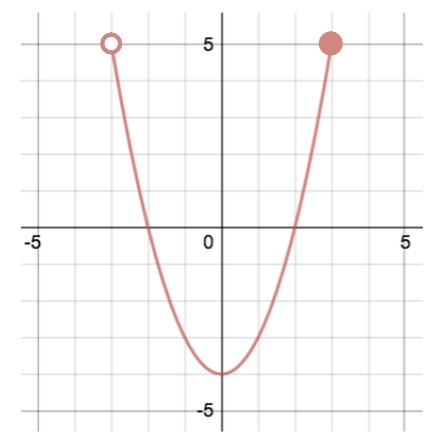
What is the domain of the graph?
a)
{x| -∞ ≤ x ≤ ∞}
b)
(-∞,∞)
c)
-3 ≤ x ≤ 3
d)
-15 ≤ y ≤ 9
53.
For the function {(0,1), (1,-3), (2,-4), (-4,1)}, write the domain and range.
a)
D: {1, -3, -4,}
R: {0, 1, 2, -4}
b)
D: {-4, 0, 1, 2}
R:{-4, -3, 1}
c)
D: {0, 1, 2, 3, 4}
R:{1, -3, -4}
d)
D: {0, 1, 2, -4}
R: {1, -3, -4, 1}
54.
Identify the domain of the following relation:
a)
{-6, 14, 2, 28}
b)
{(-6,14), (0,32), (2,38), (4,44)}
c)
{-6, 0, 2, 4}
d)
{14, 32, 38, 44}
55.
Is the relation a function? Why.
a)
Yes, because the x-value 11 has two y-values pair with it.
b)
Yes, because each x-value has only one y-value paired with it.
c)
No, because the x-value 11 has two y-values pair with it.
d)
No, because each x-value has only one y-value paired with it.
56.
Solve for f(10):
f(10) = -x - 5
a)
15
b)
-5
c)
-15
d)
50
57.
Find the inverse of
f(x) = 1/4x - 7
a)
f-1(x) = 4x + 7
b)
f-1(x) = -4x + 28
c)
f-1(x) = -4x - 7
d)
f-1(x) = 4x + 28
58.
Find the inverse of f(x) = -4x - 12
a)
f-1(x) = 4x - 3
b)
f-1(x) = -1/4x - 3
c)
f-1(x) = 1/4x + 3
d)
f-1(x) = -4x - 3
59.

Given f(x) = x+3, find f(-2).

a)

-1

b)

1

c)

5

d)

-5

60.

The relation in the graph is..

a)

a function but not a one-to-one function.

b)

a one-to-one function.

c)

not a function

61.

The relation in the graph is..

a)

a function but not a one-to-one function.

b)

a one-to-one function.

c)

not a function

62.

The relation in the graph is..

a)

a function but not a one-to-one function.

b)

a one-to-one function.

c)

not a function

63.
When is this function increasing?
a)
−2.5 < x < 2.5
b)
0 < x < 5
c)
0 < x < 55
d)
−5 < x < 0
64.
What are the local maxima of this graph?
a)
local maximum at (2.2, 3.9)
b)
local maximum at (-8, 5)
c)
local maximum at (5, -8)⋃(3.9, 2.2)
d)
local maximum at (-8, 5)⋃(2.2, 3.9)
65.
Over what interval is this function constant?
a)
−5 < x < ∞
b)
−3 < x < 4
c)
4 < x < ∞
d)
−5
66.
List the types of intervals that the graph demonstrates in order.
a)
decreasing, constant, increasing, constant
b)
increasing, decreasing, constant
c)
increasing, constant, increasing, constant
d)
increasing, constant, decreasing, constant
67.
What are all the x-intercepts?
a)
(−2.55, 0), (2.55, 0)
b)
(−3,0), (−2,0), (2,0), (3,0)
c)
(0, 36)
d)
(−∞,∞)
68.
Where is the function increasing?
a)
y ≥ −1
b)
y ≤ −1
c)
y ≥ 3
d)
y ≤ 3
69.
List the intercepts of the graph.
a)
(2, 0), (0, 2), (0, 1), (0, −5)
b)
(2, 0), (1, 0) (−5, 0), (0, 2)
c)
(−2, 0), (1, 0), (5, 0), (0, 2)
d)
(2, 0), (0, −2), (0, 1), (0, 5)
70.
Which statement is true about this function?
a)
The function is never constant
b)
The function is always increasing
c)
The function is never decreasing
d)
The function increases on the interval 11:00 < x < 15:00
71.
What are the zeros?
a)
0 and 2
b)
-4 and 0
c)
2 and 3
d)
0 and 4
72.
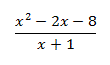
Find the vertical asymptote.
   x2-2x-8
__________
    3x-2
a)
y=2/3
b)
x=3/2
c)
x= 2/3
d)
x=1/3
73.
Which asymptote(s) are determined by looking only at the denominator?
a)
vertical
b)
horizontal
c)
both
d)
none
74.
What are the asymptotes?
a)
x= -1 y = -3
b)
x=1 y = -3
c)
x= -1 y =3
d)
x=1, y=3
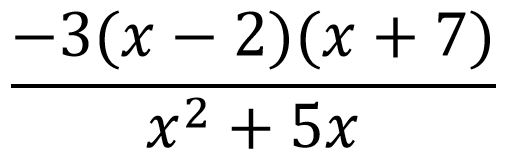
75.
What are the Vertical Asymptotes of...
a)
x = 0, -5
b)
x=0, 5
c)
x = 2, -7
d)
x = -2, 7
76.
What is the Horizontal Asymptote?
a)
None
b)
y= 0
c)
y= 1
d)
y= 5/4
77.
What is the hole?
a)
x= 4
b)
x= -4
c)
x= 5
d)
x= -5
78.

Determine whether the graph of the function has a vertical asymptote or a removeable discontinuity at x = -1.

a)

Vertical Asymptote

b)

Discontinuity

c)

Hump Day

d)

Infinite

79.
What is/are the x-intercepts of this graph?
a)
(-2,0) and (2,0)
b)
(-2,0)
c)
(3,0)
d)
(2,0) and (3,0
80.

What creates a hole in the graph of a rational function?

a)

Crossing the x-axis

b)

An absence of dirt.

c)

Crossing a vertical asymptote.

d)

A factor that cancels out.

81.
Find the horizontal asymptote.
a)
None
b)
y=-2
c)
y=2
d)
y=0
82.

Factor and cancel out in order to simplify.

a)

9(x+10)

b)

x+10

c)

9

d)

x+9

83.
(x²+11x+24)/(x²+4x-32)
a)
A.(x+7)/(x+4)
b)
B.3/4
c)
C.(x+3)/(x+4)
d)
D.(x+3)/(x-4)
84.

What is the X-Intercept?

a)

(0,0)

b)

(4,0)

c)

(0,4)

d)

(-5,0)

85.

Find the coordinates of the hole.

a)

(-3, -3)

b)

(-3, 3)

c)

(3, -3)

d)

(3, 3)

86.

Find the equation of the graph

a)
b)
c)
d)
87.

Select all the functions that have a slanted asymptote?

a)
b)
c)
d)
88.
What are the excluded values?
a)
k = -3, 8
b)
k = 3, -8
c)
k = 3, 8
d)
k = -3, -8
89.
a)

(v + 9) / 8

b)

(v - 1) / 8

c)

1 / 8

d)

(v + 8) / 9

90.
a)
a
b)
b
c)
c
d)
d
91.

Subtract and simplify. 6a+212a2+6a+8\frac{6}{a+2}-\frac{12}{a^2+6a+8}  

a)

 6(a+2)a+4\frac{6\left(a+2\right)}{a+4}  

b)

 6a+4\frac{6}{a+4}  

c)

 6a+12(a+2)(a+4)\frac{6a+12}{\left(a+2\right)\left(a+4\right)}  

d)

 6(a+2)(a+2)(a+4)\frac{6\left(a+2\right)}{\left(a+2\right)\left(a+4\right)}  

92.
Add
a)
A.
b)
B.
c)
C.
d)
D.
93.
Simplify.
a)
A.
b)
B.
c)
C.
d)
D.
94.
Simplify
a)
A.4x³/(x+2)
b)
B.4x³/(x+10)
c)
C.2x³/(5x+1)
d)
D. 2x³/(x+5)
95.
Simplify
a)
(x-9)/(x+9)
b)
1/(x-9)
c)
(x+9)
d)
1/(x+9)
96.
Multiply and Simplify 
a)
4(x+3)/(x+2),
b)
(x+2)/4(x+1)
c)
(x+2)/4(x+3),
d)
4(x+1)/(x+2), 
97.
Multiply and Simplify
a)
(n-10)/8n+56
b)
(n-10)(n+7)/8n+56
c)
(n-10)/8
d)
(n+10)/8
98.
Divide and Simplify
a)
A
b)
B
c)
C
d)
D
99.
What is the domain of the graph?
a)
y≥1
b)
x ≥ 1
c)
All real numbers
d)
none of these
100.
What is the proper range?
a)
x≥0
b)
y≥0
c)
All real numbers
d)
{0, 1, 2, 3, 4,...}
101.
When is this function increasing?
a)
{x| -2.5 < x < 2.5}
b)
{x| 0 < x < 5}
c)
{x| 0 < x < 55}
d)
{x| -5 < x < 0}
102.
f(x) = x, g(x) = 2x, h(x) = x3
Find f(g(a))
a)
3a
b)
a2
c)
2a
d)
a3
103.
p(x) = 3x + 4
q(x) = 2x2
Find p(p(-3))
a)
-9
b)
7
c)
-11
d)
None of these
104.
What is the inverse of the function
f(x) = 2x + 4   ?
a)
f-1(x) = 4(x -2)
b)
f-1(x) = (x-4)/2
c)
f-1(x) = x/2 - 4
d)
f-1(x) = x/4 + 2
105.
If f(4) = 5, then f-1(5) = ?
a)
4
b)
-5
c)
5
d)
-4
106.
Factor
3a2 + 4a + 1
a)
(7a-10)(a-8)
b)
Not factorable
c)
(3a+1)(a+1)
d)
(3a-1)(a-1)
107.
Given f(x) = 2x and
g(x) = x2+3 , find f(g(x)).
a)
x2+2x+3
b)
4x2+3
c)
2x2+3
d)
2x2+6
108.
What does it mean to find the inverse of a function?
a)
the x's and y's are switched
b)
the x's and y's are divided by 2
c)
the x's and y's are made negative
d)
the x's and y's are the same
109.

Which is the inverse of the table?

a)
b)
c)
d)
110.
When finding the inverse of a relation, 
1st you replace f(x) with y
2nd switch the x's and y's
What do you do next?
a)
solve for y
b)
replace y with f-1(x)
c)
solve for x
d)
find the greatest common factor
111.

What function best describes this graph?

a)

y=x+42y=-\sqrt{x+4}-2

b)

y=x42y=\sqrt{x-4}-2

c)

y=x42y=-\sqrt{x-4}-2

d)

y=x+4+2y=\sqrt{x+4}+2

112.

From the table below calculate the quantity asked for:

Find g(f(2))g\left(f\left(-2\right)\right)  

a)

-4

b)

5

c)

6

d)

1

113.
(c5)(c3)(c3)
a)
c45
b)
3c11
c)
c11
d)
3c45
114.
(x⁴)²
a)
x⁸
b)
x⁶
c)
d)
8
115.
(6x2)(-3x5)
a)
18x7
b)
-18x7
c)
18x7
d)
3x7
116.
Simplify the expression in exponential form:
1340
a)
0
b)
134
c)
1
117.
Simplify the expression:
(58) ÷ (52)
a)
56
b)
510
c)
54
d)
516
118.
Simplify (2x4y7)3
a)
6x7y10
b)
6xy32
c)
8x12y21
d)
8x7y10
119.
Evaluate the expression using the quotient rule.
a)
214 z13
b)
22/z7
c)
214/ z7
d)
2z7
120.
  simplify    7-2
a)
1/7= 1/49
b)
-49
c)
-14
d)
1/14