wayground logo

Free Printable Worksheets

Font size

S
M
L
XL
Worksheets

Midterm Review 2025

Total questions: 95

Worksheet time: 1hrs 9mins

Name
Class
Date
1.
Which colonial region was settled by Puritans and Pilgrims seeking religious freedom?
a)
New England
b)
Southern
c)
Middle
d)
Backcountry
2.
Which colonial region was settled by people with many different cultural and religious backgrounds?
a)
New England
b)
Middle
c)
Southern
d)
Backcountry
3.
Which colonial region contained rocky soil and cold climate?
a)
New England
b)
Middle
c)
Southern
d)
Backcountry
4.
Large farms, called ___________________, were spread throughout the Southern colonies.
a)
Trade centers
b)
Plantations
c)
Settlements
d)
industrial centers
5.
Why was slavery LESS important in the Middle Colonies and the New England Colonies than in the Southern Colonies?
a)
They were far behind the South in business and industry.
b)
They did not rely heavily on cash crops.
c)
Slavery was important in all of the colonial regions. 
6.
How was the agreement which bonded Pilgrims called?
a)
Mayflower Compact
b)
Declaration of Independence
c)
Napoleonic Code
d)
Geneva Conventions
7.
1st representative governing body in the American colonies.
a)
English Bill of Rights
b)
Articles of Confederation
c)
Virginia House of Burgesses
d)
Congress
8.
There were people in the colonies in North America who had more power in the decisions being made by the government.  Which group had the MOST power in the colonial government?
a)
wealthy landowners
b)
slaves
c)
women
9.
Where did debtors settle?
a)
Plymouth Colony
b)
Pennsylvania
c)
Georgia
d)
Jamestown
10.
Where were the first armed conflicts of the American Revolution?
a)
Yorktown
b)
Saratoga
c)
Lexington and Concord
d)
Bunker Hill
11.
What was the name of the British king during the American Revolution?
a)
Charles III
b)
George III
c)
William III
d)
James III
12.
Who was the major author of the Declaration of Independence?
a)
Benjamin Franklin
b)
John Adams
c)
Thomas Jefferson
d)
Patrick Henry
13.
Surrounded by French and Continental armies, a large British army surrendered here.
a)
Saratoga
b)
Yorktown
c)
Bunker Hill
d)
Lexington and Concord
14.
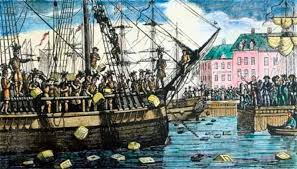
Samuel Adams and Paul Revere led members of the Sons of Liberty in this protest against taxes.
a)
First Continental Congress
b)
Boston Massacre
c)
Boston Tea Party
d)
Stamp Act Congress
15.
Which one of these is not an advantage that helped the American patriots defeat Great Britain.
a)
defense of their own land, principles and beliefs
b)
support from France
c)
superior numbers of soldiers and greater experience
d)
strong leadership from men like George Washington
16.
The French and Indian War happened AFTER the Stamp Act.
a)
True
b)
False
17.
The French and Indian War cost King George and Great Britain a lot of money. To help pay for the war, the British colonies were ordered to 
a)
give up their food
b)
work for free
c)
become a part of the Army
d)
pay taxes without representation
18.
A snowball fight between the colonists and soldiers in Boston that ended in 5 colonists being killed was called
a)
Boston Tea Party
b)
Boston Massacre
c)
Boston Party
d)
Boston Parliament
19.
A secret organization formed to protest the Stamp Act was called
a)
Congress
b)
Sons of Liberty
c)
Parliament
d)
Loyalists
20.
American colonists were asked to help cover the cost of the French and American War by paying
a)
Patriots
b)
snowballs
c)
taxes
d)
boycott
21.
Colonists who supported the Bitish king were called 
a)
Patriots
b)
Republicans
c)
Democrats
d)
Loyalists
22.
Many colonists did not want to remain loyal to Great Britain and King George. They wanted to be free from British rule. These colonists were called 
a)
Patriots
b)
Republicans
c)
Democrats
d)
Loyalists
23.
The 13 colonies were fighting for freedom from England. What is another word for freedom? 
a)
taxes
b)
tariff
c)
liberty
d)
patriot
24.
In 1765, the Parliament of Great Britain passed the Stamp Act. The purpose of this act was to 
a)
get rid of colonists who were willing to support the king
b)
raise money by putting a tax on tea, sugar, and molasses
c)
get rid of French colonists in the Northern colonies
d)
raising money by passing a tax on newspapers and other paper products
25.
Describe the economy of the New England Colonies.
a)
These colonies grew and sold crops that were used every day like wheat and grain
b)
These colonies grew crops that were used to make great profit.  At first they grew tobacco. Later their big crop was cotton.
c)
These colonies created and traded manufactured goods from raw materials.  They created the final products like paper from wood.
d)
The first colony in America set up in 1607. Due to their harsh conditions and lack of communication, the early colonists began to govern themselves and make decisions to solve their daily problems.
26.
Describe the economy of the Middle Colonies.
a)
These colonies grew and sold crops that were used every day like wheat and grain
b)
These colonies grew crops that were used to make great profit.  At first they grew tobacco. Later their big crop was cotton.
c)
These colonies created and traded manufactured goods from raw materials.  They created the final products like paper from wood.
d)
The first colony in America set up in 1607. Due to their harsh conditions and lack of communication, the early colonists began to govern themselves and make decisions to solve their daily problems.
27.
Describe the economy of the Southern Colonies.
a)
These colonies grew and sold crops that were used every day like wheat and grain
b)
These colonies grew crops that were used to make great profit.  At first they grew tobacco. Later their big crop was cotton.
c)
These colonies created and traded manufactured goods from raw materials.  They created the final products like paper from wood.
d)
The first colony in America set up in 1607. Due to their harsh conditions and lack of communication, the early colonists began to govern themselves and make decisions to solve their daily problems.
28.
Describe the significance of the Jamestown colony.
a)
These colonies grew and sold crops that were used every day like wheat and grain
b)
These colonies grew crops that were used to make great profit.  At first they grew tobacco. Later their big crop was cotton.
c)
These colonies created and traded manufactured goods from raw materials.  They created the final products like paper from wood.
d)
The first colony in America set up in 1607. Due to their harsh conditions and lack of communication, the early colonists began to govern themselves and make decisions to solve their daily problems.
29.
What was the significance of the English Bill of Rights?
a)
A charter of liberties agreed to by King John of England.  It made the king obey the same laws as citizens (1215)
b)
Written in 1689, this document was a shift of political power from the British monarchy to Parliament.
c)
A document written by the Pilgrims in 1620 establishing themselves as a political society and setting guidelines for self-government.
d)
This was a religious movement that became widespread in the American colonies in the 1730s
30.
Describe the idea of "Representative Government."
a)
A government that has been limited  in power by a constitution, or written agreement.
b)
The idea that the government serves to equally protect the rights of the people.
c)
A government where someone is elected to vote for (or represent) a group of people
d)
The idea that people can make decisions on how their government should work
31.
Which is not a part of the New World?
a)
North America
b)
Caribbean
c)
South America
d)
Asia
32.
How did diseases impact the New World?
a)
They didn't
b)
They wiped out 75-90% of the Europeans
c)
They wiped out 75-90% of the indigenous people
d)
They helped the natives beat the Spanish
33.

The Columbian Exchange is best defined as

a)

Exchange of plants, animals, disease, and technology between the rest of the world following Columbus's voyage

b)

The relationship between people in different parts of the world

c)

The story of how Columbus came to North America

d)

Everything Columbus brought back to Spain after his first voyage

34.
A period of cultural and biological exchanges between the New and Old World was known as
a)
Civil War
b)
Columbian Exchange
c)
Columbus Voyage
d)
Spanish Inquisition
35.
What group of people suffered the most during the Columbian Exchange?
a)
Animals
b)
Explorers
c)
Native Americans
d)
Europeans
36.
Which three continents were part of the triangle trade?
a)
France, Africa, the Americas
b)
The Americas, Europe, Africa
c)
Australia, Antartica, Africa
d)
Africa, Europe, Middle East
37.
The Middle Passage was the name for the journey from 
a)
Europe to Africa
b)
Americas to Europe
c)
Africa to the Americas
d)
Americas to Africa
38.
What was the Columbian Exchange? 
a)
American and the New World would exchange items in trade with European countries
b)
Columbus exchanged ideas with other Europeans
c)
An exchange between two people from Columbia
39.
What cause many Native Americans to die during the time of the Columbian Exchange?
a)
Diseases
b)
Spoiled Food
c)
Spoiled Meat
d)
War with Europeans
40.

Which Native American group inhabited the Northeast, known as the Eastern Woodlands? This area is heavily forested.

a)

Kwakiutl

b)

Iroquois

c)

Inuit

d)

Sioux

41.

Native Indians living in Kentucky would most likely use which of the following to build their shelters.

a)

wood

b)

stone

c)

sod

d)

ice

42.

Explorations created conflict between European countries. Why?

a)

Countries wanted to add land to their growing empires.

b)

Countries stole off each other to afford to pay for the trips.

c)

Countries made agreement with Asians in exchange for land

d)

Countries gave away resources other countries had claimed.

43.

Name one of the cultural interactions between the Spanish and American Indians that caused hardship and suffering for the American Indians?

a)

Introduction of European diseases to the American Indians

b)

Introduction of European economy to the American Indians.

c)

Introduction of the European social life to the American Indians.

d)

Introduction of European settlements to the American Indians.

44.

Which of the following was NOT a reason why Europeans used Africans as labor?

a)

They are immune to European diseases

b)

They had no friends or family in the Americas.

c)

Africans provided permanent cheep labor.

d)

They were already living in the Americas.

45.

What are three areas of conflict between Europeans and American Indians?

a)

land, crops, and technology

b)

trade, crops, and language differences

c)

land, disease and differences in cultures

d)

crops, trade and disease

46.

Which of the following is NOT a REASON for the Great Migration?

a)

Job Opportunities

b)

Better Education

c)

To escape racism

d)

Better fertile land for farming

47.

What was the main purpose of the Proclamation of 1763?

a)

To prevent colonist from talking about the King

b)

To help colonist trap fur in the Ohio River Valley

c)

To forbid colonist from moving across the Appalachian Mountains

d)

To give all colonist born in 1763 a free birthday dessert at their favorite restaurant

48.

What is a Command Economy?

a)

CAPITALISTIC economy in which there is free competition and prices are determined by interaction of supply and demand

b)

An economic system COMBINING private and public enterprise.

c)

When production, investment, price, and income are determined centrally by a GOVERNMENT.

d)

A system that relies on customs, history, and time-honored beliefs.

49.

What is the primary cultural reason that Native Americans came into conflict with Europeans?

a)

The belief that wampum (strings of beads) should be used for money

b)

The belief in matrilineal ancestry (lineage traced through the mother)

c)

The belief that everyone should be a nomadic hunter

d)

The belief that individual use of property should be temporary

50.

One element of culture that described most Native American cultures was the belief:

a)

that all things are connected

b)

in a single deity

c)

that the Catholic Church needed to be reformed

d)

that they were God's chosen people

51.

Where in the U.S. today would you expect to find the most Spanish speaking citizens?

a)

Northwest

b)

Southwest

c)

New England

d)

The Great Lakes

52.

. What does this excerpt from Columbus’s diary tell us about his plans for the native people?


“It appears to me, that the people are ingenious, and would be good servants and I am of opinion that they would very readily become Christians, as they appear to have no religion.” Christopher Columbus

a)

to learn all he could about native religions

b)

to sign treaties with the Native leaders

c)

to convert and control the Native people

d)

to become trading partners with the Native people

53.

Based on this excerpt written from his experiences in the Americas, what was de las Casas’ perspective toward the Spanish treatment of native peoples?

“New Spain was discovered in 1517 and, at the time, great atrocities were committed against the indigenous people of the region and some were killed by members of the expedition. In 1518 the so-called Christians set about stealing from the people and murdering them on the pretence of settling the area.

--Bartolome’ de las Casas; 16th century Spanish explorer, historian, and Dominican friar

a)

He fully supported Spanish settlements.

b)

He felt that the role of the Spanish should be to convert the Natives to Christianity.

c)

He felt the Natives would make great slaves.

d)

He felt that the treatment of the Natives by the Spanish was cruel and wrong.

54.

When the Spanish came to South America, they brought steel, armor and weapons, horses, and disease. Which of these is NOT an effect of the Spanish conquest?

a)

The naming of an Incan King to the Spanish Royal court.

b)

Spanish control of large parts of the Americas

c)

The death of large numbers of Native Americans.

d)

The spread of Catholicism and the Spanish language.

55.

What is one way in which the Great Convergence led to an exchange between cultures?

a)

Europeans brought cattle, horses, and grain and took back tobacco, corn, and cocoa

b)

European explorers were tolerant of the diverse religious beliefs of Native Americans

c)

People all across Europe began to dress and speak like Native Americans

d)

Elements of all three cultures blended to form a new, common language

56.

Which is an early attempt to establish laws that promoted the common good?

a)

slave codes

b)

Mayflower Compact

c)

Treaty of Paris

d)

Committee of Correspondence

57.

The colonists' reaction to the removal of King James II and the adoption of the English Bill of Rights was:

a)

to start a war with England

b)

to end the triangular trade system

c)

to form new assemblies with more local control

d)

to increase the slave trade

58.

How did William Penn preserve and protect the rights of citizens in the colony he founded?

a)

by trading with Great Britain

b)

by establishing an elected assembly

c)

by having frequent town meetings

d)

by removing Native Americans

59.

Which competition best explains the conflict that led to the French and Indian War?

a)

Control of fishing, fur trapping, and territorial rights in the Ohio River Valley

b)

The fight over taxation without representation in the New England colonies

c)

The opposition to the spread of slavery throughout the Middle Colonies

d)

The race to create the first permanent settlements west of the Appalachian Mountains

60.

Why did Gen. Gage send troops to seize weapons at Concord?

a)

to force colonists to pay overdue taxes

b)

to keep the weapons safe from Native Americans

c)

to better arm the British against the French

d)

to eliminate the threat of a colonial rebellion

61.

How did the warm climate and long growing season impact choices about how human resources were developed in the Southern colonies?

a)

Fishing became the region’s leading industry

b)

Ship building became the primary source of income for most families

c)

Most workers took jobs in manufacturing

d)

Enslaved persons became the primary labor force on farms and plantations

62.

Which best describes why shipbuilding became important in the New England colonies?

a)

Warm climate, long growing season, fertile soil.

b)

Large forests and many seaports

c)

Fewer enslaved persons compared to the south

d)

Strong religious beliefs of people in the region.

63.

How did the Declaration of Independence threaten Great Britain?

a)

as free and independent states they would no longer pay taxes

b)

It included a declaration of war against all loyalists in the colonies

c)

It gave more rights to women and enslaved persons than they had in England

d)

After it was read to the people, they attacked and killed British merchants

64.

Hammurabi is best known for creating

a)

a style of battle

b)

a hanging garden

c)

a code of laws

d)

a system of canals

65.

Which of these activities would an archaeologist most likely do?

a)

make maps

b)

examine objects

c)

read old newspapers

d)

study earth's features

66.

How are the sources of power in a democracy and a dictatorship different?

a)

A democracy is rule by a supreme power based on heredity or divine right while a dictatorship is rule by religious leaders.

b)

A democracy allows only one political party to govern while a dictatorship is rule by the people.

c)

A democracy is rule by the people while a dictatorship is rule by a single person or small group through control of the military police.

d)

A democracy is rule by leaders while a dictatorship is rule by a supreme power base on heredity or divine rights.

67.

How is a market economy different from a command economy?

a)

In a market economy, the government makes decisions about what to produce while in a command economy, members of society collectively own all property and wealth.

b)

In a market economy, all members of society collectively own all property and wealth, while in a command economy, individuals and business make most decisions about what it produces

c)

In a market economy, economic decisions are based on customs while in a command economy, the government makes decisions about what people produce.

d)

In a market economy, individuals and business make most decisions about what to produce while in a command economy the government makes decisions about what to produce.

68.

Why did Thomas Paine write Common Sense?

a)

To compel American Colonists to seek their independence from England

b)

to free slaves

c)

to ensure that all people would have a vote in Congress

d)

to create support for King George III

69.

“We hold these truths to be self-evident, that all men are created equal, that they are endowed by their Creator with certain unalienable Rights, that among these are Life, Liberty and the pursuit of Happiness.” Jefferson uses of the term “self-evident” in order to

a)

anger the colonists

b)

shame John Adams

c)

point out that this should be considered obvious

d)

argue against the early Roman view of Natural Law

70.
All of the following describe the land-bridge theory except
a)
it was called Pangea
b)
it was called Beringia
c)
the first humans are believed to have crossed it in search of food
d)
it happened around 10,000 years ago
71.
The Age of Exploration was supported by all of the following events except
a)
invention of the printing press
b)
search for faster trade routes
c)
invention of steam power
d)
desired to have a better understanding of the world
72.
The Pilgrims, Puritans and Quakers all left England in search of
a)
faster trade routes
b)
gold
c)
religious freedom
d)
job opportunities
73.
Slavery was at the heart of the economy in this region.
a)
New England Colonies
b)
Middle Colonies
c)
Southern Colonies
74.
The pamphlet that described reasons why the colonists should break away from England was
a)
The Crisis
b)
Uncle Tom's Cabin
c)
Common Sense
d)
Writs of Assistance
75.
Loyalty to one's region rather than one's nation is 
a)
sectionalism
b)
nationalism
c)
federalism
d)
patriotism
76.
The author of this political cartoon was
a)
Thomas Jefferson
b)
Paul Revere
c)
Ben Franklin
d)
Thomas Jefferson
77.
Any human made object
a)
sachem
b)
tool
c)
artifact
d)
wampum
78.
The Age of Exploration begins as a search for 
a)
religious freedom
b)
more land
c)
faster trade routes
d)
God
79.
This was the first permanent English settlement in the New World
a)
Plymouth
b)
Jamestown
c)
Ronaoke
d)
Albany
80.
The belief that the colonies exist to make the mother country rich.
a)
mercantilism
b)
nationalism
c)
sectionalism
d)
patriotism
81.
This war led to debt and to taxation of the colonies
a)
War of 1812
b)
Mexican American War
c)
Revolutionary War
d)
French and Indian War 
82.
It taxed legals documents, newspapers, and playing cards
a)
Sugar Act
b)
Stamp Act
c)
Quartering Act
d)
Intolerable Acts
83.
March 5, 1770, 5 people are dead
a)
Boston Massacre
b)
Battle of Lexington and Concord
c)
Battle of Saratoga
d)
Battle of Bunker Hill
84.
April 19, 1775, the "shot heard 'round the world"
a)
Boston Massacre
b)
Battle of Lexington and Concord
c)
Battle of Saratoga
d)
Battle of Bunker Hill
85.
This act taxed lead, tea, glass, and paper and included the Writs of Assistance
a)
Tea Act
b)
Quartering Act
c)
Townshend Act
d)
Intolerable Acts
86.
The refusal to buy certain goods
a)
embargo
b)
boycott
c)
tariff
d)
impeach
87.
The Spanish motives for exploration were all of the following except
a)
Germs
b)
God
c)
Gold 
d)
Glory
88.
Shipbuilding, whaling, and rocky soil characterize this region of colonies
a)
New England
b)
Middle 
c)
Southern
89.
Flat land, plantations, and slave labor characterize this region of colonies 
a)
New England
b)
Middle 
c)
Southern
90.
Why was Cyrus the Great considered such a fair ruler?
a)
He made slavery illegal
b)
He gave everyone equal power
c)
He gave food to the poor 
d)
He allowed people to practice their own customs/religion
91.

Ideas from the English Bill of Rights were included in the _______

a)

Magna Carta

b)

Declaration of Independence

c)

14th Amendment

92.

Magna Carta contained the ideas of _________and common law

a)

limited government

b)

monarchies

c)

naturalization

93.

The English Bill of Rights contained the ideas of consent of the governed and individual rights. Consent of the governed means ______

a)

the people have no legal rights

b)

the king is in charge of everything

c)

the people agree to and are part of their government

94.
A tax on imports is called a:
a)
whiskey tax
b)
tariff
c)
cabinet
d)
bond
95.
A tariff can help American industry by:
a)
making foreign goods more expensive
b)
making foreign goods illegal
c)
improving the quality of American goods
d)
All of these