
 Worksheets
Chapters 22-23 Vietnam and Social Change TEST
Total questions: 35
Worksheet time: 9hrs 45mins



On January 22, 1964, the Joint Chiefs of Staff sent Secretary of Defense McNamara a memorandum that included the following recommendations:
o Assign responsibilities for the total US program in Vietnam to the US military commander
o Commit additional US forces, as necessary, in support of the combat action within South Vietnam
o Commit US forces, as necessary, in direct actions against North Vietnam
What happened as a direct result of these recommendations?
North Vietnamese leaders appealed for a ceasefire.
US military involvement in Vietnam escalated.
South Vietnamese leaders rejected military assistance
Soviet ground troops were deployed to Vietnam.
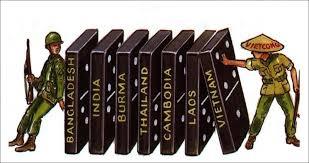
The domino theory, which provided the basis for US entry into the Vietnam War, was the belief that intervention was necessary to prevent-
the expansion of communism across Southeast Asia
the inclusion of Taiwan in the Warsaw Pact
the loss of UN military bases in Asia
the rise of China as a dominant economic power
The primary reason given by US leaders to justify military involvement in Vietnam was that it would-
promote reconstruction after World War II
maintain the policy of detente
fulfill prior United Nations obligations
keep communism from spreading throughout the region
As part of the Nixon administration's policy of Vietnamization, the US military-
trained South Vietnamese forces to take over combat responsibilities from US troops
shared military technology with North Vietnam
imposed martial law in North Vietnam
installed a puppet government in South Vietnam
During the time between the passage of the Gulf of Tonkin Resolution and start of the Tet offensive, what happened in the Vietnam War?
All US civilians were evacuated from Vietnam.
Peace talks between South Vietnam and North Vietnam were conducted in Paris.
The US government deployed more and more troops to Vietnam.
South Vietnam surrendered to North Vietnam.
____________________________________________
o College "teach-ins"
o Burning draft cards
o Student Protests
Which of the following is the best title for this list?
Protests Against the Vietnam War
Opposition to the Arms Race
Support for gender equality
Demands to Stop Dumping Chemical Waste

The event described in this headline resulted in-
Bloody Kent State Riot: 4 Killed and 12 Shot (headline)
decreased federal funding of student loans
increased support for the antiwar movement
the reinstatement of the draft
an end to federal investigations of student organizations
How did press coverage of events during the Vietnam War affect the United States?
Film footage from the front lines increased congressional support for the war.
Reporting on military setbacks contributed to public disillusionment with the war and widening the credibility gap.
Increased US media presence overseas resulted in overwhelming international support for US intervention.
Live presidential press conferences led to a decline in partisan politics in Congress.
Select Features of the War Powers Resolution, 1973
o The President may only make use of armed forces following a declaration of war, authorization by Congress, or an attack on the United States.
o The President must consult with Congress regularly regarding the use of armed forces as long as troops remain in hostile situations.
o Within 90 days the President will end the use of armed forces unless Congress acts to approve continued military action,
How does this resolution demonstrate the principle of checks and balances?
It expands the power of judicial review to military courts.
It allows the executive to determine the length of military conflicts.
It allows Congress to limit the military authority of the executive branch.
It gives Congress oversight of military strategy and operations.
Which of the following heightened the distrust the American people had of the government during the Vietnam War?
Emancipation Proclamation
Pentagon Papers
Truman Doctrine
All of the above
North Vietnam ultimately took over South Vietnam in 1975.
True
False
The potential for the drafting of women, the legalization of same-sex marriage, and the decline of the role of the husband in the family were all reasons behind what?
Protests to the Vietnam War
Stop ERA campaigns
Women's Suffrage movement
American Indian Movement
"The problem lay buried, unspoken, for many years in the minds of American women. It was a strange stirring, a sense of dissatisfaction, a yearning that women suffered in the middle of the twentieth century in the United States. Each suburban wife struggled with it alone. As she made the beds, shopped for groceries, matched slipcover material, ate peanut butter sandwiches with her children, chauffeured Cub Scouts and Brownies, lay beside her husband at night—she was afraid to ask even of herself the silent question—“Is this all?”
Who MOST likely stated the above quote?
Phyllis Schlafly
Betty Friedan
Janis Joplin
Rachel Carson

